If you’re working out how to choose a paddleboard for the first time, the short answer is this: for most UK beginners, the right first board is an inflatable all-rounder between 10′ and 11′ long, around 32″ wide, generally costing somewhere between £200 and £400.
It’s the setup I recommend to most beginners, as an all-rounder works on lakes, slow rivers and flat days on the coast. That said, a few factors can change the answer, and I’ll go through each of them below.
My first board was a cheap SUP from Amazon, and I now paddle a touring board, so I’ve been through these decisions myself. If you’d rather skip straight to specific boards, my guide to the best paddle boards for beginners in the UK has my picks.
How to Choose a PaddleBoard: The Short Answer
- Type: an inflatable all-round board. It stores in a cupboard, fits in a car boot, and works on lakes, rivers, and calm seas.
- Length: 10′ to 11′ (305cm to 335cm), with 10’6″ (320cm) the sweet spot for most adults.
- Width: around 32″ (81cm). Go to 33″ to 34″ (84cm to 86cm) if you are nervous about balance.
- Budget: £250 to £400 buys an excellent board. Below £200, there are only a couple I would recommend.
Thanks for your support – I may earn a small commission from affiliate links in this article Learn more
Inflatable or Hard Paddleboard: Which Should You Buy?
For most UK beginners, an inflatable is the right choice. It rolls up into a backpack, lives in a cupboard or under the stairs, and goes in the boot of a normal car. A hard board needs a garage or shed, roof bars, and somewhere to dry it.
Hard boards are stiffer and a little faster, which matters to racers and surfers. For flat water and rivers, a good inflatable at full pressure feels solid underfoot, and it copes far better with being dropped on a slipway or bumped into rocks.
I have only ever owned inflatables. The main reason is storage: I have nowhere to keep a 10′ (305cm) hard board, and I suspect that is true for most people reading this.
Which Type of Paddleboard Do You Need?
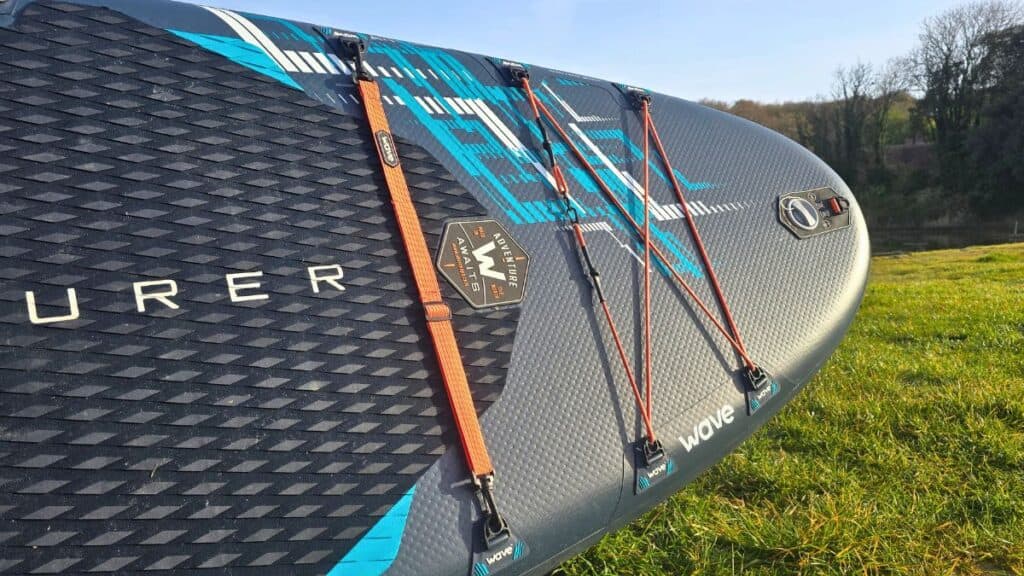
An all-round board. All-rounders have a rounded nose and a wide, stable middle, and they are built to do a bit of everything: calm lakes, slow rivers and flat days on the beach.
The other main types are:
- Touring: longer and narrower with a pointed nose. Built to cover distance in a straight line.
- Yoga and fitness: extra wide with a full-length deck pad for stability when you are not standing in a paddling stance.
- Surf and race: short and agile for waves, or long and narrow for speed. Neither suits a beginner.
The mistake I see most often is jumping straight to a specialised board before you have learnt the basics. Spend a season on an all-rounder and you will know what kind of paddling you enjoy, which tells you what to buy next.
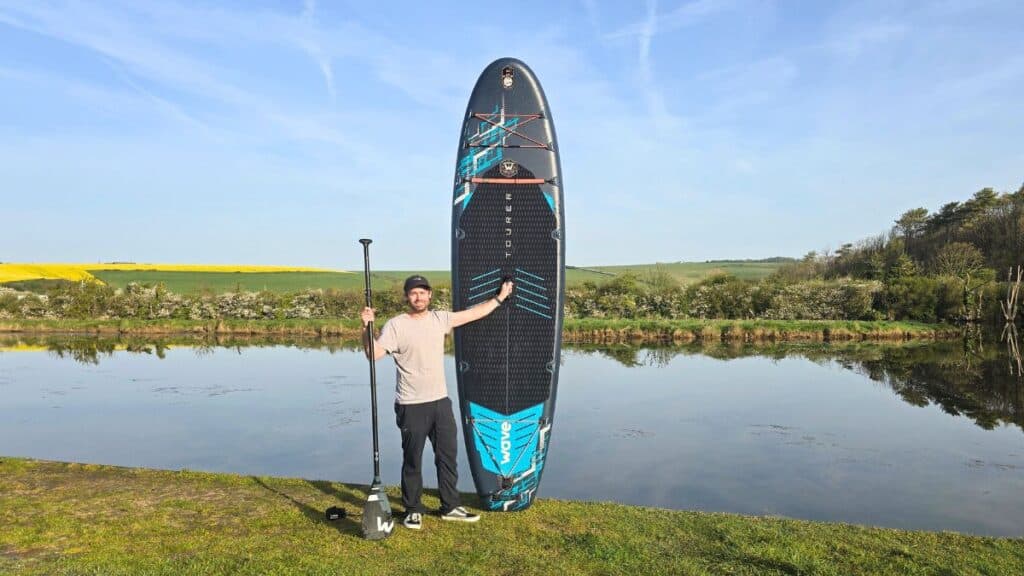
That is how it went for me. I now paddle a Wave Pro 3.0, a 12’6″ (381cm) touring board, because I enjoy covering distance downriver and along the coast. It is light, tracks well and was reasonably priced. For bigger trips where safety comes first I use the Bluefin Carbon 12, which has two independent air chambers. I would use it more, but at 11.15kg it is noticeably heavier to carry than the Pro. I compare the two in Wave Pro vs Bluefin Carbon.
What Size Paddleboard Should You Get?
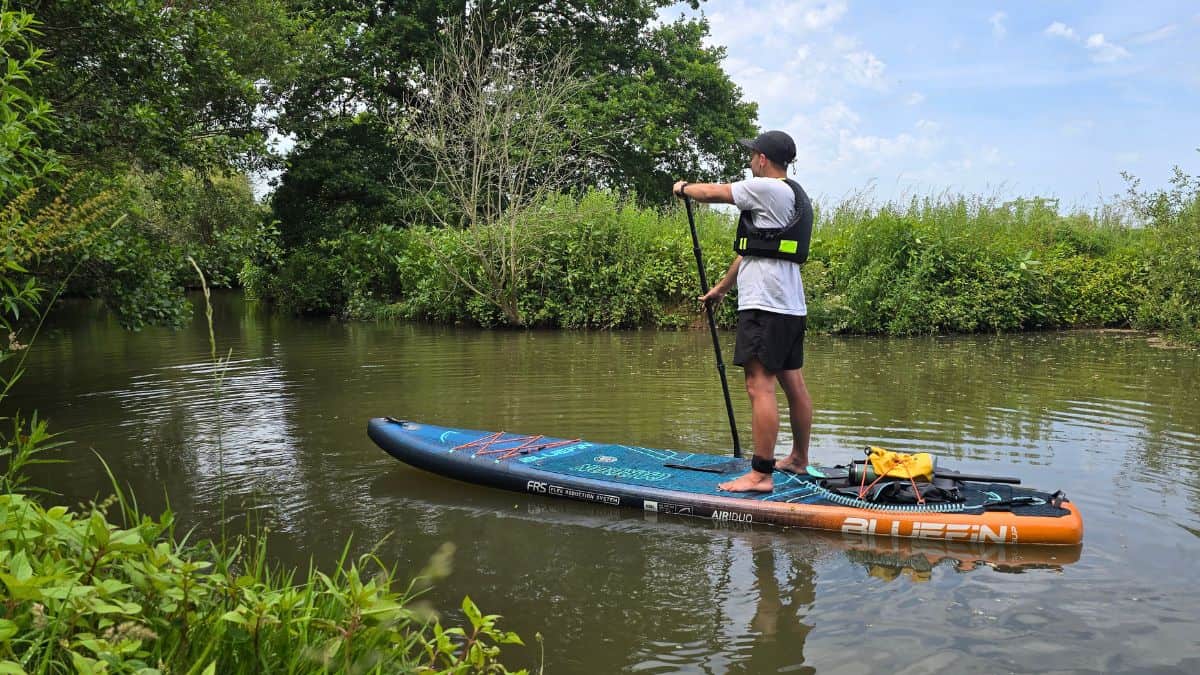
Between 10′ and 11′ (305cm and 335cm) long for most adults, and 10’6″ (320cm) is the sweet spot. That length is stable enough to stand up on within a session or two, short enough to turn easily, and long enough to keep going in a straight line.
Longer boards glide further with each stroke and track better, which is why touring boards start around 12′ (365cm). Shorter boards turn more easily but wander off line. Below 10′ (305cm) you are into kids’ and surf boards.
Check the maximum rider weight too, and leave some headroom. A board loaded close to its limit sits lower in the water and feels sluggish, and you may want to carry a dry bag or bring your dog along for a paddle. For reference, I am 163cm and about 65kg, so most all-rounders have plenty of spare capacity for me. Heavier or taller paddlers should look towards the longer end of the range.
I go into much more detail, with weight and height guidance, in my paddleboard sizes guide.
How wide should a beginner paddleboard be?
Around 32″ (81cm). That is wide enough to feel stable while you find your balance, without being so wide that your paddle stroke has to reach out to the side.
If you are nervous on the water or worried about balance, 33″ to 34″ (84cm to 86cm) gives more stability. Some all-rounders go as narrow as 30″ (76cm), which suits confident paddlers who want a bit more speed.
How thick should an inflatable paddleboard be?
6″ (15cm). Almost every adult inflatable all-rounder is this thickness, and it gives the stiffness you need. Thinner 4″ (10cm) boards flex in the middle and are mainly for children or very light paddlers.

How Much Should You Spend on a Paddleboard?
Between £250 and £400 buys an excellent beginner board. Boards from Wave, Bluefin and Aquaplanet in this range are more than enough for most people, and they come with decent accessories.
Below £200 I would generally steer clear. The exceptions are the Wave Cruiser 3.0 at £159.99 and the Wave Tourer 3.0 from £179.99. I cover a few more in my best budget paddleboard guide.
At £700 and above you are into premium brands such as Red Paddle Co and Starboard. They are excellent boards, but they make more sense once you know what style of paddling you enjoy. Most people want an all-rounder for calm water, and they do not need to spend that much to get one.
My own first board was a cheap one from Amazon. I bought it to find out whether I liked paddleboarding before spending more, and it did that job.
Warranty is another reason to spend a little more. Wave covers its boards for two years, Aquaplanet for three, and Bluefin for five, while most budget boards sold on Amazon only come with one year.
Prices change often, and boards are regularly discounted, so check current prices before you buy.
What Should Come With a Paddleboard Package?
A fin or fins, a pump, a leash, a paddle, and a bag. Almost every inflatable is sold as a package with all five, but the quality of each varies a lot, and this is where brands cut costs.
When two boards have similar specs, compare the accessories:
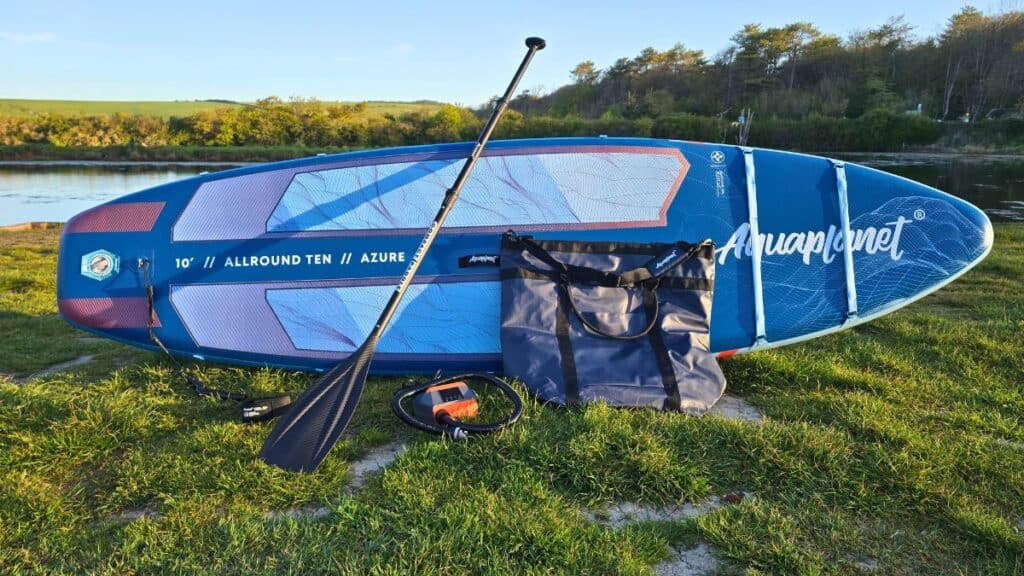
- Pump: single-action pumps are slow. Dual- and triple-action pumps get you to pressure faster. Some boards, like the Aquaplanet Allround 10, include a 12V electric pump, which saves a lot of effort at the start of every session.
- Leash: a coiled leash with a quick-release buckle is the safer option, especially on rivers.
- Paddle: aluminium paddles are heavy but tough. Carbon or carbon-blend paddles are lighter, and you notice the difference after an hour.
- Bag: a backpack with padded straps matters if you have a walk from the car to the water.
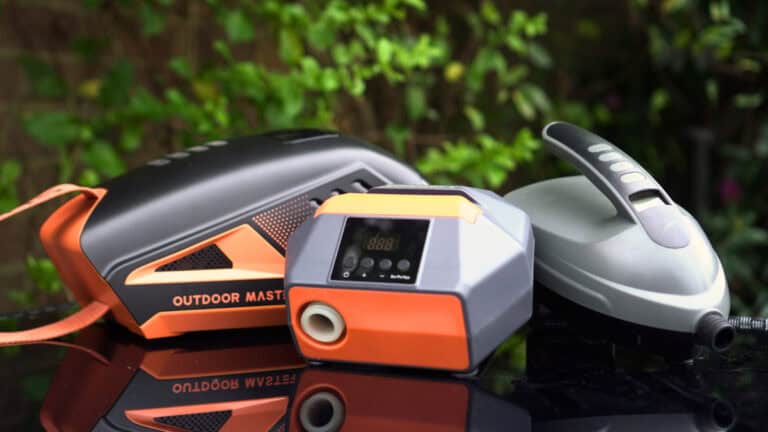
My paddleboard accessories guide covers what else is worth buying, and if your board comes with a hand pump, I have tested a few electric pumps for paddleboards.
Where Will You Paddle?
If you are starting out, somewhere calm and sheltered, an all-rounder suits all of it. Lakes, slow rivers and calm water such as the meanders at Cuckmere Haven in Sussex are ideal places to learn, and the same board will take you off a beach on a flat day.
If you want to paddle on rivers and canals in England and Wales, you will usually need a licence or membership. I explain the options in my waterways licence guide.
Once you know where you want to go, the board choice gets easier. Regular long river or coastal trips point towards a touring board later on. Short sessions on a local lake are well served by an all-rounder for years.
Which Paddleboard Would I Recommend for Beginners?
The Wave Tourer 3.0. It was my first go-to board, and it is still the one I recommend to most beginners. These three are all boards I have tested:
- Wave Tourer 3.0: available in 10’3″ (312cm) and 11’3″ (343cm), both 32″ (81cm) wide, from £179.99. An excellent package for less than £200, with a dual-action pump and quick-release leash. It gives a beginner everything they need to build confidence without spending a lot.
- Aquaplanet Allround 10: 10′ (305cm) long and 33″ (84cm) wide, around £250. Compact and light, it comes in a tote bag and includes an electric pump.
- Wave Cruiser 3.0: 10’9″ (327cm) long and 32″ (81cm) wide, £159.99. The cheapest board I would recommend, with a simpler single-action pump.
For more options at different prices, see my best paddleboards for beginners.
Final Thoughts
Most beginners do not need to overthink this. An inflatable all-rounder around 10’6″ (320cm) long and 32″ (81cm) wide, from a well-established brand, will cover almost everything you want to do in your first few seasons.
Spend the time comparing accessories rather than chasing specs, and leave the touring, race and surf boards until you know what kind of paddling you enjoy. That is the point where a second board makes sense.
Related Guides & Reviews
If you are still deciding, these will help:
- Wave Paddle Boards: Complete Guide to Every Wave 3.0 SUP
- Bluefin Paddle Boards: Complete Guide to Every Bluefin SUP
- Best 2 Person Paddle Boards: Tandem SUPs Compared
- Best Paddle Board Accessories: Essential Paddleboarding Gear
- Best Electric Pump for Paddle Boards

Steve Cleverdon
Adventure-driven outdoor gear reviewer and paddleboarder, Steve has spent 20 years exploring rivers, coastlines, and trails across Britain and abroad, sharing what he’s learned along the way. Learn more about Steve or get in touch.