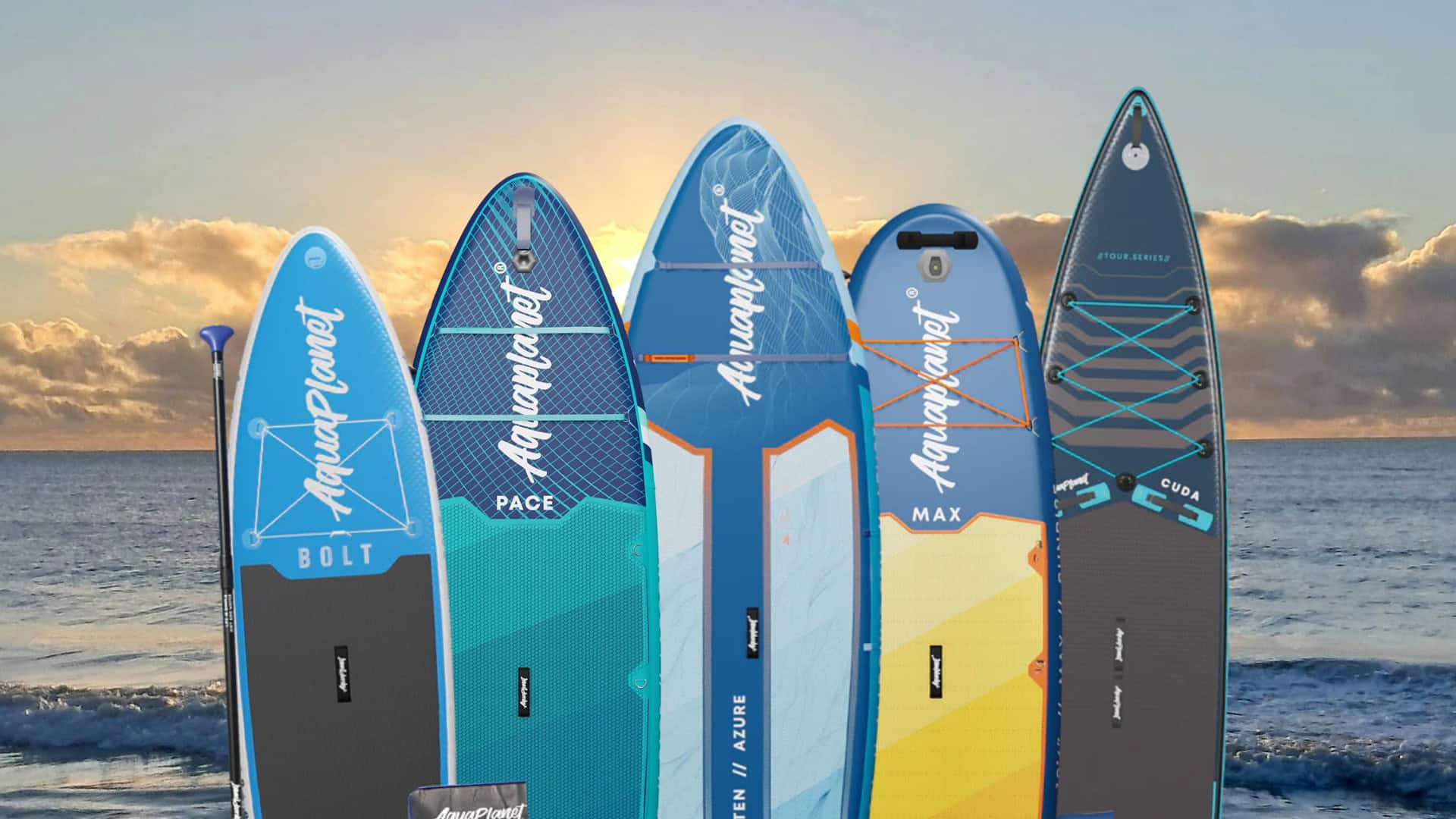
Aquaplanet is one of the UK’s best-known inflatable paddle board brands, built on a straightforward proposition: complete packages, competitive prices, and enough range to cover most paddlers. Every board comes with everything you need to get on the water — pump, paddle, leash, fins, bag, and repair kit — without having to budget separately for accessories.
The current range of Aquaplanet paddle boards is tighter and more focused than it has been in previous years. There are five boards across three series: the PACE and MAX as the core all-rounders, the ALLROUND TEN as the entry-level compact option, the BOLT for children, and the CUDA Expedition for long-distance touring. This guide covers all five — specs, construction, pricing, and who each one suits.
Thanks for your support – I may earn a small commission from affiliate links in this article Learn more
What Sets Aquaplanet Apart
Complete Package Approach Every Aquaplanet board comes with a full kit as standard — board, paddle, pump, leash, fin(s), repair kit, and a bag so you won’t need to purchase a pump or paddle separately before your first session.
Tiered Construction Across the Range Aquaplanet uses different construction methods depending on what each board is designed to do. The PACE and MAX use high-density laminated dropstitch, while the ALLROUND TEN uses a heat-bonded system that prioritises weight and compact storage over rigidity. At the top of the range, the CUDA Expedition uses a UCF fused layer structure with a carbon PVC exoframe and carbon-toughened side rails — a step up in engineering that is reflected in how the board performs on open water.
UK-Based Brand with Real Support Aquaplanet operates out of Bath and offers UK phone support. For a brand at this price point, that is worth noting — many budget SUP brands have limited after-sales presence, and knowing there is a team you can actually speak to makes a difference if something goes wrong.
Electric Pump Included on the ALLROUND TEN The ALLROUND TEN is the only board in the current range that comes with an electric pump as standard. For paddlers who find manual inflation a barrier — particularly families or those who just want to get on the water quickly — this is a practical and meaningful inclusion.
Aquaplanet Paddle Boards: Quick Comparison
| Model | Price (from) | Dimensions | Rider Limit | Best For |
|---|---|---|---|---|
| ALLROUND TEN 10′ | £249 | 10′ x 33″ x 6″ | up to 100kg | Compact, lightweight all-rounder |
| PACE 10’6″ | £389 | 10’6″ x 32″ x 6″ | up to 120kg | All-round beginners |
| PACE Plus 11’8″ | £399 | 11’8″ x 32″ x 6″ | up to 160kg | Taller or heavier beginners |
| MAX 10’6″ | £389 | 10’6″ x 31″ x 6″ | up to 130kg | Confident beginners wanting better glide |
| MAX Plus 11’8″ | £399 | 11’8″ x 32″ x 6″ | up to 160kg | All-round progression |
| BOLT 9’4″ | £199 | 9’4″ x 28″ x 4″ | up to 60kg | Children |
| CUDA Expedition 14′ | £399 | 14′ x 31″ x 6″ | up to 160kg | Expedition and long-distance touring |
ALLROUND TEN
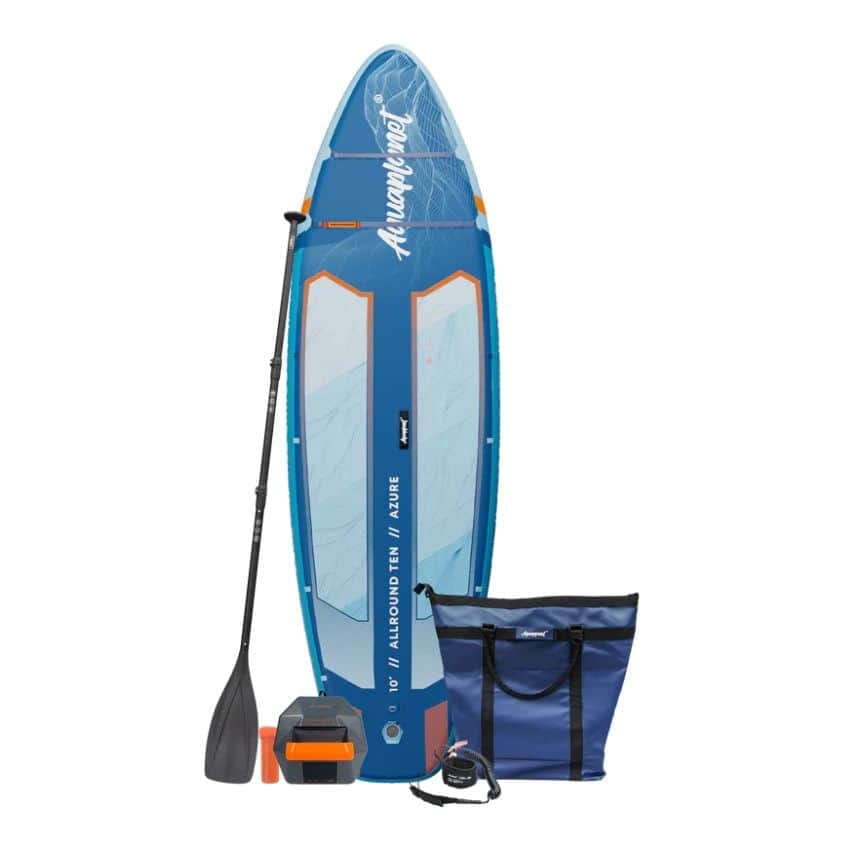
Best For: Paddlers who want the lightest, most portable board in the range — compact storage, easy transport, and a package that includes an electric pump.
ALLROUND TEN 10′ — £249
Key Benefits:
- At 7.8kg, it’s the lightest board that Aquaplanet makes
- Centre-line folding system packs down smaller than a traditional rolled board — fits into a tote bag rather than a standard backpack
- Electric pump included as standard — inflates via a car 12v port, no manual pumping required
- 10′ x 33″ x 6″ shape — wide and beginner-friendly on flat water
- 15–21psi inflation range and heat-bonded construction
- 3-year warranty
The ALLROUND TEN is Aquaplanet’s entry-level paddle board. At £249 it sits £140 below the PACE, and that gap reflects a deliberate difference in design priorities: the ALLROUND TEN trades some capacity and rigidity for a lighter, more compact, and easier-to-use package. For a first-time paddler who wants to get on the water without spending close to £400, it is the natural starting point.
The centre-line folding system is the defining feature. Instead of rolling the board up in the conventional way, the ALLROUND TEN folds down its centre line, resulting in a significantly more compact package. Aquaplanet ships it in a tote bag rather than a traditional SUP backpack — it takes up less boot space, sits more easily in a flat storage spot at home, and is lighter to carry to the water. The 4-piece paddle breaks down smaller than the standard 3-piece designs used elsewhere in the range, which helps with the same problem.

The included electric pump is a best addition that is easy to overlook on a spec sheet but changes the session experience. You plug it into your car’s 12v port and it inflates the board while you get changed — no manual pumping, no working up a sweat before you hit the water. For families with multiple boards, or for anyone who finds the inflation process a deterrent, this is a real benefit.
At 33″ wide, the ALLROUND TEN is actually the widest board in the current Aquaplanet range — wider than both the PACE and MAX at 10’6″. The 100kg rider limit is worth noting though: it is lower than the PACE 10’6″ at 120kg. If you are above that threshold, the PACE or MAX Plus are the boards to look at.
Pros:
- Lightest board in the range at 7.8kg — noticeably easier to carry
- Compact fold-down system is genuinely more convenient than a standard rolled board
- Electric pump included — the only board in the range that comes with one
- 33″ wide platform is stable and well-suited to beginners and casual paddlers
- 3-year warranty
Cons:
- 100kg rider limit is the lowest in the adult range — not suitable for heavier paddlers
- No manual pump included — requires a 12v car port to inflate
- Less rigid than the PACE and MAX under load despite the same PSI rating
5% discount applied at checkout
Read my full in-depth review here
PACE
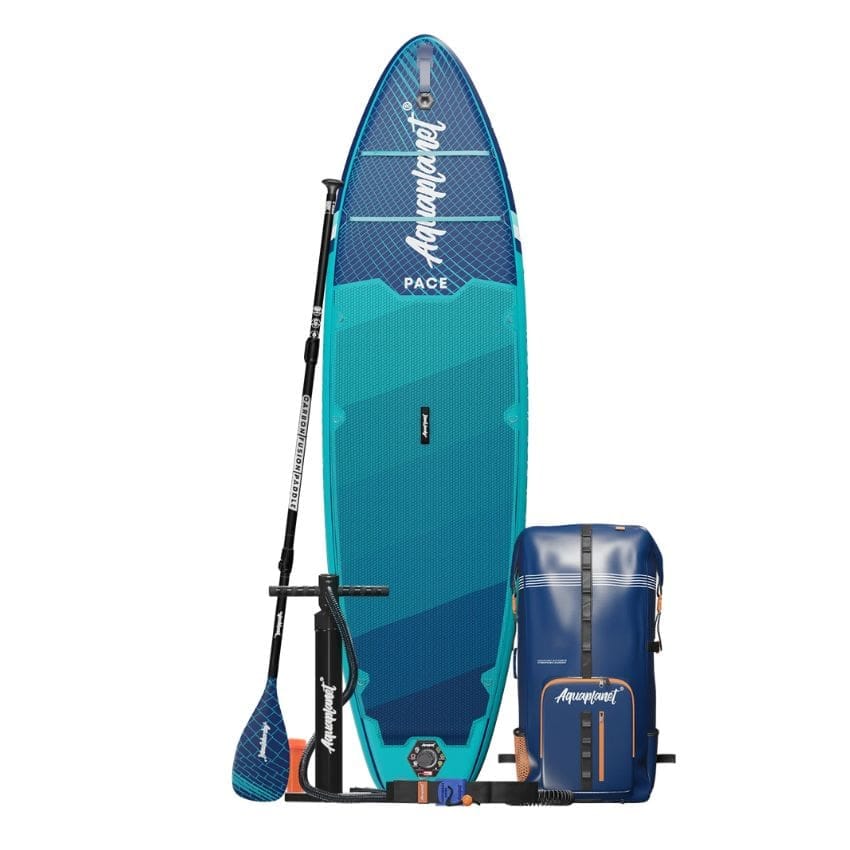
Best For: First-time paddlers and families who want a capable, stable all-rounder with everything included.
PACE 10’6″ — £389 | PACE Plus 11’8″ — £399
Key Benefits:
- 32″ width across both sizes gives a forgiving, stable platform for beginners
- High-density laminated dropstitch construction keeps the board rigid at inflation pressure
- Full package — paddle, pump, leash, bag, fins, and repair kit included
- 3-year warranty on both models
- The Plus steps up to 160kg rider limit and 11’8″ length for taller or heavier paddlers
At 32″ wide and 6″ thick, the PACE 10’6″ is stable and forgiving on flat water. The 10’6″ length provides enough glide to paddle efficiently without becoming unwieldy to handle on and off the water — a practical combination for paddlers who are still building confidence.
The PACE inflates to 15–17psi. That is enough for a solid, rideable board, but it is worth knowing that the MAX series reaches 21psi for the same price — so if rigidity underfoot is the priority, the MAX is the stronger comparison.
The PACE Plus 11’8″ extends the range for taller adults and heavier paddlers who need more board under them. At 11’8″ with a 160kg rider limit, the 32″ width is maintained from the 10’6″, so the stability trade-off for the extra length is minimal. The longer waterline also gives better tracking on longer paddles.
If you are not sure which size suits you, the paddle board sizes guide covers how length and width affect stability and performance in practical terms.
Pros:
- 32″ width is stable and forgiving on flat water
- 120kg rider limit on the 10’6″, 160kg on the Plus
- 3-year warranty
- PACE Plus 11’8″ offers 160kg capacity at £399 — strong value for a full-size board
Cons:
- Aluminium paddle rather than the carbon fusion paddle in the MAX package
- Inflates to 15–17psi only — less rigid than the MAX at the same price
MAX
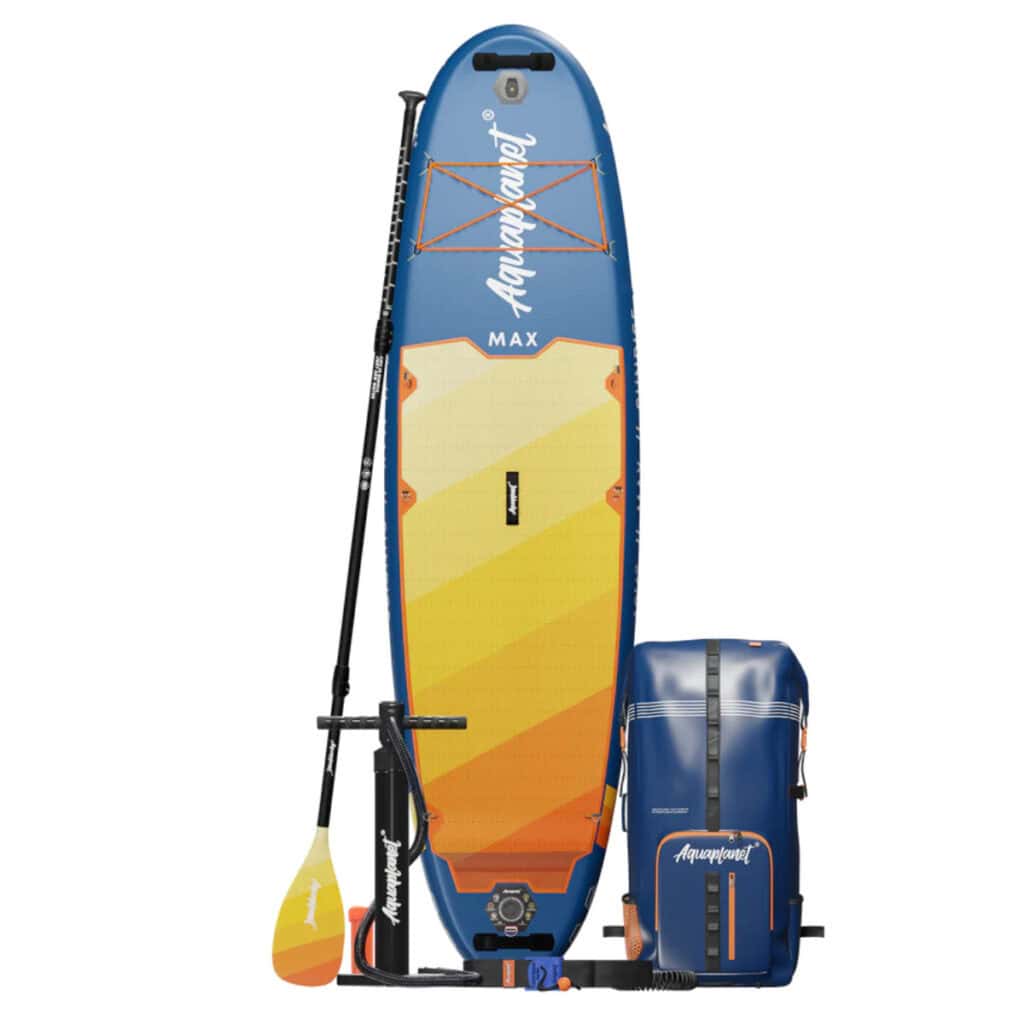
Best For: Paddlers who want a step up from the entry-level without a price premium — more rigidity, a better paddle, and the same stable dimensions.
MAX 10’6″ — £389 | MAX Plus 11’8″ — £399
Key Benefits:
- 15–21psi inflation range gives noticeably more rigidity than the PACE at the same price
- Carbon fusion paddle included
- Edge-to-edge full-length deckpad for comfort and grip across the whole board
- MAX Plus extends to 160kg capacity and 11’8″ length at £399
- Both models backed by a 3-year warranty
The MAX series sits at the same retail price as the PACE but delivers more capable kit. The jump to 15–21psi is the most significant difference between the two: higher inflation pressure produces a stiffer board underfoot, which improves both stability and efficiency with each paddle stroke. On flat water at cruising pace, a stiffer board requires less effort to maintain speed. That distinction is subtle to a complete beginner but noticeable by mid-season.
The carbon fusion paddle changes the practical experience of a session in a way the spec sheet undersells. A carbon paddle is lighter, transfers energy more efficiently, and reduces fatigue over a longer paddle compared to a standard aluminium shaft. Having it in the standard package rather than as a paid upgrade makes the MAX the stronger choice for anyone planning to paddle regularly.
The MAX 10’6″ at 31″ wide is one inch narrower than the PACE 10’6″. That inch matters more to absolute beginners than it does to paddlers with a few sessions behind them. If you are buying your first board and plan to paddle mostly on flat, calm water, the PACE’s extra inch of width is a reasonable safety net. If you already have some time on the water or are confident in your balance, the MAX is the better board at the same price.
The MAX Plus 11’8″ widens back to 32″ while adding the length, the higher rider limit, and the full-length deckpad. If you are deciding between the PACE Plus and MAX Plus at £399, the MAX Plus wins on construction quality and kit.
Pros:
- 15–21psi pressure range delivers a noticeably stiffer, more efficient ride
- Carbon fusion paddle is a meaningful upgrade over the PACE package
- Edge-to-edge deckpad is more comfortable and functional than partial-length alternatives
- Same price as the PACE — no compromise needed on budget
Cons:
- MAX 10’6″ at 31″ wide is marginally less stable than the PACE for absolute beginners
- 130kg rider limit on the 10’6″ — heavier paddlers should go straight to the Plus
- No touring-specific rigging or stowage
5% discount applied at checkout
Read my full in-depth review here
BOLT
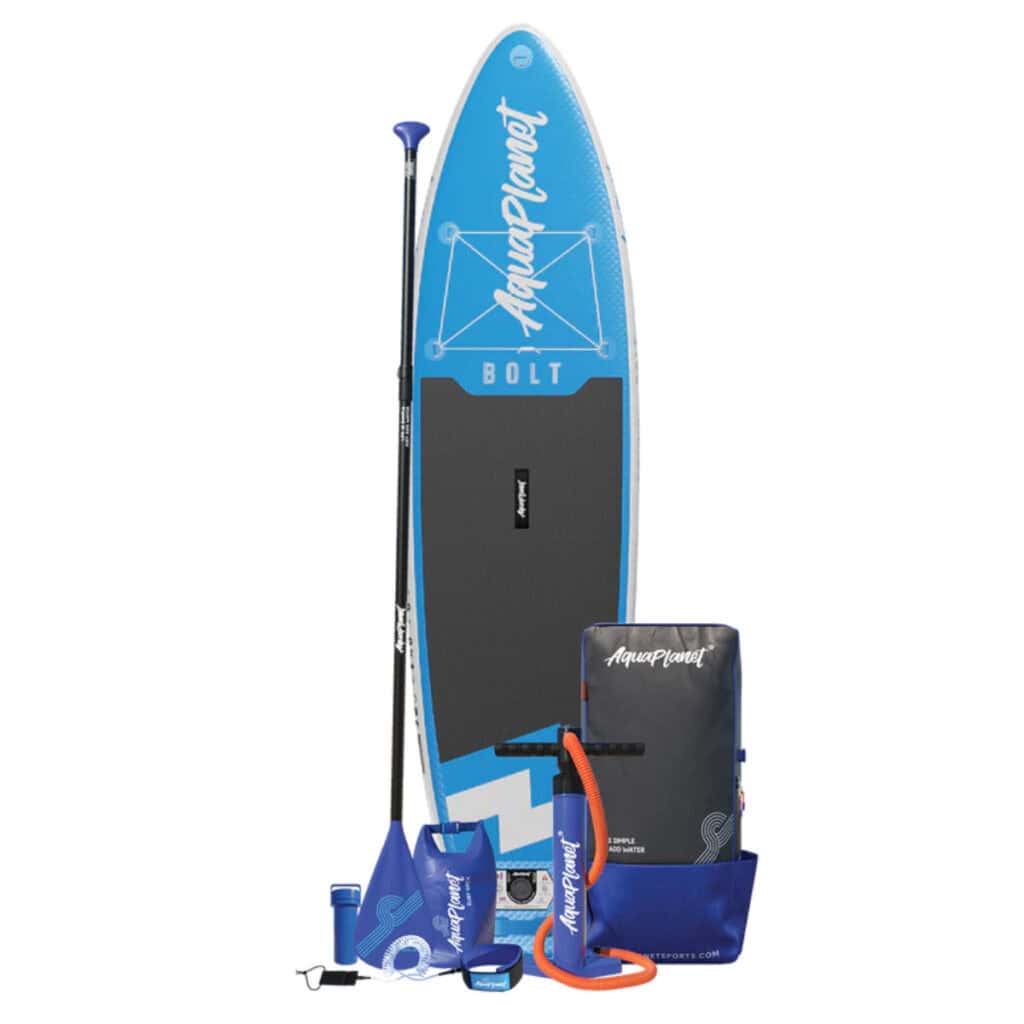
Best For: Children up to 60kg who need a properly proportioned board rather than a scaled-down adult SUP.
BOLT 9’4″ — £199
Key Benefits:
- Dimensions sized for children at 9’4″ x 28″ x 4″
- At £199, the most affordable board in the Aquaplanet range
- Light and quick to inflate — practical for parents managing multiple boards on a session
- Complete package included — paddle, pump, leash, fins, bag, and repair kit
- Capable in small surf as well as flat water
The BOLT is the right board for families getting a child their own kit. At 9’4″ long, 28″ wide, and only 4″ thick, the dimensions are genuinely child-appropriate — the lower profile sits the child closer to the water, which makes the board easier to handle and reduces the feeling of instability that comes from a high-sided adult board. A 6″ thick board at full inflation sits the paddler higher than a 4″ equivalent; for an adult, that is fine, but for a child it can feel precarious.
At £199 complete, there is not much to argue with on price. For parents with multiple children who all want their own board, or for families who want a board specifically sized for smaller family members, the BOLT offers a practical entry without a large financial commitment.
The 60kg rider limit is strict. Once a child is approaching that threshold, they will be at or near the board’s limit and would be better served by moving up to the ALLROUND TEN or PACE. It is worth factoring in how quickly the child is growing before committing.
Pros:
- Properly child-sized dimensions rather than a compact adult board
- £199 complete is hard to argue with for a dedicated children’s kit
- Light and easy for a child to carry and manage
- Fun in small surf — more versatile than a flat-water only kids’ board
Cons:
- 60kg limit means a growing child will outgrow it within a few seasons
- 4″ thick and 28″ wide — not suitable for adults or larger children
- Lower pressure rating than the 6″ adult range
CUDA Expedition
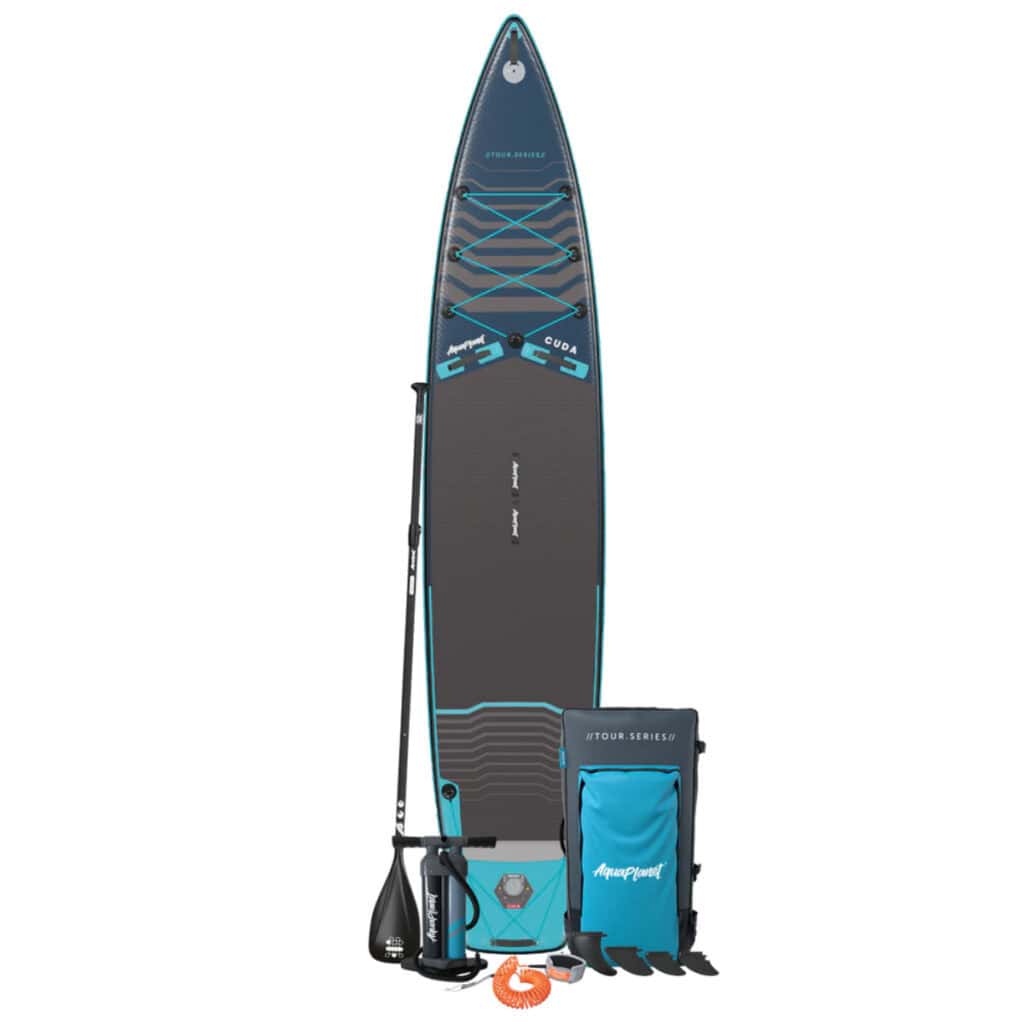
Best For: Experienced paddlers heading out on multi-day expeditions, open water crossings, or long river tours who want the best construction Aquaplanet make.
CUDA Expedition 14′ — £399
Key Benefits:
- Based on a board that holds the Bristol to London paddling speed record
- UCF fused layer construction with a carbon PVC exoframe and carbon-toughened side rails
- 14′ x 31″ x 6″ — long enough for serious glide with a stable midsection
- Up to 160kg rider weight — holds its capacity across the full 14′ length
- Double centre handles for portaging; front and rear bungee stowage for multi-day loads
- Deep, full-width diamond-camber deckpad for comfort on long sessions
The CUDA is the most seriously engineered board in the Aquaplanet range, and at £399 it is a remarkable piece of kit for the money. The UCF fused layer construction, combined with a carbon exoframe and carbon side rails, produces a paddling platform that is stiff, responsive, and built to absorb the kind of rough treatment that multi-day expeditions place on a board. This is not the same board as the PACE with a different label — the construction genuinely differentiates it, and you notice it underfoot immediately.
The 14′ length and tapered bow combination delivers glide that shorter boards cannot replicate. On flat water, the CUDA holds momentum between strokes significantly better than any other board in the current range. On open sea or river touring, the flat tail profile gives stability when the board is fully loaded. For paddlers who spend their weekends heading somewhere with a map and a tent, this is the board that makes those trips practical rather than a feat of endurance.
The double centre handles are a practical expedition feature that most SUPs lack. Portaging a 14′ board solo is considerably easier when you can hold it in the middle with both hands. The front and rear stowage rigging means you can carry a meaningful load without improvising solutions, and the wide diamond-camber deckpad keeps you comfortable over long sessions in a way that narrow traction strips do not.
At £399 — the same price as the PACE Plus and MAX Plus — the CUDA is exceptional value within the Aquaplanet range. The caveat is obvious: a 14′ expedition board demands commitment. If you are not regularly paddling longer routes and distances, the CUDA’s length and touring-specific design will work against you rather than for you. For more on how to build up paddle technique for longer trips, the how to paddle board guide covers the fundamentals.
Pros:
- Carbon-reinforced construction at £399 is exceptional value
- 14′ glide efficiency is unmatched anywhere in the Aquaplanet range
- Double handles and front/rear stowage rigging make loaded touring genuinely practical
- Built to take rough treatment over multiple seasons
- Speed record heritage backs up the efficiency claims
Cons:
- 14′ is a specialist choice — not suitable for beginners or casual paddlers
- 31″ width is not wide by absolute standards — paddlers who prioritise stability over speed should consider a wider board
My Take on Aquaplanet
The current Aquaplanet range is leaner than it has been in previous years, and as a result, their lineup is much more focused. Every board has a distinct purpose and a clear audience, with minimal overlap.
For most beginners, the decision comes down to the PACE versus the MAX. Both are sub £400, both are well-built, and both come with everything you need. The MAX edges it for anyone who plans to paddle regularly: the higher inflation pressure, the carbon paddle, and the full-length deckpad add up to a meaningfully better session experience for the same outlay. The PACE is the sensible pick if you are buying for a nervous beginner who wants the widest, most forgiving board possible at 10’6″.
The ALLROUND TEN is worth considering if portability is your priority over performance. It is lighter, more compact, and comes with an electric pump — a combination that suits paddlers with limited storage, smaller cars, or a preference for a lighter carry to the water. The 100kg rider limit is the one reason to pause: if you are above that, the PACE or MAX Plus are the better call.
The CUDA Expedition is the standout board in the range, but it is for a specific type of paddler. If you are heading out on longer routes, loaded touring, or multi-day trips, the carbon construction and 14′ glide efficiency at £399 is a combination you will not find elsewhere at this price. If you are not paddling those routes regularly, it is the wrong choice — the length works against you in any other context.
The BOLT does exactly what it should: a properly sized children’s board at a price that makes it easy to say yes. Just keep an eye on the 60kg limit as the child grows.
Aquaplanet Paddle Boards FAQs
Which Aquaplanet board is best for beginners?
The MAX 10’6″ is the strongest all-round choice for most beginners. It inflates to 21psi for a noticeably stiffer ride, comes with a carbon fusion paddle, and is priced the same as the PACE at £389. If you want the widest possible platform or are a heavier paddler, the PACE Plus or MAX Plus at 11’8″ are the better options.
What is the difference between the PACE and MAX series?
The PACE and MAX are very similar boards at the same price. The key differences are inflation pressure (15–17psi on the PACE versus 15–21psi on the MAX), the paddle (aluminium on the PACE, carbon fusion on the MAX), and the deckpad (partial on the PACE, full-length edge-to-edge on the MAX). The PACE 10’6″ is also one inch wider at 32″ versus 31″ on the MAX. For regular paddlers, the MAX is the better value at the same price point.
What is the ALLROUND TEN, and how does it differ from the PACE and MAX?
The ALLROUND TEN is a separate product in Aquaplanet’s Leisure Series, not a replacement for the PACE or MAX. It is lighter (7.8kg versus around 8.2–10kg for the PACE/MAX), uses a centre-fold system to pack down more compactly, and comes with an electric pump as standard. The trade-off is a lower rider limit (100kg) and a construction that prioritises portability over rigidity. It suits paddlers for whom storage and transport are the main considerations.
Is the CUDA Expedition suitable for beginners?
No. The CUDA is a 14′ expedition board designed for experienced paddlers covering real distances. Its length and touring-specific shape make it harder to manoeuvre and less forgiving on shorter paddles. Beginners should look at the PACE or MAX series.
Do Aquaplanet boards come with a warranty?
The PACE series, MAX series, and ALLROUND TEN all come with a 3-year manufacturer’s warranty. The CUDA Expedition carries a 1-year warranty. The BOLT also carries a 1-year warranty — check the product page for current terms.
Can Aquaplanet boards be used in the sea?
Yes, all Aquaplanet boards can be used in calm coastal conditions and sheltered sea paddling. The CUDA Expedition is specifically built for open water use. For beginners heading to the coast, the PACE or MAX are suitable for flat, sheltered water — but always check conditions, wear a leash, and carry a buoyancy aid.
Does Aquaplanet sell board-only options?
Aquaplanet no longer sells boards without a package — all current boards are sold as complete kits including paddle, pump, leash, fins, bag, and repair kit.
Related Guides & Reviews
The resources below cover the basics, common questions, and related kit to help you get more out of your time on the water.
- How To Paddle Board: Complete SUP Guide for Beginners
- Best Budget Paddle Boards in the UK
- Best Paddle Board Accessories: Best SUP Gear
- Wave Paddle Boards Compared: Complete Guide to Every Wave 3.0 SUP
- Bluefin Paddle Boards Compared: Complete Guide to Every Bluefin SUP
All images courtesy of Aquaplanet • All Rights Reserved.

Steve Cleverdon
Adventure-driven outdoor gear reviewer and paddleboarder, Steve has spent 20 years exploring rivers, coastlines, and trails across Britain and abroad, sharing what he’s learned along the way. Learn more about Steve or get in touch.