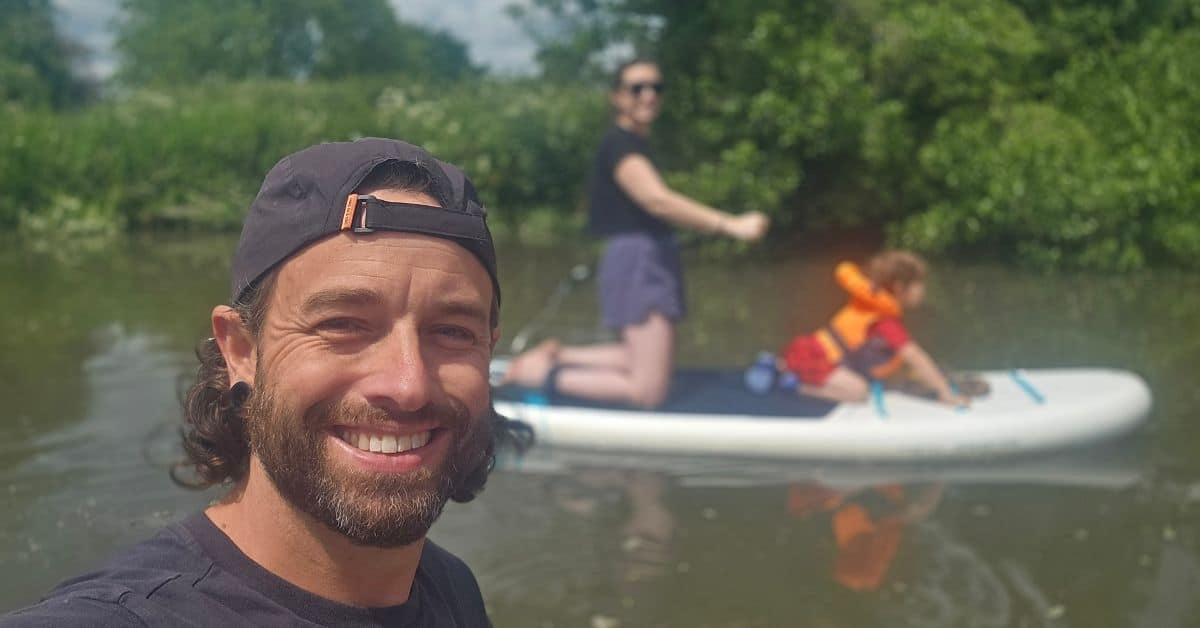
If you’re after a paddleboarding spot in Sussex that swaps the open coast for a calm, tree-lined river, Barcombe Mills on the River Ouse deserves to be near the top of your list. It’s probably my most-frequented paddleboard location — the kind of place that’s been quietly brilliant for years without ever feeling overrun.
I’ve paddled here in every season, in all conditions, with my kids when they were small, with friends who’d never been on a board, solo at sunrise, and on more social afternoons than I can count.
In this guide, I’ll cover everything you need before you go — parking, the launch point, what the river’s actually like, the route to The Anchor, wildlife to look out for, and a few honest notes from someone who keeps coming back.
Thanks for your support – I may earn a small commission from affiliate links in this article Learn more
Paddleboarding Barcombe Mills — Quick Facts
- Location: Barcombe Mills Road, Barcombe, East Sussex BN8 5BX (near Lewes)
- Licence required: No, on the non-tidal stretch at Barcombe Mills
- Water type: Flat, slow-moving, non-tidal river. Calm in both directions.
- Depth: Quite deep in places — buoyancy aids recommended, especially for beginners
- Suitable for beginners: Yes — stick to the open section near launch for first visits
- Parking: Free car park at Barcombe Mills Road. Height barrier in operation (standard vans fine). Avoid the grass section in winter — there’s a genuine risk of getting stuck.
- Facilities on site: None — bring everything you need with you
- Nearest pub: The Anchor Inn, approx. 30–40 mins downstream by paddle
- Best time to visit: Summer weekends for the social atmosphere; early mornings any season for peace and wildlife. Good on windy days when other spots aren’t paddleable — the tree-lined banks provide excellent shelter.

Where Is Barcombe Mills?
Barcombe Mills sits just outside the village of Barcombe, a few miles north of Lewes in East Sussex. The site takes its name from the mills that operated on the River Ouse here for centuries — records go back to the Domesday Book, and milling continued until the original buildings were destroyed by fire in 1939. The weirs, millstreams, and old sluice channels they left behind are part of what makes the water here so interesting to paddle.
One thing worth saying upfront: there is another River Ouse, up in Yorkshire. This is emphatically not that one. This is the Sussex Ouse — winding its way through the South Downs National Park in a much more civilised fashion, and with considerably better weather prospects.
A Bit of History Worth Knowing
Barcombe Mills has a long and layered history, and you’ll feel traces of it as you paddle. The Ouse here was once a working navigation — commercial boats used the river to carry goods inland from Lewes, and the locks and cuts you’ll notice on the water are remnants of that era. The stretch above Barcombe Mills became properly navigable under the River Ouse Navigation Act of 1790, though by the early 20th century, commercial traffic had long gone.
The old mills themselves burned down in 1939, but several pillboxes from the Second World War still survive around the site, along with a handsome old brick bridge and the Environment Agency sluice gates that now control the river’s flow. It’s that sluice — effectively a water control structure that regulates how much flow passes through — that keeps the stretch between Barcombe Mills and The Anchor pub so calm and paddler-friendly. Without it, you’d have a more tidal, current-driven river. With it, you get a stretch of water that barely feels like it’s moving.
Parking and Access
There’s a free car park at Barcombe Mills Road, which is the main starting point for anyone heading to the water. It’s a reasonable size — enough to fit everyone on a typical summer day without too much stress. A couple of things to know before you arrive:
First, there’s a height barrier in operation. Most standard vehicles are absolutely fine — my Vauxhall Vivaro van gets through without issue — but if you’re in something taller or have boards loaded on roof bars, check your clearance before you commit to the turning.
Second, and this matters in winter: over half the car park is a grass area, and when the ground is wet and waterlogged — which it frequently is around Barcombe Mills in the colder months, given how prone this area is to flooding — parking on it is a genuine risk. I’ve almost been stuck there once or twice myself.

From the car park to the first launch point is roughly 100 metres along a track. That’s close enough that you have a real choice: pump up at the car and carry your inflated board down, or carry your kit to the bank and inflate there. I’ve done both, and both work fine. The launch area is a nice flat grass bank — a good spot to sit and get your bearings before you push off.
One final note on the car park: it’s a fairly active spot, with people coming and going to the water and the riverside walks throughout the day. That said, as with any rural car park, it’s worth not leaving valuables on display. Take anything important with you to the water.

Do You Need a Licence to Paddle Here?
No licence is required to paddle on the non-tidal stretch of the River Ouse at Barcombe Mills. Just turn up and get on the water. If you’re planning a longer trip further upriver or downstream into the tidal section, it’s worth checking current access guidance via Paddle UK, but for the standard Barcombe Mills paddle, you’re good to go without any paperwork.
What’s the Water Like?
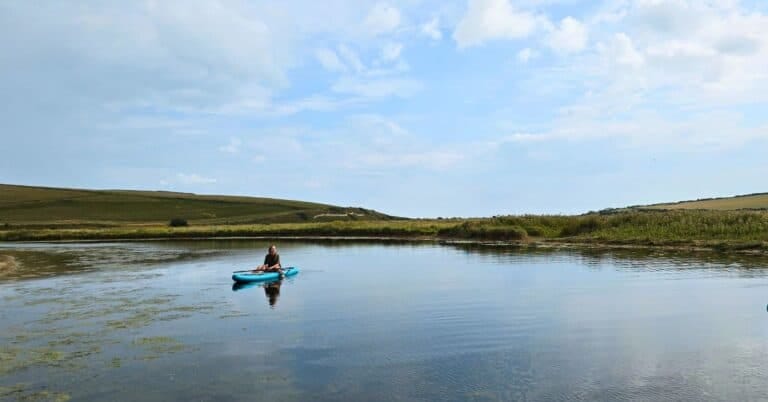
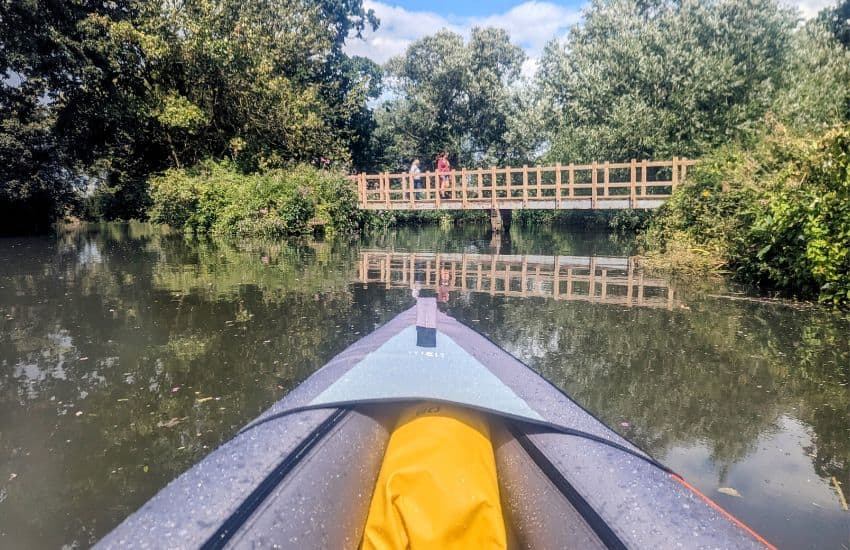
Flat, calm, and slow-moving — that’s the short version. The sluice gates at Barcombe keep the stretch between here and The Anchor effectively still, with minimal current. On most days, you genuinely wouldn’t know the water was moving at all. That makes it an excellent choice for beginners and for anyone who just wants a relaxed, undemanding paddle.
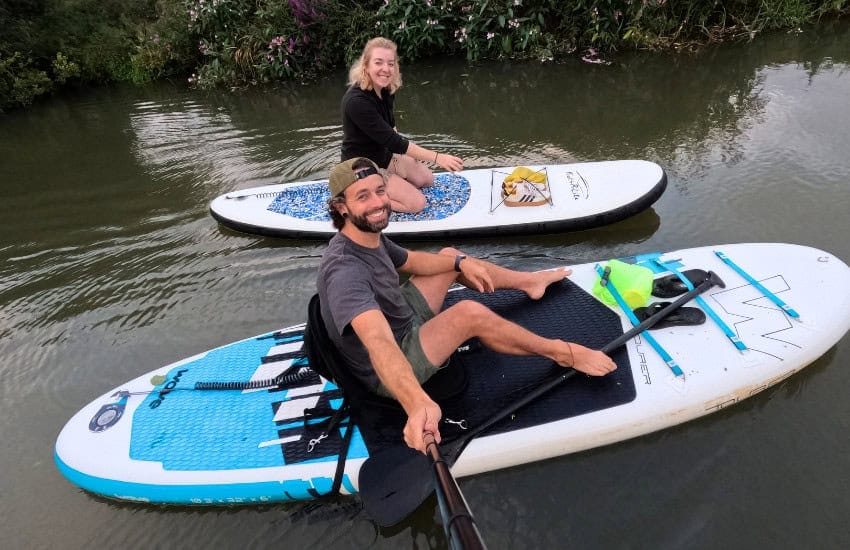
That said, the river is quite deep in places — deeper than it might look from the bank. It’s not the shallow, wade-out-if-you-fall environment of somewhere like Cuckmere. If you go in, you’re swimming, so a buoyancy aid is worth taking seriously here, especially for younger or less confident paddlers.
On water quality: you will see people swimming in the river at Barcombe Mills, and I’ve done it myself. But honestly, I’d advise against it these days. The Ouse can be pretty dirty at times and the water quality is variable. If you end up in the drink (it happens), try to keep your mouth shut and don’t swallow any. Not the most glamorous advice, but the honest call.
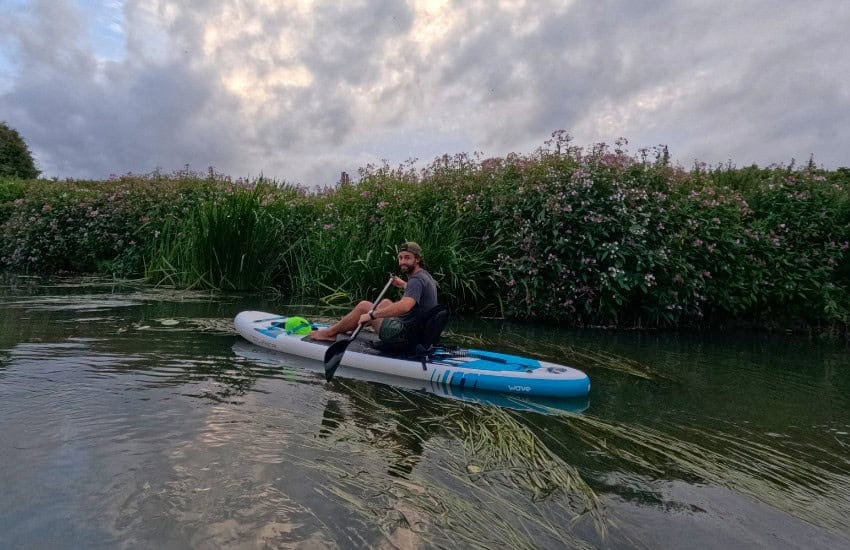
One thing that makes Barcombe Mills genuinely stand out compared to most Sussex paddle spots: it’s extremely sheltered. The river runs through a tree-lined corridor for virtually its entire length, with woodland on both banks keeping the wind off the water almost completely. I’ve paddled here on days when the wind elsewhere was strong enough that I’d have had no business being out on open water — and on the Ouse at Barcombe, you’d barely know it was blowing. If you check the forecast and it looks too windy for a coastal or open-water session, Barcombe Mills is often the answer. It’s one of the few spots in the area where a breezy day genuinely isn’t a reason to stay home.
The Paddle Itself — What to Expect
From the launch point, you can paddle in either direction. Most people head downstream towards The Anchor Inn, which is about a 30 to 40 minute paddle away at a relaxed pace. The return is equally doable — with minimal current in either direction, it’s a genuine two-way route, and you won’t be fighting the water on the way back. You can also head upstream towards Isfield, which is a different but equally good paddle — more open, calmer, and the route that most guided tours use.

Heading downstream, the river starts wide and open, which is ideal for getting your balance and settling into a rhythm. As you go further, sections of the bank become increasingly overgrown — trees overhanging the water, branches you’ll need to duck under, narrower stretches where you have to pick your line.
For confident paddlers, this is one of the most enjoyable parts of the route. It feels like proper river paddling rather than just crossing a flat body of water. For complete beginners, it’s worth knowing that the character of the river changes as you go further, and turning around early is a perfectly good option.

One of the things I genuinely love about this stretch is the challenge of threading through the overhanging branches and weaving around obstacles. It keeps you engaged in a way that pure flat-water paddling doesn’t always.
I use this spot regularly to test new boards — the Wave SUP Tourer and the Bluefin Cruise have both had good days out here — and the variety of the water makes it a more useful test environment than somewhere uniformly calm. I’ll be bringing the Wave Pro 3.0 down here for its first proper test soon.
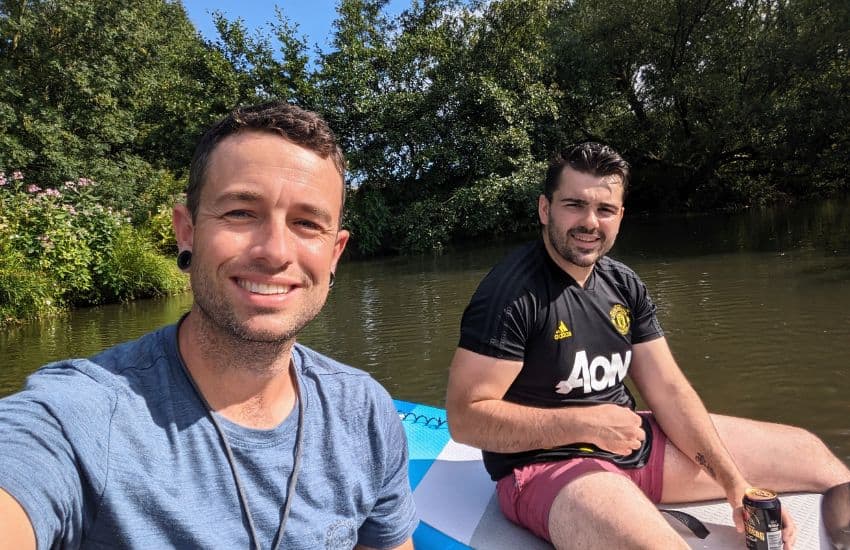
I always come with a cup holder on my board. In summer, that means cans and ciders; in winter, it means a coffee and something from the bakery. There’s something genuinely special about drifting along a quiet river with a hot drink, especially on a cold morning when the mist is sitting on the water, and you’ve got the place almost to yourself. Some of my best mornings of the year have been here.
Is Barcombe Mills Good for Beginners?
Yes, with one caveat. The flat, non-tidal water and easy launch make this a solid choice for a first time out — no surf, no tidal push, no open-water nerves. I’ve brought plenty of friends here who’d never been on a board before, including my two boys when they were four and six. They loved it.

The caveat is the depth. Unlike somewhere like Cuckmere Haven, where the water is genuinely shallow, the Ouse at Barcombe is deeper in places, and you won’t be able to stand up if you come off. For confident swimmers, that’s fine. For anyone less sure in the water, a buoyancy aid is non-negotiable, and I’d keep first-timers to the wider, more open section near the launch rather than heading straight into the overgrown downstream stretch.
If you’d rather learn with a guide, both SUPHaven and The Hatt run paddleboard tours from Barcombe Mills and know this stretch of river well.
Wildlife — What You Might See
Barcombe Mills is genuinely good for wildlife, and being on the water at board height gives you a different perspective to the walkers on the bank. The regulars are all here: swans (plenty of them, and confident enough to make their feelings known if you get too close), ducks, Canada geese, and herons standing motionless on the banks. There are fish in the river — carp, pike, trout, and migratory sea trout — and on a calm day, you can often make them out from the board.
Paddle slowly on the more sheltered overgrown sections, and you’ve got a reasonable chance of spotting kingfishers. Dragonflies and damselflies are abundant in summer. One regular visitor to Barcombe reports reliably seeing kingfishers near the car park area on quiet mornings — worth arriving early if that’s what you’re after.

One seasonal note worth flagging: swans nest on the riverbanks in spring, and it’s genuinely lovely to see. But nesting swans are also territorial and will absolutely let you know if they feel you’re too close. Give nesting birds a wide berth, stay well off the banks during the nesting season, and read the mood of any swan that starts moving purposefully towards you. They’re magnificent animals and best appreciated from a respectful distance.
The Anchor Inn
The Anchor Inn sits on the riverbank about 30 to 40 minutes downstream, and it’s been the natural turnaround point for paddlers on this stretch for years. It has a beer garden, serves food, and on a summer afternoon, it earns its reputation.
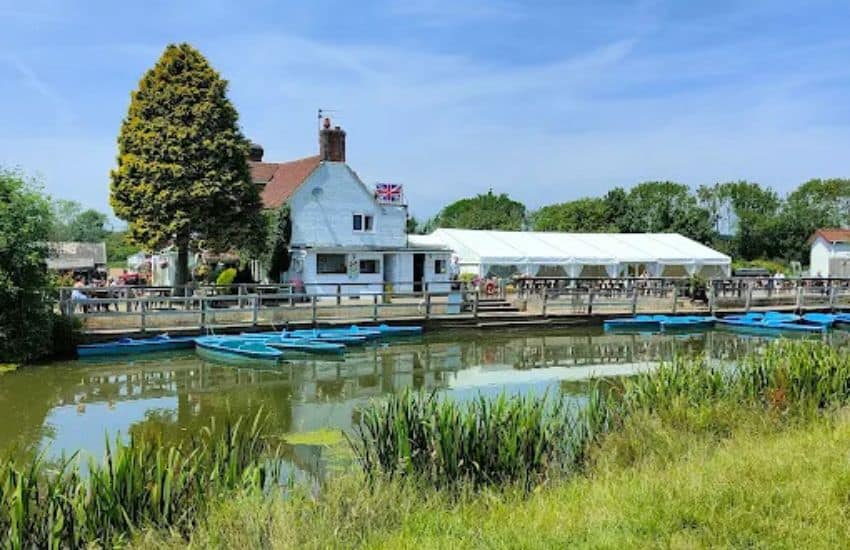
A few notes, though. The Anchor runs a boat hire operation from the riverbank — rowing boats for hire on the Ouse — and that’s almost certainly why they’ve historically been a bit sensitive about paddleboarders using their bank as a launch or landing point. I wouldn’t recommend launching from The Anchor, and I’d be respectful about where you pull out if you do stop. I’ve climbed out there myself and gone in for a drink without any issue, but I wouldn’t bank on it being straightforward every visit.
My usual approach is to paddle down to the pub, sit on the water and enjoy the moment — cup holder loaded, cider in hand if the weather’s good — and then turn around and paddle back. The river is calm enough in both directions that the return paddle is no harder than the outward leg. It’s a perfectly good way to do the route, and it means you’re not dependent on the pub’s landing arrangements.
Some of My Favourite Days Here
Barcombe Mills has been the setting for more good days on the water than anywhere else I paddle regularly. There’s a spot just downriver from the launch point where families set up on summer weekends — picnics on the bank, kids in and out of the water, general riverside chaos in the best possible way.
We’ve spent entire days there with friends and their kids, multiple boards and kayaks all out at once, and it has exactly the right energy. Busy enough to feel sociable, peaceful enough that you can drift off and get twenty minutes of quiet if you want it.
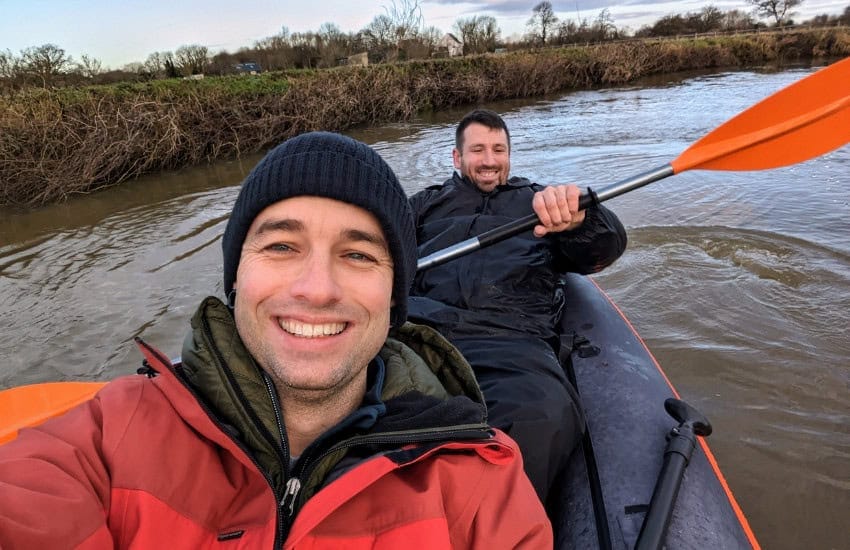
The other end of the spectrum: one early January, my brother-in-law Adam and I got to Barcombe Mills at sunrise, just a few days into the new year, and had one of the best mornings I can remember on the water. We were in kayaks that time. Cold, still, barely anyone about — the mist sitting low on the river, the whole place feeling like it was ours. We paddled down to The Anchor with our coffees and croissants, sat on the water, and ate breakfast there. No rush. Nowhere else to be. It was exactly the kind of morning you remember.
(We tried to repeat it at Cuckmere Haven the following year. The meanders were frozen. Less successful, but a good walk on the downs afterwards, so no complaints.)
What Else Is There to Do?
Barcombe Mills rewards a full day out rather than a quick paddle and drive home. A few things worth knowing:
- Lewes — just a few miles south and well worth a stop. Good independent shops, Harvey’s Brewery, the castle, and a solid selection of pubs and cafés. A good place to grab breakfast before you paddle or a proper meal afterwards.
- Riverbank walks — the Ouse Valley Way runs nearby, and the surrounding countryside is excellent walking territory. The disused railway trackbed from Barcombe Mills towards Anchor Lane is a particularly nice flat walk.
- Boathouse Farm Camping — riverside camping close to the route if you’re planning an overnight trip.
- The Anchor Inn boat hire — if you fancy a change from paddleboarding, The Anchor Inn hires out rowing boats on the river.
Final Thoughts
Barcombe Mills is my most-visited paddleboarding spot for good reason. It’s not the most dramatic scenery in Sussex — it’s not trying to be. What it offers is something harder to find: a calm, accessible, genuinely beautiful stretch of river that works for a solo sunrise paddle, a family day out, a social afternoon with mates, or a proper board test. I’ve done all of those things here, more times than I can count, and I’m always glad I went.
There are no facilities on site, so bring everything you need — food, drinks, the cup holder for your board. In the summer, that’s a cider and a snack on the water in the sunshine. In January, it’s a flask of coffee and a croissant drifting downriver in the mist. Both are better than they have any right to be. Give it a visit.
Paddleboarding at Barcombe Mills FAQs
Related Guides & Reviews
The resources below cover the basics, common questions, and related kit to help you get more out of your time on the water.
- How To Paddle Board: Complete SUP Guide for Beginners
- Best Budget Paddle Boards in the UK
- Best Paddle Board Accessories: Best SUP Gear
- Wave Pro 3.0 Paddleboard (SUP) Review
- Wave Tourer SUP Review

Steve Cleverdon
Adventure-driven outdoor gear reviewer and paddleboarder, Steve has spent 20 years exploring rivers, coastlines, and trails across Britain and abroad, sharing what he’s learned along the way. Learn more about Steve or get in touch.