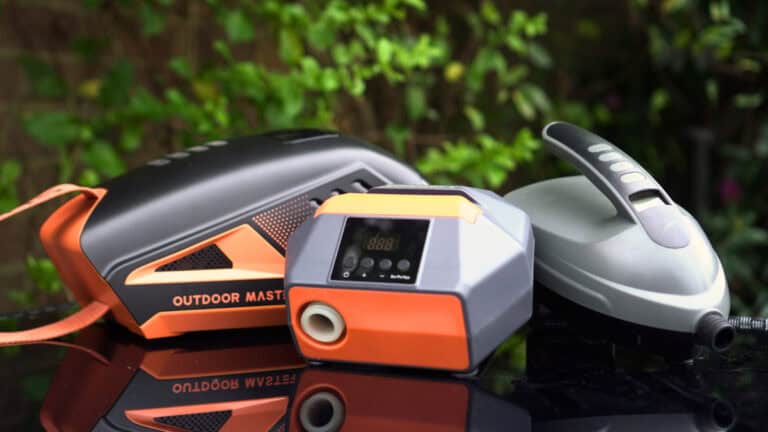
Two boards from the Aquaplanet lineup, a £140 price gap, and a decision that isn’t as obvious as it looks. If you’re trying to choose between the Aquaplanet Allround 10 and the Aquaplanet Max 10’6, you might expect the answer to be simple — buy the cheaper one to start, upgrade later. But the differences between them go deeper than price, and in a few key areas, the cheaper board actually has the edge.
I’ve tested both on the water and reviewed each one in detail on this site. This comparison lays out exactly where they differ, who each board suits, and which one I’d point you towards depending on what you actually need. Here’s everything you need to know about the Aquaplanet Allround 10 vs Aquaplanet Max 10’6 before you decide.
Thanks for your support – I may earn a small commission from affiliate links in this article Learn more
Aquaplanet kindly loaned me the Allround 10 and Max 10’6″ for review. All opinions are my own.
Allround 10 vs Max 10’6″ Side-by-Side Comparison
| Aquaplanet Allround 10 | Aquaplanet Max 10’6 | |
|---|---|---|
| Length | 10′ | 10’6″ |
| Width | 33″ | 31″ |
| Thickness | 6″ | 6″ |
| Board Weight | 7.8kg | 8.2kg |
| Max Rider Weight | 100kg | 130kg |
| Max Payload | 110kg | 178kg |
| Max PSI | 15 PSI | 21 PSI |
| Construction | Heat-fusion welded seams | Heat-welded seams, fusion laminated drop-stitch |
| Deck Pad | Gecko Grip (centre-fold compatible) | Edge-to-edge honeycomb EVA |
| Fin System | Single quick-release clip-in | Single shatterproof clip-in |
| Paddle | 4-piece compact aluminium | 3K carbon fusion, 670g |
| Leash | Coiled ankle leash | Quick-release waist belt |
| Pump | Electric (12V, £80 RRP) | Dual-action manual |
| D-Rings | Fabric loops | Metal D-rings (5 each side) |
| Carry System | Tote bag | Hydrophobic backpack with padded waist strap |
| Warranty | 3 years | 3 years |
| Price | £249 | £389 |
| Steve’s Rating | 4.8/5 | 4.9/5 |
5% discount automatically applied at checkout
Key Differences Between the Two Boards
On paper, both boards share the same brand DNA — heat-welded seams, 6-inch thickness, a 3-year warranty, and a commitment to a complete package. But the differences emerge quickly once you dig into the details, and a few of them cut against what you’d expect.
The most counterintuitive one: the cheaper Allround 10 ships with an electric pump; the more expensive Max doesn’t. That single fact shifts the value calculation considerably. Strip out the electric pump’s £80 standalone value, and the real-world gap between these two boards narrows significantly.
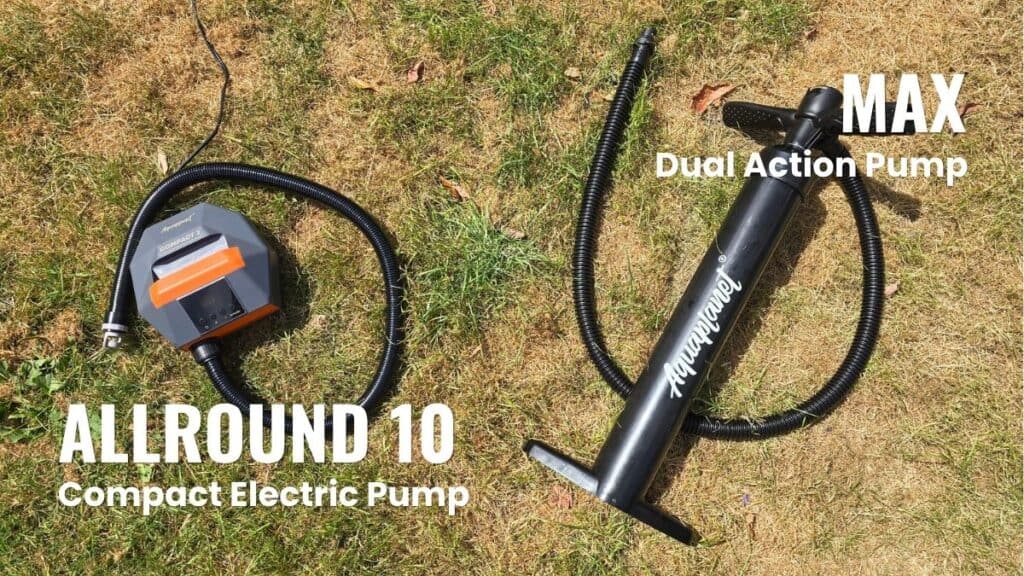
Beyond the pump, four differences really matter: portability, the dimensions, the deck pad, and the paddle.
The Allround 10 is a fundamentally different kind of board to transport and store — it folds in half lengthways into a tote bag, rather than rolling into a backpack, which is incredibly useful when you’re trying to fit a paddleboard into an already stuffed boot of a small car, a storage compartment in a campervan, or in a cupboard at home.
The Max packs into an excellent, well-built backpack — but it’s still a full-sized inflatable SUP rolled up, and it takes up considerably more space. The Max is longer and narrower, built for performance and progression, and it comes with a carbon fusion paddle that outperforms anything you’d expect at this price point. The deck pad distinction — Gecko Grip vs honeycomb EVA — matters more the longer you paddle.
Design and Build Quality
Both boards use heat-welded seam construction and share the same 3-year warranty, so there’s no meaningful gap in build confidence from Aquaplanet’s perspective. Both feel solid and well-finished.
Where they differ is in the materials and how that affects the on-water experience. The Max uses fusion laminated drop-stitch with a recommended PSI of 15 and a max of 21, which means it can be inflated to a noticeably stiffer platform than the Allround’s ceiling of 15 PSI. At 15 PSI, both boards feel rigid underfoot. Push the Max to 18–20 PSI, and the difference becomes more obvious — it gets closer to the feel of a hard board, which makes a difference to efficiency and glide on longer paddles.

The deck pad is where the two boards diverge most visibly. The Allround 10 uses Gecko Grip — a skateboard-style grip surface that runs either side of the centre fold line. It’s comfortable enough barefoot on shorter sessions and wipes dry in seconds at the water’s edge, but it’s firmer than foam and your feet notice it on paddles over an hour or two.
The Max uses a full edge-to-edge honeycomb EVA deck pad — thinner than the chunky foam pads you’ll find on most boards, but still more cushioned and comfortable for longer sessions. It too can be easily be wiped dry after a paddle, but it wins out as the more comfortable surface of the two underfoot, particularly over a few hours.
The other notable design difference is the attachment points. The Allround 10 uses stitched fabric loops in place of D-rings, which I believe is a weight-saving choice. They work fine once you’re set up, but they’re slightly fiddlier than metal clips. The Max runs five metal D-rings down each side, set out in a layout optimised for a kayak seat.
Portability and Storage
This is where the Allround 10 separates itself most clearly — and it’s not even close.
Most inflatable paddleboards, including the Max, pack down in the same way: roll the board up, then stuff it into a large backpack. The Max’s backpack is genuinely one of the better ones I’ve used — hydrophobic fabric, padded waist strap, well-organised pockets — but it’s still a substantial piece of luggage that takes up a large amount of space, whether that’s in a car boot, a spare room, or in the shed.
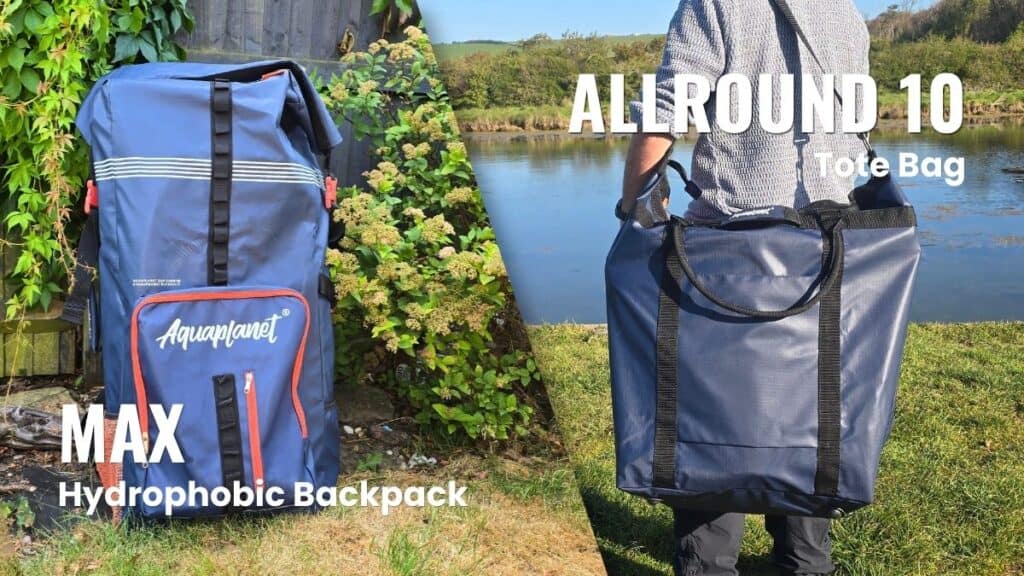
The Allround 10 does something different. Instead of rolling as is, it folds in half lengthways down a central crease first before it rolls, then packs into a tote bag alongside the paddle, pump, and accessories. The whole thing can easily fit on a shelf. That’s a completely different storage proposition to any other board, and for a lot of people – especially those short on space – it can be the deciding factor before they’ve even thought about how it paddles.
The reason this is possible is thanks to the Gecko Grip deck surface on either side of the board (a centre strip is removed to allow the board to fold lengthways), this design decision enables the entire centre-fold concept to work.
In practical terms: if you live in a flat, have limited garage space, travel in a motorhome or van, drive a small car, or want to keep your board in your office, the Allround 10 is in a different category.
At 7.8kg the Allround 10 is also lighter than the Max at 8.2kg — not a dramatic difference, but when you’re carrying a board any distance to the water, lighter is always welcome.
Performance on the Water
I tested the Allround 10 at Cuckmere Haven in Sussex and the Max on the River Ouse at Barcombe Mills. Both sessions were in calm conditions, which meant I could assess each board’s natural character rather than fighting the water.
The Allround 10 paddles exactly as you’d hope a 10-foot beginner all-rounder would. It’s responsive on turns, holds momentum well between strokes, and the 33-inch width gives it a planted, settled feel even in the hands of someone who hasn’t paddled before. Tracking is clean, with only the occasional correction needed, and the board never felt like it was working against me.

The Max has a different character. At 31 inches wide and 10’6″ long, it cuts through the water more cleanly and glides further between strokes. There’s noticeably more efficiency to each paddle stroke, and on a longer session that compounds into real time and energy saved.
The kick pad at the tail gives you a platform for step-back turns, which adds a bit of technique and fun once you’re comfortable. For someone still finding their feet, those first couple of sessions on the Max require a little more attention than on the Allround — the extra couple of inches of width you lose matter more than it sounds when you’re new. But most paddlers settle in quickly, and after that, the performance dividend is worth it.
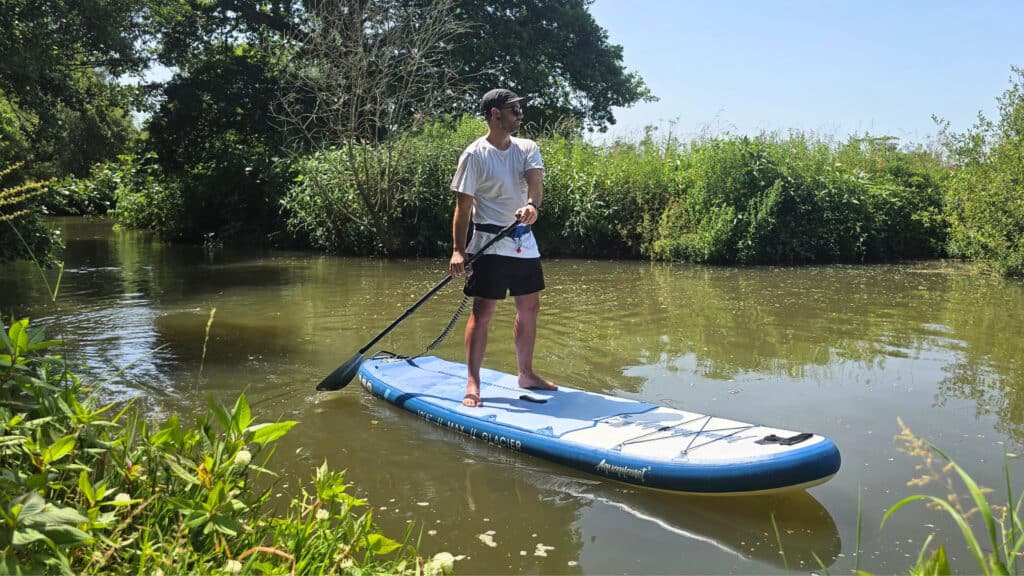
For shorter recreational paddles on calm water — a lake, a sheltered estuary, a morning river session — both boards do the job comfortably and enjoyably. The gap between them will be felt more as you progress as a paddleboarder.
5% discount automatically applied at checkout
Stability and Who Each Board Suits
The Allround 10’s extra two inches of width (33″ vs 31″) gives it a stability advantage. For complete beginners, that can be the difference between feeling confident and feeling anxious on the water, particularly in the first session or two. Both boards are stable enough for most adults to stand on comfortably, but the Allround is the more forgiving of the two and the right choice if you’re starting from scratch.
The more significant consideration is weight capacity. The Allround 10 is rated to a max payload of 110kg; the Max is rated to 178kg. That’s a 68kg gap. In practice, if you’re a lighter paddler going solo, both boards will be fine. But if you’re on the larger side, paddling with a child on the front, bringing a dog, or regularly carrying gear and water, the Max’s headroom is a practical advantage.
Aquaplanet Allround 10 suits: Beginners who want maximum stability from their first session; paddlers short on storage space who need a board that packs down as small as possible; van and motorhome travellers; anyone who wants an electric pump sorted from the outset and doesn’t want to add to their setup costs later.
Aquaplanet Max 10’6 suits: Paddlers who want a board they’ll grow with rather than outgrow; anyone stepping up from a first board who wants a noticeable performance upgrade; heavier paddlers or those who frequently paddle with gear or a child; anyone who values a premium carbon paddle and a practical waist leash as part of the package from day one.
Kit and Accessories
This is where the comparison becomes interesting, because the kit tells a different story to the price.
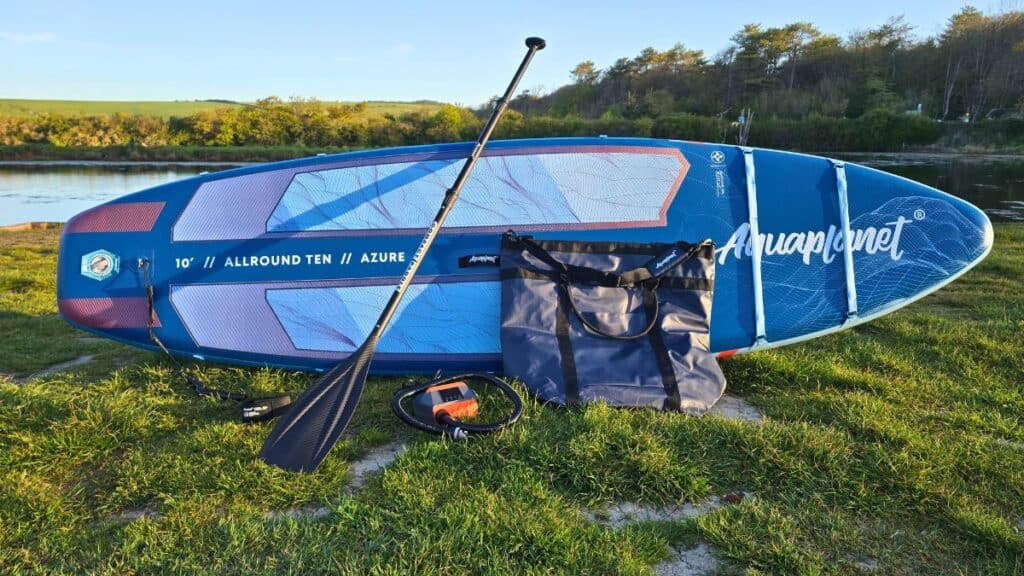
Aquaplanet Allround 10 ships with:
- Compact 12V electric pump (RRP £80 standalone)
- 4-piece compact aluminium paddle
- Coiled quick-release ankle leash with padded cuff
- Quick-release clip-in fin
- Tote bag
- Bungee storage with integrated bottle holder
Aquaplanet Max 10’6 ships with:
- Dual-action manual pump
- 3K carbon fusion paddle (670g)
- Quick-release waist belt leash
- Shatterproof clip-in fin
- Hydrophobic backpack with padded waist strap and side paddle holder
- Bungee storage
- Action camera mount
- Rear kick pad
The pump situation is the standout. The Allround 10 includes an electric pump worth £80 — a piece of kit that most boards at this price point don’t come close to including. The Max gives you a dual-action manual pump, which is functional but requires a lot more effort to reach 15 PSI, let alone 20.
If you buy the Max and want to add an electric pump later, you’re looking at another £80 on top of the £389, which puts the effective cost at around £469. The Allround’s kit starts looking like even stronger value in that light.
That said, the Max’s paddle is superior. The 3K carbon fusion paddle at 670g is one of the best paddles I’ve used bundled with any board — lighter and more comfortable in hand than aluminium, with an ergonomic handle that makes a long session easier. The Allround’s aluminium paddle is fine for a beginner, but once you’ve used carbon, it’s hard to go back.
The leash is another upgrade worth noting. The Max’s quick-release waist leash is easier to forget about during a session and considerably faster to release in an emergency than an ankle leash.
The carry systems are covered in detail in the portability section above, but in kit terms it’s worth noting: the Max’s hydrophobic backpack is a genuinely excellent bag — better than most brands who treat the backpack as an afterthought rather than an important piece of the package. For carrying distance to the water it’s considerably more comfortable than the tote. The tote bag wins on storage and pack-down size, but if you’re regularly walking any real distance to the launch point, the backpack is still a winner.
Value for Money
The Allround 10 at £249 looks like the budget choice. Once you factor in the electric pump’s £80 standalone value, it’s closer to £170 for the board and remaining kit — which makes it exceptional value at that price point.
The Max at £389 carries a bigger headline price, but the carbon paddle alone is worth a chunk of that if you were to buy it separately. The backpack, waist leash, and higher-spec construction all contribute to a package that consistently outperforms what you’d expect at sub-£400.
The honest comparison: if you buy the Allround 10 and later want the Max’s paddle quality and a better leash, you’ll probably spend money upgrading both. If you buy the Max and later want an electric pump, you’ll spend another £80. Either way, your total outlay converges. The question is which upgrades matter most to you now, and what you’ll actually use.
If you’re paddling three or four times a season, the Allround 10 is outstanding value. If you’re planning to paddle regularly and the quality of the session matters — better glide, lighter paddle, more comfort underfoot — the Max pays for itself over a season.
5% discount automatically applied at checkout
Which One Should You Buy?
If you’re a complete beginner who wants the most stable board possible, values compact storage, and wants an electric pump included from day one, go with the Aquaplanet Allround 10. At £249 with an electric pump in the box, it’s one of the strongest-value beginner packages on the market, and the centre-fold design solves a storage problem most boards don’t even try to address.
If you’re a beginner who wants something you’ll still be happy with in three years time — or an intermediate paddler looking for a meaningful performance step up — go with the Aquaplanet Max 10’6. The carbon paddle, waist leash, and higher weight capacity make it the better long-term investment, and the board itself paddles with more efficiency and character once you’re comfortable on the water.
f you’re leaning towards the Max but want more length for longer-distance or open water paddling, it’s also available as the Max Plus 11’8″ — the same package, just more board.
The one scenario worth thinking through: if you buy the Max and know you’ll want an electric pump, factor in that additional £80 cost upfront. At £469 combined, you’re in different territory to the Allround 10.
Aquaplanet Allround 10 vs Max FAQs
Is the Aquaplanet Max worth the extra money over the Allround 10?
It depends on how you paddle. The Max’s carbon fusion paddle, waist leash, and larger weight capacity represent a real upgrade in quality and long-term usability. But the Allround 10 includes an electric pump the Max doesn’t — so once you account for that, the price gap widens considerably. If you’ll paddle regularly and want a board that rewards progression, the Max is worth it. If you’re a beginner after great value and easy storage, the Allround holds its own.
Which board is better for beginners?
Both are well-suited to beginners, but in different ways. The Allround 10 is wider at 33 inches, which gives it a more forgiving, planted feel and makes it the safer choice for complete first-timers. The Max at 31 inches requires slightly more balance, but most people settle into it quickly. If you’re starting from scratch, the Allround 10. If you’re newer to paddleboarding but physically confident and want a board you’ll still be challenged by in two years, the Max.
Why does the cheaper board come with an electric pump but the more expensive one doesn’t?
The Allround 10’s electric pump is the centrepiece of its kit package — Aquaplanet have built the whole value story around it. The Max instead puts the budget into a higher-spec carbon paddle, a premium backpack, and a waist leash. Both are valid choices, but they prioritise different things.
Which board packs down smaller?
The Allround 10 by a significant margin. Its centre-fold design means it folds in half lengthways and packs into a tote bag that fits on a shelf or in a cupboard. The Max rolls up in the usual way and packs into a backpack, which takes up considerably more space at home. If storage is a primary concern — flat, van life, a small hallway — the Allround is the clear choice.
What’s the difference in weight capacity between the two boards?
The Allround 10 has a max payload of 110kg; the Max has a max payload of 178kg. That’s a significant gap. For most solo adult paddlers under 90kg paddling without much gear, either board is fine. For heavier riders, paddlers who regularly bring a child or a dog, or anyone who carries meaningful amounts of kit, the Max’s capacity is the more sensible choice.
Can both boards be used as a kayak?
Yes – The Max is better set up for it. It has five metal D-rings on each side in an optimised layout for attaching a kayak seat (sold separately), which makes the conversion clean and practical. The Allround 10 uses fabric loops rather than D-rings, which are compatible but fiddlier to attach a seat to. Both can technically work; the Max does it more comfortably – especially if already out on the water.
Related Guides & Reviews
The resources below cover the basics, common questions, and related kit to help you get more out of your time on the water.
- Aquaplanet Paddle Boards Compared: Full Range Guide
- Best Paddle Board for Beginners UK: 8 Top SUPs Compared
- Best Electric Pump for Paddle Boards
- Best Budget Paddle Boards in the UK
- Paddle Board Accessories: Best SUP Gear

Steve Cleverdon
Adventure-driven outdoor gear reviewer and paddleboarder, Steve has spent 20 years exploring rivers, coastlines, and trails across Britain and abroad, sharing what he’s learned along the way. Learn more about Steve or get in touch.