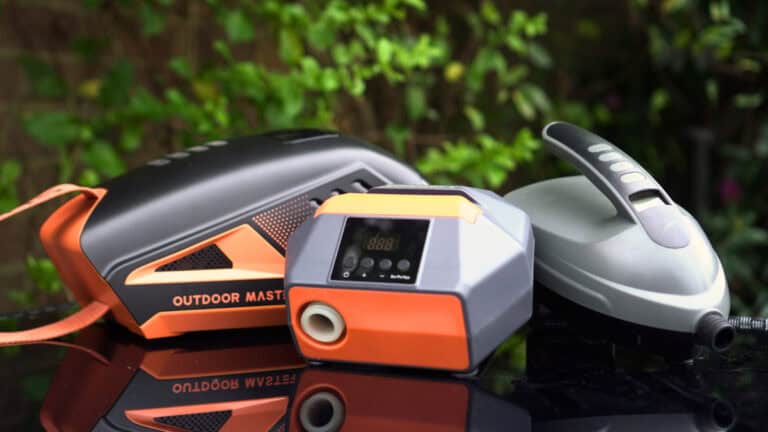
Most electric SUP pumps tie you to the car park. The Wave Electric Pump is cordless, runs from a rechargeable battery, and is small enough to carry to wherever you want to launch.
Thanks for your support – I may earn a small commission from affiliate links in this article Learn more
Wave gifted their Electric Pump 20PSI for review. All opinions are my own.
- Inflation Speed
- Portability
- Noise Level
- Features
My Verdict
A compact, cordless electric pump you can take anywhere. It inflates a board at a decent pace, it’s easy to use, the auto shut-off is precise, and the built-in light, 12V backup and USB-C charging are all useful extras. However, there’s no active cooling so it needs a short cool-down between boards. At £119.99, I’d say it’s good value for how much it opens up where you can paddle.
Pros
Cons
Where to Buy
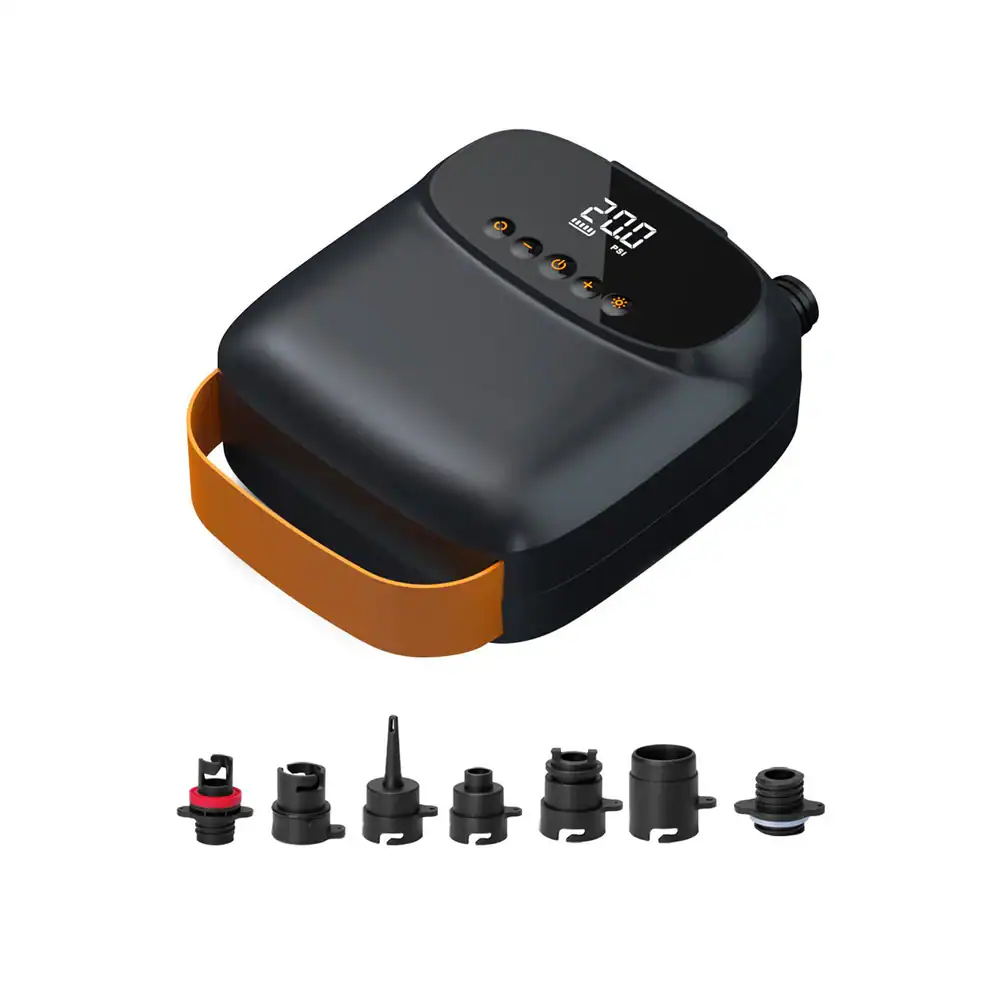
Wave Electric Pump 20PSI
My Verdict: “A small, cordless electric pump you can take anywhere. It inflates a board at a decent pace; it’s easy to use, and the auto shut-off is precise”
Save 10% off Wave SUPs and accessories via this link ↑
The Wave Electric Pump is the compact, battery-powered pump in Wave SUPs’ range of paddle board accessories, sold alongside its paddleboards and kayaks. It’s a dual-stage pump: a high-volume stage fills the board quickly, then it switches to a high-pressure compressor to finish the job. It has a digital display with auto shut-off, a deflate mode, and runs from its built-in battery or your car’s 12V socket.
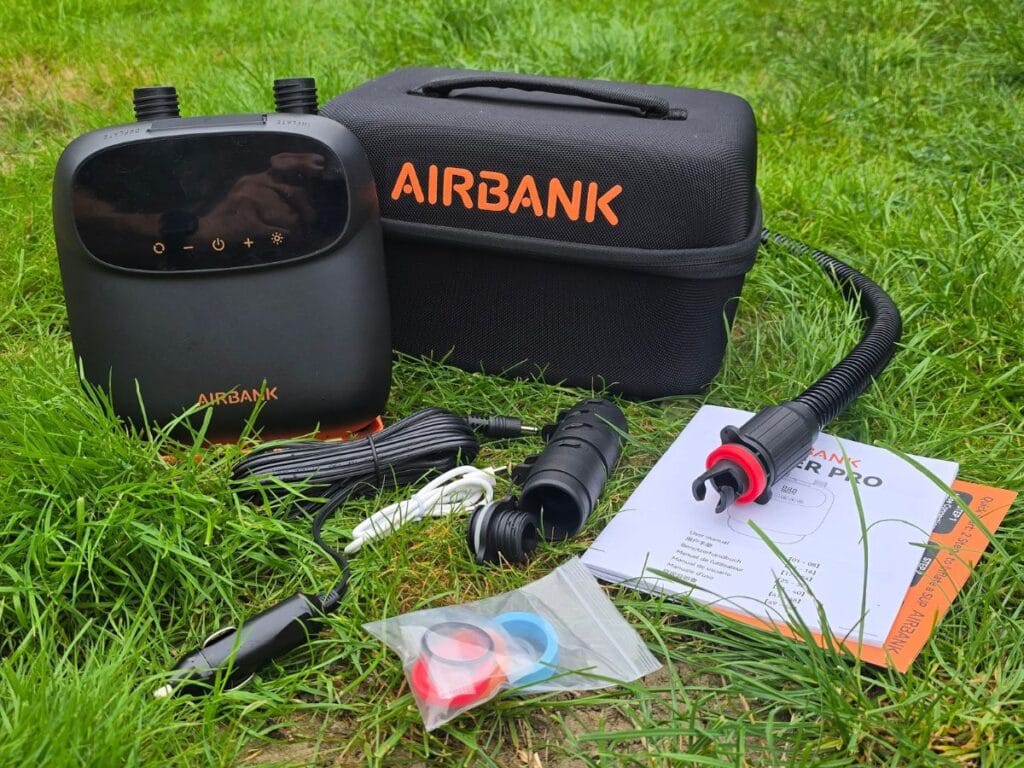
It’s worth knowing that Wave doesn’t make this pump itself. The box it arrived in says AirBank Puffer Pro 20 PSI Rechargeable SUP Air Pump, so this is an AirBank pump sold under the Wave name. If you’ve seen the Puffer Pro elsewhere, it’s the same pump.
Full Specifications
Price: £119.99
Max pressure: 20 PSI
Inflation time: approx. 8–10 minutes (to 15 PSI on a standard SUP)
Battery: 5200mAh 12V rechargeable
Dimensions: 26 x 18.5 x 18.5cm (10.2 x 7.2 x 7.2″)
Power options: Rechargeable battery or 12V car outlet
Weight: 1.26kg (AirBank figure)
Charge time: about 2 hours via USB-C (AirBank figure)
Digital display with auto shut-off / Inflate and deflate functions / Dual-stage inflation / 12V car cable / USB-C charging cable / 7 nozzle adapters (paddle boards, inflatable boats, foam mattresses, inflatable beds, wings, kites and inflatable tents) / Carry case
How I Tested It
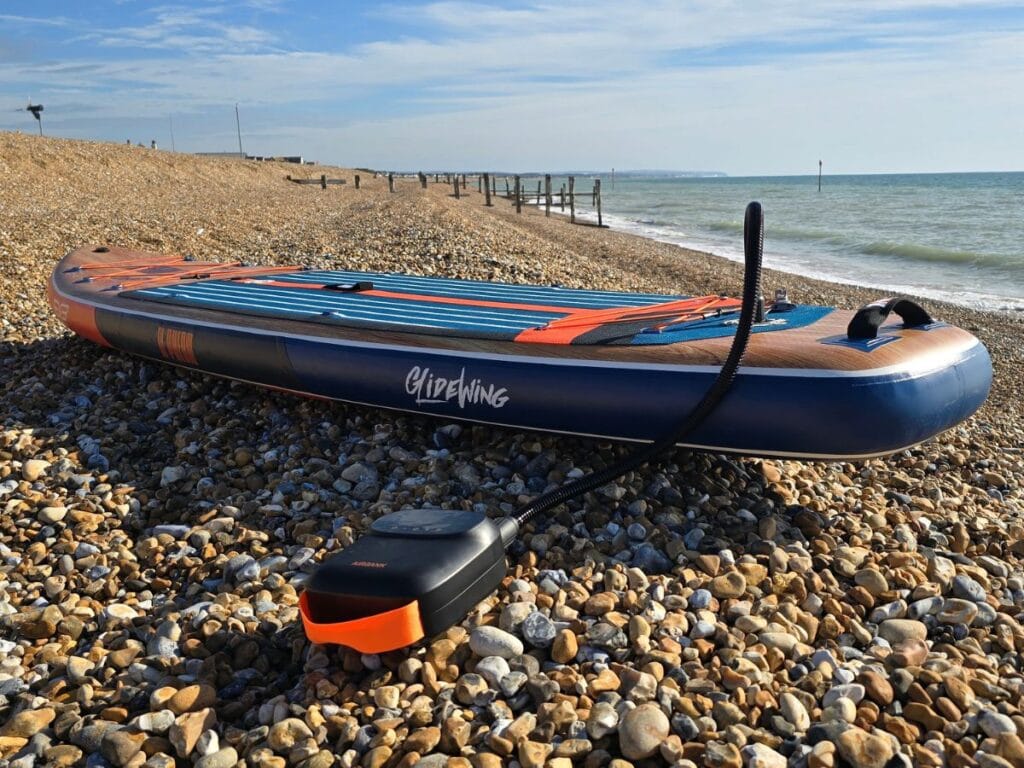
Holywell is one of my favourite spots to paddle board close to home, tucked under the White Cliffs at the start of the South Downs National Park. It’s a bit of a trek from the roadside down to the beach, though. Too far to walk with an inflated board, and not one I’d want to do carrying a manual pump or a large electric pump like the Shark 3, as that’s extra gear I’d need to store on my board or leave on the beach. Neither of which I’d want to do.
I’ve used the Wave Electric Pump over multiple paddle sessions this summer, at Holywell and elsewhere. Alongside that real-world use, I’ve been running back garden tests to check Wave’s claims. Here’s how I’ve got on with it.
How Fast Does the Wave Electric Pump Inflate a Paddle Board?
Wave says it takes “approx. 8–10 minutes (to 15 PSI on a standard SUP)”, but in my experience, I would say it’s closer to 11 minutes per board. It took me 11 minutes 30 seconds to inflate my Niphean Classic 11″ to 15 PSI, and exactly 11 minutes to inflate the Wave Cruiser.
The pump starts off relatively quiet for the first minute or so while it gets to 1 PSI. That’s the high-volume stage pushing lots of air in at low pressure. Then the motor kicks in, along with the volume, as it switches to the high-pressure compressor that does the hard work of firming the board up.
Wave says it’ll take a board to 20 PSI, leaving it “rock-hard for peak stability and performance on the water”. To put that to the test, I inflated my Wave Pro 3.0 to 20 PSI in my back garden. It got there in 15 minutes 35 seconds, a little over four minutes longer than the 11 minutes it took to get my Wave Cruiser to 15 PSI.
Timing-wise, that’s in line with most electric pumps I’ve used. The Bluefin E-Swift Lite, for example, took 10–12 minutes to 15 PSI. The one outlier is the Outdoor Master Shark 3, which got a board to 15 PSI in just under four minutes when I tested it. It’s extremely fast, but it’s also much bigger and heavier. Either way, 11 minutes of standing around beats the pre-paddle workout that comes with manual pumping.
Battery Life and Charging
Wave doesn’t say how many boards the 5200mAh battery covers, but AirBank claims four boards to 15 PSI, or two to 20 PSI. Over the summer, I’d never inflate more than two boards to 15 PSI before charging the pump again out of habit, so I ran a few more back garden tests to put AirBank’s claim to the test.
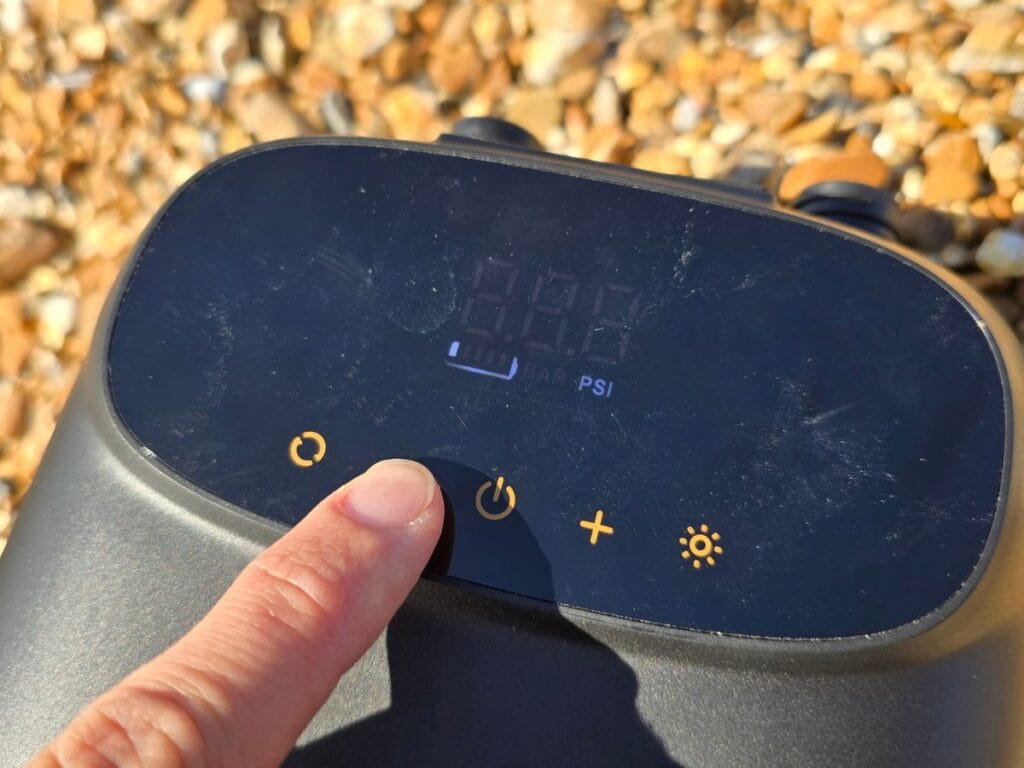
On a single full charge, it did in fact inflate four boards to 15 PSI, so the claim stands up. Inflating the Wave Pro to 20 PSI used roughly 40% of the battery, going by the display’s five bars (each one is 20%). That puts two boards to 20 PSI well within reach, in line with AirBank’s claim. That’s plenty for a solo session, a paddle with friends or a family day out.
After inflating a SUP to 15 PSI, I can’t say I ever noticed the pump feel warm after one board. Pushing to 20 PSI during my test was a different story. It was 22°C outside, and the pump sat in direct sun while it worked, and afterwards it was noticeably warm to hold. So much so that I wouldn’t want to inflate a second board straight away. There’s no active cooling, so I’d give it 10–15 minutes to cool down first. That’s the trade-off for a pump this compact.
If the battery does run out, the 12V DC connection lets you inflate a SUP from your vehicle’s socket instead. It’s a useful backup option for when you arrive at the car park and realise you forgot to charge it. Recharging at home is done with a USB-C cable from the mains, which AirBank says takes about two hours, but I personally found it took much longer to recharge to 100%.
Is the Wave Electric Pump Loud?
Like all electric pumps, yes, but it’s easier to live with than most. I measured it at around 78dB from about 1m away, which is roughly the level of a busy road. The noise electric pumps make is always the biggest cringe with them, especially when pumping a board in a crowded place.
It’s quieter for the first minute or so, until the motor kicks in for the high-pressure stage. The real benefit here, though, is that it’s wireless. I can head off to a quieter corner, away from the crowds, and not stress so much about the noise. No cable tying me to the car.
Features and Controls on the Wave Electric Pump
For a fairly functional piece of kit, there are a few nice touches here.
Control Panel
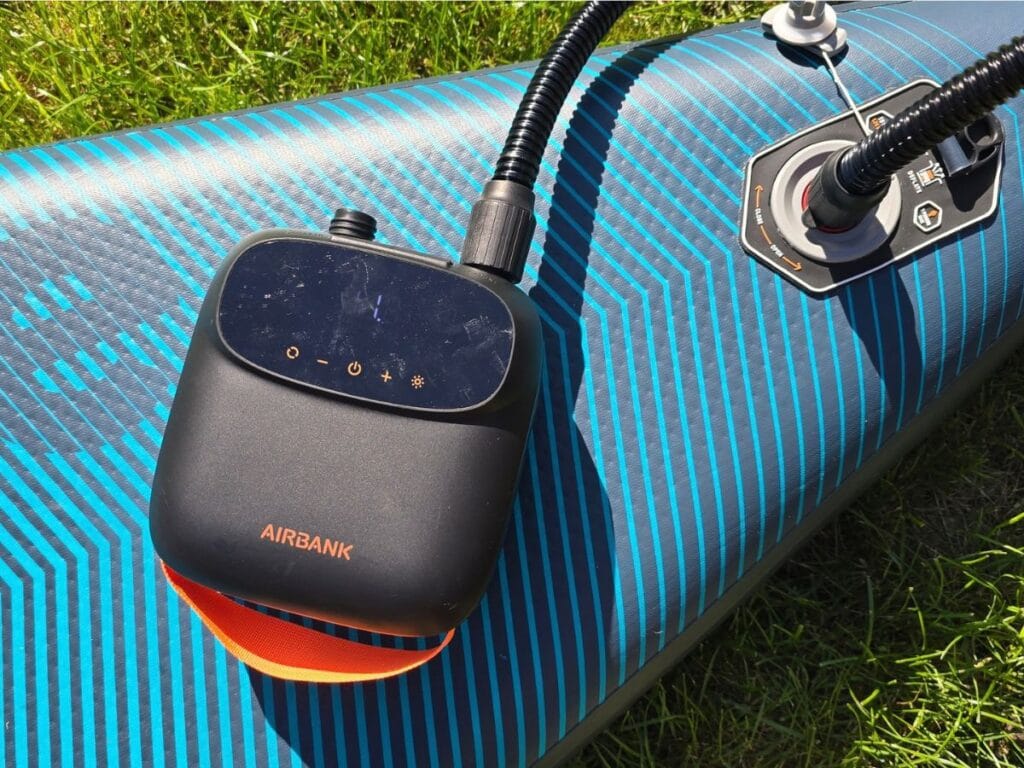
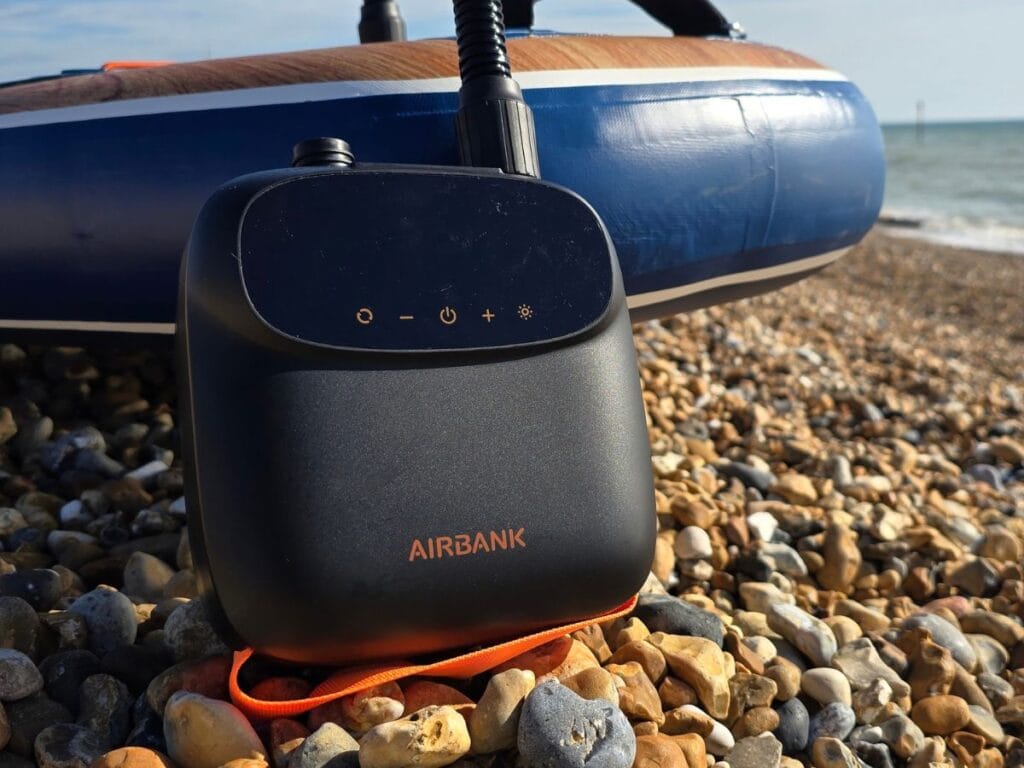
There are five buttons on the screen: power on/off and start, + and – to set the PSI, light on/off, and a switch between PSI and Bar. Set the pressure you want, press start, and walk away. Wave’s pitch is “set the exact PSI you need and the pump will stop precisely when it reaches that level, no monitoring required!” It lives up to that. It cut off the instant it hit the PSI I’d set, every time.
Built-In Light
The built-in light is handy for setting up before dawn, or packing up after coming back from a paddle after dark.
Inflate and Deflate Valves
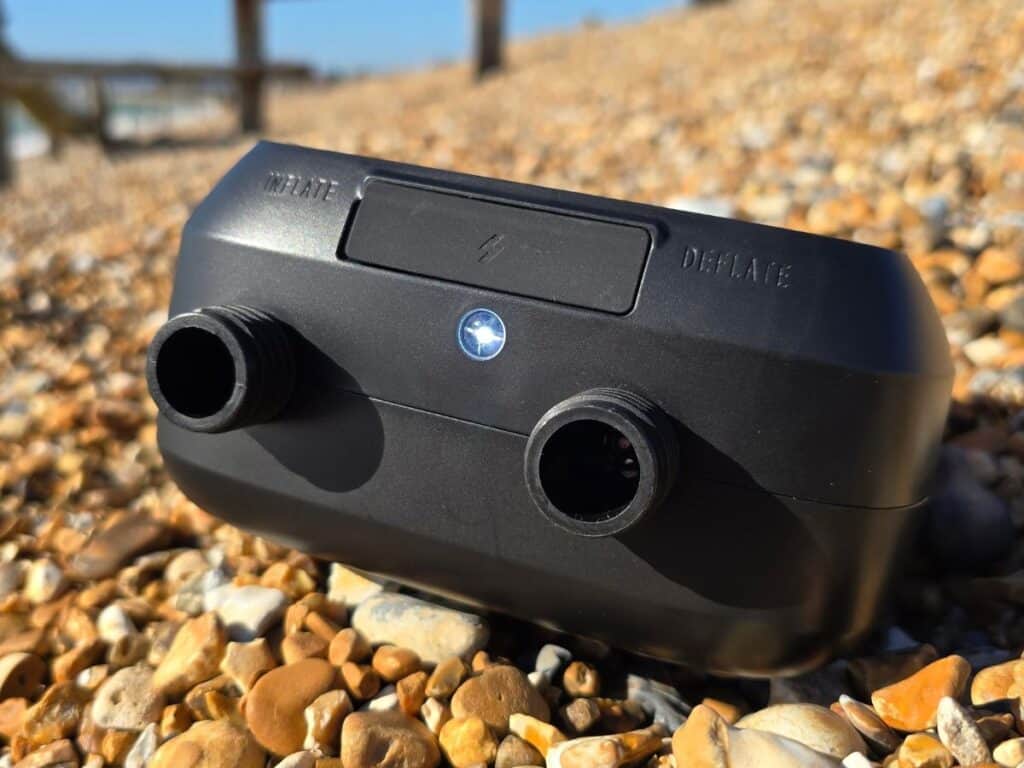
This is fairly self-explanatory. There’s a separate valve for inflating and deflating, and you screw the hose onto the thread of whichever action you need. Wave says the deflate mode will “quickly and thoroughly suck all the air out of your board”, making it easier to roll back into its bag.
Using the Wave electric pump to deflate a board is incredibly simple. First, make sure the tube is screwed onto the deflate valve, then turn the power on. There’s no need to adjust any settings, as they’re irrelevant when deflating a paddle board. Be aware, though, that there’s no auto cut-off when deflating, so stay near your board and turn the pump off when it’s done.
Rubber Feet
The rubber feet keep the pump still while it’s inflating, so it doesn’t vibrate itself off the board. A small detail, but one you’d notice quickly without it.
Power Bank
Something neither Wave nor AirBank mention on their product pages, but I was curious, so I tested to see if the pump would also charge my phone, and it did! Meaning it does in fact double as a power bank. You can use it to charge your phone or other small devices while you’re out. Just keep in mind that any charge you use this way is charge you won’t have for inflating.
What’s in the Case
The kit comes with a 12V cable, a USB-C charging cable and seven nozzles that fit a wide range of high-pressure inflatables, including SUPs, inflatable kayaks, boats, and more.
How Portable Is the Wave Electric Pump?
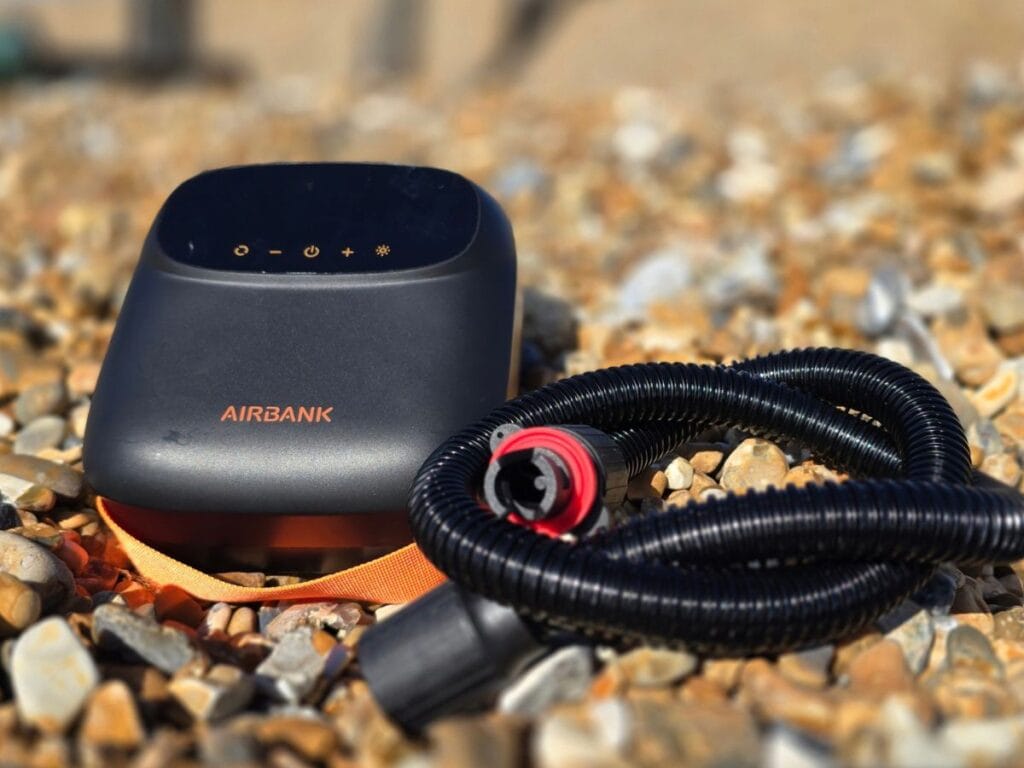
This is where the Wave Electric Pump really comes into its own. The biggest selling point for me is how compact it is. At 26 x 18.5 x 18.5cm, it’s about the size of a kid’s lunchbox.
I only ever take the items I need when I go for a paddle: the pump and the hose, leaving the case and extra items at home. When I’m ready to paddle, I can just throw it in a small dry bag with the rest of my gear and take it out on my board.
It’s become one of my most-used pumps, because it’s allowed me to venture further with my board and trek a little further than I previously would have.
Is the Wave Electric Pump the Same as the AirBank Puffer Pro?
Yes. The box it came in is branded AirBank Puffer Pro 20 PSI Rechargeable SUP Air Pump, and the specs line up: a 5200mAh battery, 20 PSI max, dual-stage inflation, auto shut-off, a built-in light and a 12V car plug. Wave sells it under its own name at £119.99.
Alternatives to the Wave Electric Pump
If speed matters most, the Outdoor Master Shark 3 (£165) is the one I go for when I can. It inflates a board to 15 PSI in under four minutes, but at 2.9kg it’s not something I’d carry any real distance. If you only ever paddle next to the car, the Bluefin E-Swift Lite runs off your 12V socket and took me 10–12 minutes to 15 PSI, but it’s loud and has no battery. The Aquaplanet Compact is another car-powered option at around £60, weighing 1kg and rated to 20 PSI. For more options, see my guide to the best electric pumps for paddle boards.
Should You Buy the Wave Electric Pump?
If you want an electric pump you can take anywhere, yes. It’s ideal for solo paddlers and couples who launch away from the car park, walk down to beaches, or want to skip the manual pump without carrying a heavy battery pump.
If you’re inflating several boards and want them done quickly, the Shark 3 is much faster. If you always paddle next to your car, a 12V pump like the Aquaplanet Compact will do the job for less.
At £119.99, it’s not the cheapest option, but you’re paying for a pump small enough to go in a drybag and head out on the water with you. Whenever my launch spot is further than a short walk from the car park, this is the pump I pack.
Where to Buy
Wave Electric Pump 20PSI
My Verdict: “A small, cordless electric pump you can take anywhere. It inflates a board at a decent pace, it’s easy to use, and the auto shut-off is precise”
Save 10% off Wave SUPs and accessories via this link ↑
Related Guides & Reviews
The resources below cover the basics, common questions, and related kit to help you get more out of your time on the water.
- Best Paddleboard Shoes: Complete Water Shoes Guide
- Best Paddle Board Accessories: Essential Paddleboarding Gear
- Electric vs Hand Pump: Paddleboard Pump Guide

Steve Cleverdon
Adventure-driven outdoor gear reviewer and paddleboarder, Steve has spent 20 years exploring rivers, coastlines, and trails across Britain and abroad, sharing what he’s learned along the way. Learn more about Steve or get in touch.