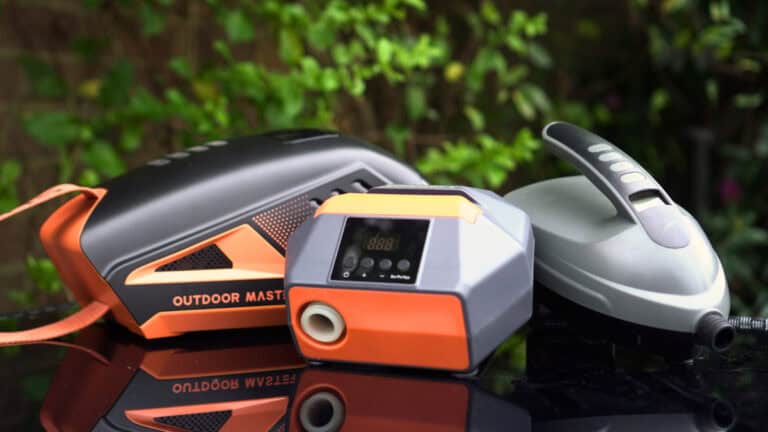
A paddleboard pump doesn’t get talked about much — but it’s the piece of kit you’ll use every single time you get on the water. Get it wrong, and you’re either red-faced and exhausted before you’ve even launched, or standing over a soft, sluggish board wondering why your SUP doesn’t feel like the reviews said it would.
I’ve pumped up boards by hand more times than I care to count, and I’ve tested most of the main electric pumps on the market too. This guide covers everything you need to know: what PSI to aim for, how hand and electric pumps actually compare, and which specific pumps are worth your money in the UK.
The short answer: most regular paddlers will benefit from investing in an electric pump. If you paddle more than once a week, the time and effort savings add up fast. But a quality dual-action hand pump is still a perfectly good option — especially if you’re just getting started.
Thanks for your support – I may earn a small commission from affiliate links in this article Learn more
Quick Comparison: Electric vs Hand Pump
| Electric SUP Pump | Hand Pump (Dual-Action) | |
|---|---|---|
| Inflation time | 8–15 minutes (hands-free) | 10–20 minutes (active effort) |
| Effort required | None | Moderate to high |
| PSI accuracy | Digital readout, auto-stops | Analogue gauge — manual judgement |
| Price (UK) | £60–£150 | £20–£50 |
| Portability | Needs a battery or 12V socket | Fully manual, no power needed |
| Best for | Regular paddlers, groups | Occasional use, travel, backup |
What PSI Does a Stand Up Paddleboard Need?
Before we get into the pump debate, it’s worth getting the basics right — because PSI is one of those things that genuinely makes or breaks your on-water experience.
Most quality inflatable SUPs perform best between 15 and 20 PSI. At anything below 12 PSI, the board feels soft and spongy underfoot, tracks poorly, and loses a lot of its stability. It’s one of the most common reasons beginners feel wobbly — their board simply isn’t inflated enough.
The exact target varies by board and brand:
- Red Paddle Co boards: 15–20 PSI (Titan pump makes 20 PSI achievable by hand)
- Bluefin boards: 15 PSI recommended
- Wave 3.0 boards: 15-20 PSI recommended
- Budget boards: usually 12–15 PSI — check your manual
A good pump gauge is essential. Any pump worth buying should have a clear, accurate pressure gauge — analogue on hand pumps, digital on electrics. The digital auto-stop on a decent electric pump is a game-changer: it inflates to exactly your target PSI and cuts out automatically, so you can’t overinflate.

Hand Pumps: When They Work and When They Don’t
How They Work
A dual-action hand pump inflates on both the push and pull strokes, which roughly doubles the speed compared to a single-action pump. All decent pumps on the market these days are dual-action — if yours only inflates on the push stroke, it’s worth upgrading.
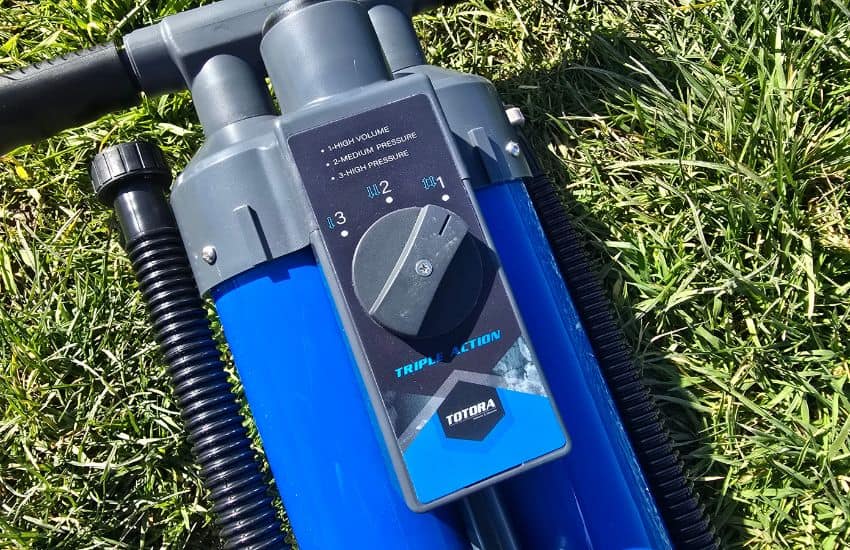
Recently, I got my hands on the Wave Pro 3.0, which comes with a triple-action pump. It’s not something you see often, but the difference is immediately noticeable. Being able to move more air with each stroke takes a lot of the effort out of the process and gets your paddleboard up to pressure noticeably faster. If you’ve only ever used a standard dual-action pump, this feels like a serious step up in efficiency.
Want to learn how to pump up you SUP faster (and with less effort)? See my guide to using a dual-action pump efficiently.
The Case for a Hand Pump
The obvious advantage is simplicity. There’s no battery to charge, no power socket needed. If you’re travelling — hiking to a remote river, for example — a hand pump is the only practical choice. They’re also significantly cheaper, and the one bundled with many entry-level boards is often good enough to get the job done.
For occasional paddling — say, a couple of times a month on a sunny weekend — a dual-action hand pump is perfectly adequate. You’ll be breathing a bit harder at the end, but most healthy adults can inflate a SUP to 15 PSI in 10–15 minutes.
Another often overlooked benefit is how quiet they are. Unlike electric pumps, which can be surprisingly loud, a hand pump lets you inflate your board without drawing attention. If you’re heading out for an early morning sunrise session, it’s a much better option — you won’t wake people nearby or disturb wildlife while everything’s still calm and peaceful.

The Downsides
Hand pumping to 18–20 PSI is genuinely hard work. The last few PSI, where the pump resistance spikes, can leave you exhausted before you’ve even reached the water. If you’re paddling with kids or a partner, watching them struggle with the pump for 15 minutes before every session gets old quickly.
The other limitation is accuracy. Analogue gauges on cheaper pumps can be inconsistent — you think you’re at 15 PSI and you’re actually at 12. It’s worth investing a few more pounds in a pump with a decent gauge.
Best Hand Pumps UK
Wave Triple-Action Hand Pump — £85
A more advanced option that stands out from standard dual-action pumps. It uses a dual-chamber setup with a 3-stage valve, so you can adjust how it works as pressure builds. You start in high-volume mode to shape the board quickly, then switch modes to make those final PSI much easier to reach. It’s noticeably quicker overall — especially on larger boards — and takes some of the strain out of getting up to 20+ PSI.
Red Paddle Co Titan Pump — £90 This is the hand pump that comes with Red Paddle Co boards, and it’s one of the best single-action hand pump on the market. The Titan reaches 20 PSI without destroying you, thanks to a wide barrel that moves large volumes of air. The gauge is clear and accurate. If you’re already getting a Red Paddle board, you’ve already got one of the best pumps available — but it’s also worth buying separately if you’re upgrading.
Decathlon Dual-Action SUP Pump — £25
Not the most impressive in terms of specs, but hard to beat on price. This is about as budget-friendly as it gets, and it’ll still get the job done for casual paddlers. It’s best suited to lower pressures or occasional use, but if you just need something simple and affordable, it’s a solid pick.
Electric SUP Pumps: Are They Worth the Money?
How They Work
Electric pumps connect either to your car’s 12V socket (cigarette lighter port) or to a rechargeable battery, and inflate your board automatically with zero effort. You set your target PSI, attach the hose, and walk away. Most quality electric pumps auto-stop at the target pressure and won’t overinflate.
The Case for Going Electric
If you paddle regularly, an electric pump pays for itself quickly in time and energy saved. On a typical electric pump, a 10’6″ SUP is ready to go in around 10 minutes while you’re getting your wetsuit on and loading the car. That’s the same time a hand pump takes — but without the effort.
The auto-stop and digital PSI display are significant improvements over hand pumps. You know exactly where you are, and the pump handles the final high-resistance PSI stage automatically. For anyone who wants their board at 18–20 PSI consistently, an electric pump makes it genuinely effortless.
They’re also a real quality-of-life upgrade when you’re paddling with other people or inflating multiple boards. Pumping up two boards by hand on a warm day is a workout you probably didn’t plan for.

The Downsides
The main limitations are battery life and dependency on power. Most electric pumps have a lithium battery that handles two or three full inflations per charge — enough for most sessions, but worth keeping topped up. If your battery is flat when you arrive at the water, you’ll be wishing you’d kept your hand pump in the car (which I’d always recommend as a backup regardless).
Electric pumps are also bulkier and heavier than hand pumps, and the cost is higher. But for most paddlers who use their board more than a few times a season, the investment is very easy to justify.
Best Electric SUP Pumps UK

Outdoor Master Shark 3 – £160: The Shark 3 is a dual-stage wireless electric pump which I’d recommend to most paddlers. It’s ridiculously quick (around 3-5 minutes for a full inflation to 15 PSI). It features an active cooling system, 8 nozzles, auto shut-off, a deflation function, plus doubles as a powerbank to charge your phone. It runs from a rechargeable battery pack or can fall back to a 12V car socket. At around £160 (save 15% off with the code STEVE), it’s on the pricier side, but a well worth investment in my experience.
Read my full review of the Outdoor Master Shark 3 here
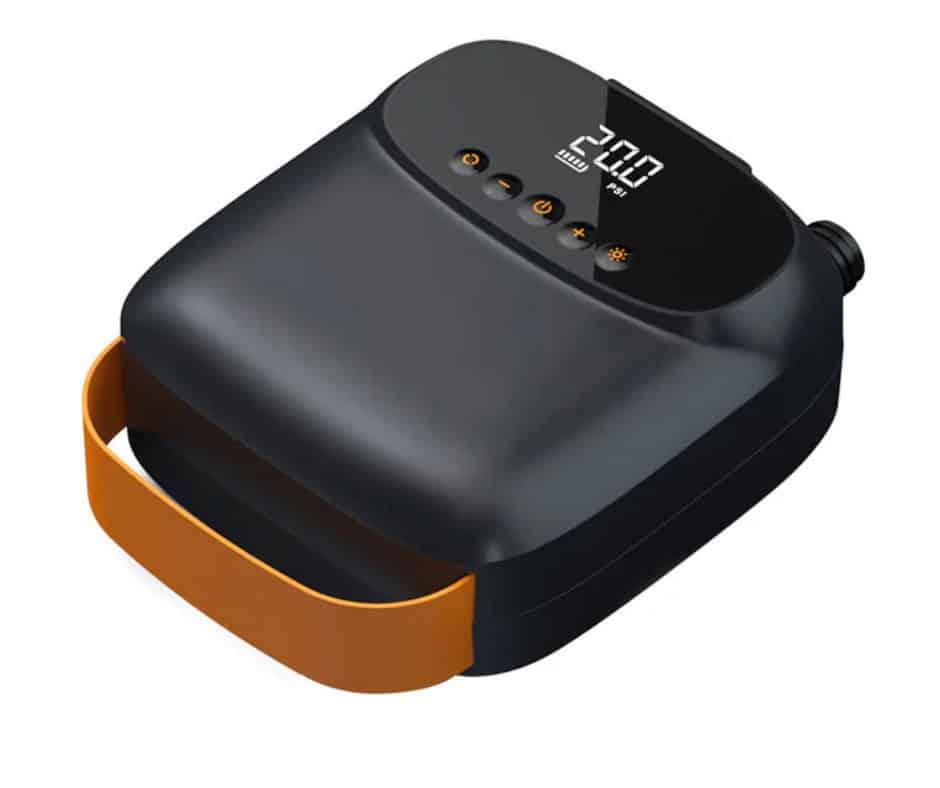
Wave Electric Pump | 20PSI — £120 A straightforward, no-frills electric pump that does exactly what most paddlers need. It runs off a 12V car socket and uses a dual-stage system to inflate boards up to 20 PSI in around 8–12 minutes, with a clear digital display and auto shut-off for hassle-free use. Build quality is solid, and while it lacks premium extras like cooling systems or multi-board support, it’s a dependable option that delivers consistent performance.
You can also get 10% off via this link, which makes it even better value.
Bluefin E-Swift Lite Electric Pump — £130 Good value at the lower end of the electric range. Works reliably to 15 PSI and has a serviceable digital display. Some users have reported inconsistency at higher PSI over time, which is why I’d lean toward the Outdoor Master Shark Pro at a similar price point. But if you’ve got a Bluefin board and want a matched setup, it’s a reasonable choice.
Want to learn more about the Bluefin E-Swift Lite? You can read my full review here.
If you want to explore more options, check out my full guide to the best electric SUP pumps for a complete breakdown of top picks and what to look for.
Electric vs Hand Pump: Which Should You Buy?
Here’s how I’d decide:
Buy an electric pump if:
- You paddle more than once a week
- You want to inflate to 18–20 PSI without effort
- You paddle with other people or inflate multiple boards
- You don’t want to arrive at the water tired before you’ve started
Stick with a hand pump if:
- You paddle occasionally (a few times a season)
- You’re already happy with the pump that came with your board
- You travel with your kit and want to keep things light
- Budget is tight — a good dual-action hand pump does the job
My honest take: most paddlers who get seriously into SUP end up buying an electric pump eventually. If you can stretch to £90–£100 upfront, the Outdoor Master Shark Pro is the one I’d go for. If you’d rather save the money and stick with a hand pump, invest in a decent dual-action option with a reliable gauge — the Red Paddle Co Titan is the benchmark.
The Bottom Line on Electric vs Hand Pumps
A good pump makes paddleboarding easier, and your board performs better. Most paddlers under-inflate their boards without realising it, and that single change — getting to a consistent 15–18 PSI — can transform how a board handles.
If you’re just getting started, the dual-action hand pump that came with your board is probably fine. But if you’re paddling regularly and want to make your sessions genuinely easier, an electric pump like the Outdoor Master Shark 3 is worth every penny.
Electric vs Hand Pump FAQs
Related Guides & Reviews
The resources below cover the basics, common questions, and related kit to help you get more out of your time on the water.
- Wave Pro 3.0 Paddleboard (SUP) Review
- Wave Tourer SUP Review | New and Improved 3.0 Model
- How To Paddle Board: Complete SUP Guide for Beginners
- Best Budget Paddle Boards in the UK
- Best Paddle Board Accessories: Best SUP Gear
- 19 Things I Wish I Knew When I Started Paddleboarding
All images courtesy of their respective brands • All Rights Reserved.

Steve Cleverdon
Adventure-driven outdoor gear reviewer and paddleboarder, Steve has spent 20 years exploring rivers, coastlines, and trails across Britain and abroad, sharing what he’s learned along the way. Learn more about Steve or get in touch.