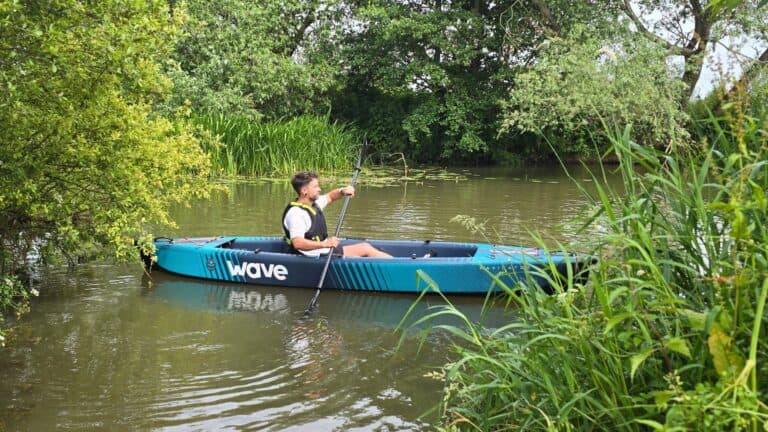
Both the Wave Navigator 3.0 and the Wave Trailblazer 3.0 are Drop-Stitch inflatable kayaks from the same brand, available in the same three sizes, and pitched at broadly the same price point. On paper, they can look almost interchangeable — two high-pressure inflatables from a brand with a strong reputation. In practice, they’re built for quite different jobs.
This Navigator vs Trailblazer comparison breaks down the key differences between the two, what each one does better, and which one makes sense for your kind of paddling.
Thanks for your support – I may earn a small commission from affiliate links in this article Learn more
Wave kindly gifted the Navigator and the Trailblazer for review. All opinions are my own.
At a Glance
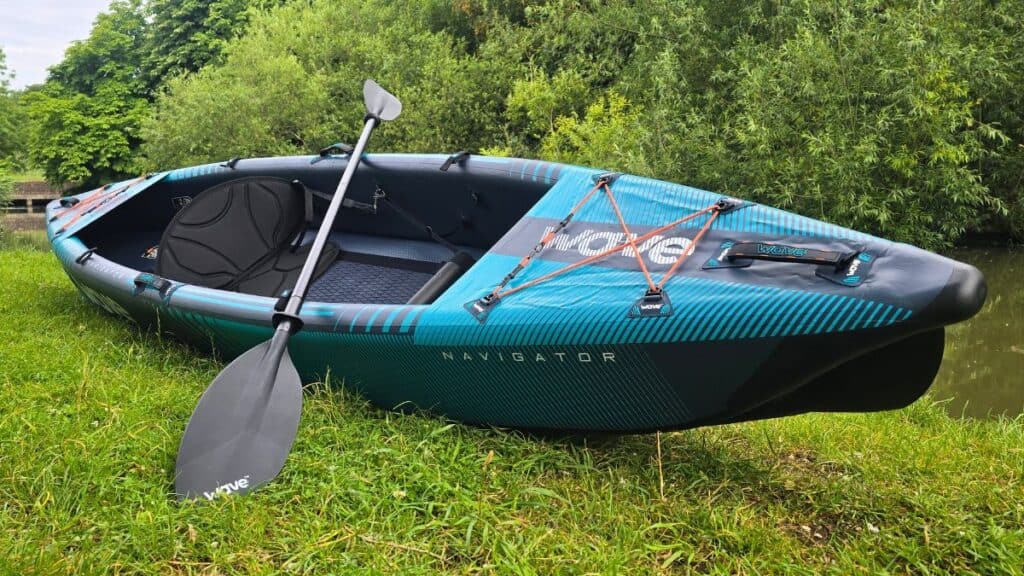
Wave Navigator 3.0 — built for flat-water performance and distance. A three-chamber Drop-Stitch hull with a solid V-shape bow and stern, designed to hold a straight line and cover ground efficiently. Best suited to intermediate paddlers who want a kayak that behaves more like a hard-shell than an inflatable.
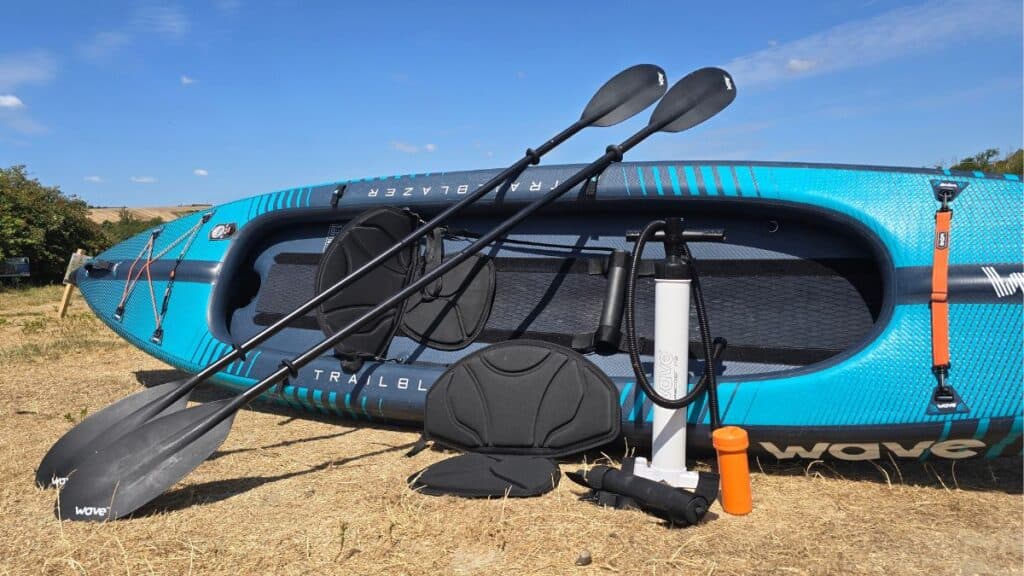
Wave Trailblazer 3.0 — built for stability and load-carrying. A wider, deeper two-chamber Drop-Stitch hull that prioritises confidence and comfort over outright speed, making it the better choice for beginners, families, and anyone paddling with passengers.
What Sets These Two Apart
Hull shape is the fundamental difference
The Navigator has a V-shape bow and stern, and those are solid sections — not inflatable chambers. They’re designed to cut through the water and hold a tracking line, which makes a real difference once you’re out on flat water and trying to cover ground without constant correction. The Trailblazer uses a wider, deeper hull without that V-shape, which sacrifices some speed in exchange for a noticeably more stable, forgiving platform.
Chamber configuration
The Navigator inflates across three separate chambers — a floor at 10 PSI and two side walls each at 15 PSI. The Trailblazer uses two chambers — a Drop-Stitch floor at 10 PSI and a single side chamber. The Navigator’s triple-chamber setup gives the walls more rigidity and provides an extra safety margin: a puncture to one chamber doesn’t compromise the whole kayak.
Width and depth
The Trailblazer is wider (84cm vs 80–82cm on the Navigator) and significantly deeper (42cm vs 35cm). That extra depth and width is what gives it the stability that makes it such a natural fit for family paddling or beginners. The Navigator’s narrower profile is part of what makes it track and paddle more efficiently.
Fins
The Navigator comes with two quick-clip fins; the Trailblazer comes with one. That second fin on the Navigator contributes to its tracking performance — particularly noticeable once you stop paddling and the kayak needs to hold a line on its own.
Target paddler
Wave positions the Navigator for intermediate paddlers wanting performance on lakes, rivers, and coastal water. The Trailblazer is aimed squarely at beginners, families, and recreational paddlers wanting a stable boat for calm conditions.
Wave Navigator vs Trailblazer: Quick Comparison
| Wave Navigator 3.0 | Wave Trailblazer 3.0 | |
|---|---|---|
| Price (from) | £410 (1-seater) | £379.99 (1-seater) |
| Price (2-seater) | £430 | £399.99 |
| Price (3-seater) | £500 | £449.99 |
| Width | 80–82cm | 84cm |
| Depth | 35cm | 42cm |
| Air Chambers | 3 (floor + 2 side walls) | 2 (floor + side chamber) |
| Max PSI | 15 PSI (walls) / 10 PSI (floor) | 10 PSI (floor + side) |
| Weight (2-seater) | 16.8kg | 16–17kg |
| Max Capacity (2-seater) | 220kg | 220kg |
| Fins | 2 (clip-in) | 1 (clip-in) |
| Hull Shape | V-shape bow and stern | Wide, flat-bottomed |
| Warranty | 2 years | 2 years |
| Best For | Flat-water touring, intermediate paddlers | Families, beginners, recreational paddling |
Wave Navigator 3.0
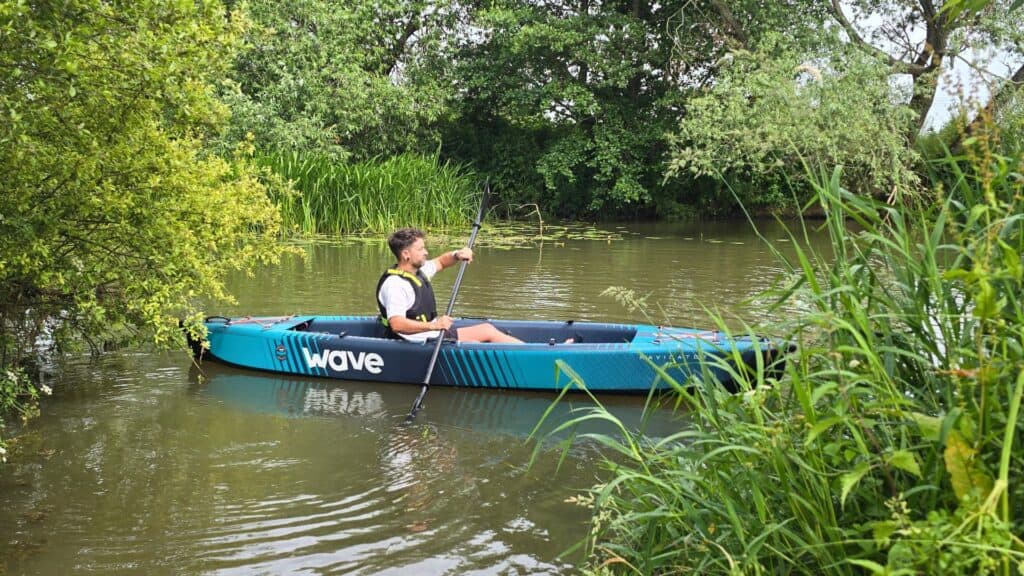
Best For: Intermediate paddlers who want flat-water performance — clean tracking, efficient paddling, and a hull that behaves more like a traditional kayak.
Wave Navigator 3.0 — £410 (1-seater) / £430 (2-seater) / £500 (3-seater)
Key Benefits:
- Three-chamber Drop-Stitch construction for rigidity and safety margin
- Solid V-shape bow and stern for clean tracking on flat water
- Two quick-clip fins for improved directional stability
- Full kit included: paddle, pump, fins, seat, footrest, repair kit, backpack
- Reinforced cargo areas front and rear
- Available in 1, 2, or 3-seater in two colourways
The Navigator’s defining feature isn’t the spec sheet — it’s the solid V-shape bow and stern. Unlike the rest of the kayak, those sections aren’t inflatable; they’re fixed rigid components, and they make a tangible difference on the water. On the water, the Navigator tracked cleanly with minimal correction even when a cross-breeze caught it side-on, and two hours of paddling felt close to effortless. That’s not typical for an inflatable kayak, and it’s almost entirely down to hull design.
The three-chamber setup also deserves a mention. With the side walls each inflating to 15 PSI independently of the floor, the Navigator feels notably rigid once fully inflated — closer to a hard-shell than most inflatables. It also means a puncture to one chamber doesn’t leave you stranded, which matters on any longer trip away from shore.
The kit is complete and well put together. Velcro paddle storage on the side of the kayak, a drainage hole, quick-clip fins, and storage running both inside and outside the kayak front and rear — the only real frustration is the bag, which is large and has no wheels. For anything more than a short walk to the water, a trolley is worth considering.
Pros:
- Tracks cleanly and efficiently — holds a line without constant correction
- Solid V-shape hull sections that never change shape once inflated
- Three-chamber safety construction
- Lots of storage options for longer outings
Cons:
- A step up from beginner-friendly — there is an initial wobble if you’re coming from paddleboarding or have no kayak experience
- Large carry bag with no wheels
Wave Trailblazer 3.0

Best For: Beginners, families, and recreational paddlers who want a stable, confidence-inspiring inflatable kayak for calm rivers, estuaries, and sheltered coastal water.
Wave Trailblazer 3.0 — £379.99 (1-seater) / £399.99 (2-seater) / £449.99 (3-seater)
Key Benefits:
- Wide, deep Drop-Stitch hull built for stability and load-carrying
- Two separate air chambers for safety margin and hull rigidity
- Adjustable Velcro seating and footrests for two paddlers of different heights
- Full kit included in one bag
- Front and rear cargo bungees with integrated bottle holder
- Drain plug at the rear for easy clean-up
The Trailblazer’s wide, deep hull makes it a different paddling experience to the Navigator — more forgiving, more planted, and much more confidence-inspiring for anyone who isn’t yet comfortable in a kayak. Out on the water, the Trailblazer never felt unstable — even with a second person shifting their weight around and stopping and starting with the paddle.
At 84cm wide and 42cm deep, it’s noticeably more spacious than the Navigator, and that extra volume is what gives it the load-carrying capability to comfortably take two paddlers along with a day’s worth of gear. The D-rings and Velcro strips along the floor make seating adjustment simple for two people of different heights.
The kit is practical and complete — the same dual-action pump, paddles, and carry backpack you’d expect from Wave at this price. The bungee cargo points at front and rear are well placed for day-trip gear, and the front strap includes a loop for a water bottle within easy reach. The bag is, like the Navigator’s, on the large side and doesn’t have wheels — park close to the water wherever possible.
Pros:
- Wide hull provides great stability
- Beginner-friendly and ideal for paddling with children
- Full kit included
- Practical cargo storage layout including bottle holder
Cons:
- Only one fin — a second would improve solo tracking
- Large carry bag with no wheels
Head-to-Head Breakdown
Build Quality
Both kayaks use Drop-Stitch construction and share the same 1000D military-grade PVC that Wave uses across their performance range, so there’s no gap in build quality between the two. The Navigator has the added structural detail of solid (non-inflatable) bow and stern sections, which means that part of the hull is always a consistent shape rather than depending on air pressure. The Trailblazer’s twin-chamber build is still rigid and well-engineered — it just doesn’t have those fixed hull sections.
Winner: Draw — both are well-built. The Navigator has a slight edge in hull engineering; the Trailblazer has a twin-chamber safety design that performs a similar function differently.
Hull Design and Performance
The Navigator’s V-shape bow and stern give it a clear advantage on the water for anyone trying to cover ground efficiently. It cuts through chop, holds a straighter line between paddle strokes, and requires less correction in a cross-breeze. The Trailblazer’s flatter, wider hull doesn’t have that efficiency — it’s built to be stable rather than fast, and you’ll notice the difference over any real distance.
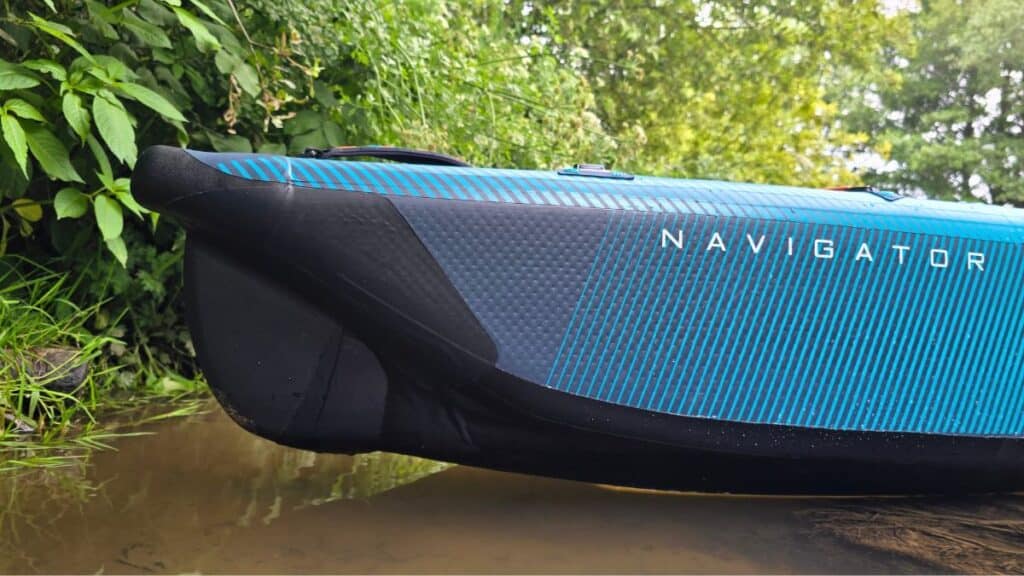
Winner: Navigator — if paddling performance matters to you, it’s not close.
Stability
The Trailblazer’s wider, deeper hull is far more forgiving on initial entry and during the paddle. A second paddler shifting around in the Trailblazer caused no concern at all. The Navigator does settle down once you’re underway, but there’s a period of adjustment coming from paddleboarding or without prior kayak experience.
Winner: Trailblazer — noticeably more stable for families and beginners.
Tracking
The Navigator’s two fins and solid bow and stern give it a clear tracking advantage. Out on the river, it held its line through a cross-breeze with minimal input. The Trailblazer’s single fin does a reasonable job, but when I lost it during a solo session at Cuckmere Haven, the bow kept swinging around whenever I stopped paddling — which tells you the fin is doing real work. Even with the fin back in, it takes more active paddling to hold a course compared to the Navigator.
Winner: Navigator — two fins and the V-bow make a real, noticeable difference to tracking.
Storage
The Navigator edges ahead on raw storage. It has cargo areas at both the front and back, both inside the kayak and on top under bungee cords, and the reinforced sections mean you can load them fully without worrying about abrasion. I carried camera gear, a tripod, dry bags, and spare clothing with room to spare. The Trailblazer has front and rear bungee cargo points plus a useful bottle holder loop up front, but the overall storage volume is a step down — still more than adequate for a day trip, though.
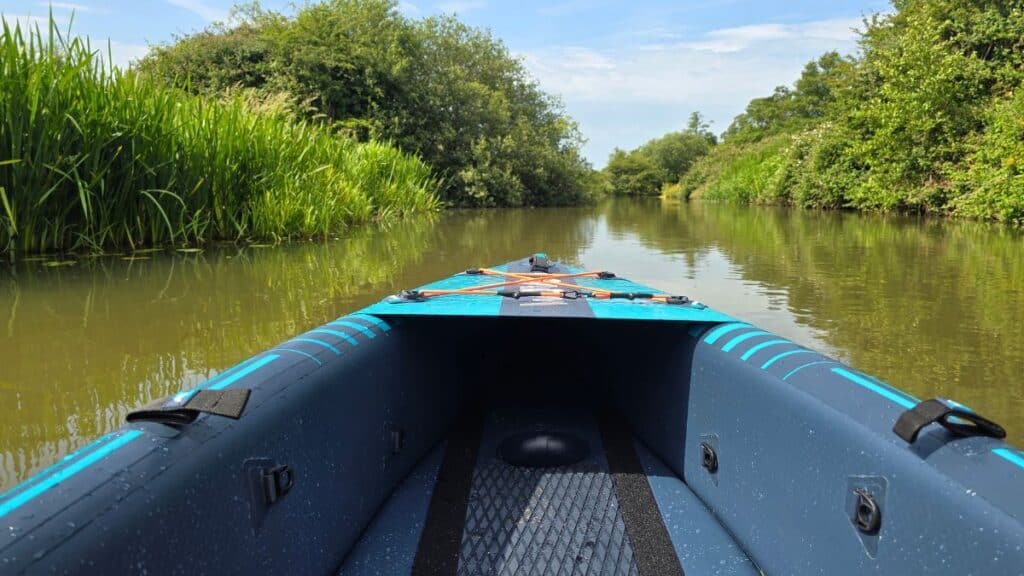
Winner: Navigator — more total storage and reinforced cargo areas.
Setup and Kit
Both kayaks come with a complete kit: double-ended paddle, dual-action pump, fins, padded seat, footrest, repair kit, and carry backpack. Neither one has a significant setup advantage — inflation time is comparable (three chambers on the Navigator versus two on the Trailblazer, but they’re similar volumes), and seat installation on both follows the same Velcro-on-the-EVA-deck approach. An electric pump makes either kayak quick to inflate.
Winner: Draw — both come with everything you need and set up in a similar timeframe.
Portability
Both have the same fundamental limitation: a large backpack-style bag with no wheels. The Trailblazer 2-seater comes in at around 16–17kg loaded; the Navigator 2-seater at 16.8kg. Both have carry handles at either end for a second person to help. Neither has a bag you’d want to haul any distance, and for either kayak a small trolley is worth considering if you can’t park near the water.
Winner: Draw — both have the same portability limitation.
Value for Money
The Trailblazer runs slightly cheaper across all three sizes (£379.99–£449.99 vs £410–£500 for the Navigator). For what you’re getting with the Trailblazer — a rigid Drop-Stitch hull and complete kit at under £400 for the 2-seater — the value is strong. The Navigator commands a small premium, and given the V-bow, three chambers, and second fin, that premium is justified for anyone who’ll actually use the performance. For a recreational paddler or family buyer who wants stability over speed, paying more for the Navigator’s hull engineering isn’t a priority.
Winner: Trailblazer — slightly better value for recreational and family use. The Navigator is worth the extra cost for performance-focused paddlers.
Which Should You Buy?
Both kayaks are well-made, well-kitted, and represent genuinely good value at their respective price points. The choice comes down to what kind of paddling you’re actually planning to do.
Buy the Navigator if you want to cover distance on flat water, you’re a confident paddler or have a bit of experience, and you want a kayak that tracks and handles efficiently rather than just floating in the right direction. It’s the better kayak for solo touring, river paddling, or anyone who gets frustrated by an inflatable that wanders off-course the moment you stop paddling.
Buy the Trailblazer if you’re paddling with kids or a beginner, you want the most stable inflatable in Wave’s range, or you’re new to kayaking and want a boat that’s forgiving rather than demanding. It handles recreational conditions — calm rivers, estuaries, sheltered coastal water — with confidence and without the wobble.
If you’re genuinely unsure which way you lean, consider where you’ll be paddling and who with. If the answer is ‘on a quiet river or estuary, usually with someone else, for a few hours at a time’ — the Trailblazer suits that exactly. If it’s ‘on flat water, solo or with an experienced partner, trying to actually get somewhere’ — the Navigator is the right call.
Navigator vs Trailblazer FAQs
What is the main difference between the Wave Navigator and the Trailblazer?
The Navigator has a V-shape hull with solid bow and stern sections designed for tracking and flat-water performance, while the Trailblazer has a wider, deeper hull built for stability and load-carrying. The Navigator suits intermediate paddlers covering distance; the Trailblazer suits beginners, families, and recreational use on calm water.
Which is more stable — the Navigator or the Trailblazer?
The Trailblazer. Its 84cm width and 42cm depth make it the more forgiving of the two, and it was designed specifically to be confidence-inspiring on the water. The Navigator settles down once you’re paddling, but the Trailblazer is the clear choice if stability is the priority.
Which tracks better — the Navigator or the Trailblazer?
The Navigator. The solid V-shape bow and stern, combined with two quick-clip fins, give it a clear advantage in holding a straight line. The Trailblazer’s single fin works well but requires more active paddling to stay on course, particularly in any kind of crosswind.
Is the Wave Trailblazer good for beginners?
Yes — it’s the better beginner option of the two. The wide, stable hull is immediately forgiving, the kit is complete, and it doesn’t demand the same level of technique the Navigator does. A complete beginner would have a much more comfortable first session in the Trailblazer.
Can both kayaks be used on the sea?
Both are designed for lakes, rivers, and sheltered coastal water — not open-sea conditions. The Navigator’s tracking performance makes it the more capable option in any light chop, but neither is built for open-water or conditions that go beyond sheltered coastal paddling.
Are the Navigator and Trailblazer the same price?
The Trailblazer is slightly cheaper across all sizes: from £379.99 (1-seater) to £449.99 (3-seater), compared to £410–£500 for the Navigator. The price difference reflects the Navigator’s additional hull engineering — V-bow, three chambers, and two fins — rather than any difference in overall build quality.
What warranty do both kayaks come with?
Both carry Wave’s standard 2-year manufacturer warranty.
Which should I buy if I want to paddle with my kids?
The Trailblazer. It’s the more stable of the two, handles extra movement from a second paddler without any concern, and the price is lower. The 2-seater at £399.99 is the natural pick for paddling with one other person; the 3-seater covers an extra passenger or more gear.
Related Guides & Reviews
The resources below cover the basics, common questions, and related kit to help you get more out of your time on the water.
- How To Paddle Board: Complete SUP Guide for Beginners
- Best Budget Paddle Boards in the UK
- Best Paddle Board Accessories: Best SUP Gear
- Wave Paddle Boards Compared: Complete Guide to Every Wave 3.0 SUP
- Best Electric Pump for Paddle Boards: 6 Top Picks

Steve Cleverdon
Adventure-driven outdoor gear reviewer and paddleboarder, Steve has spent 20 years exploring rivers, coastlines, and trails across Britain and abroad, sharing what he’s learned along the way. Learn more about Steve or get in touch.