Inflatable kayaks have come a long way. The cheap blow-up kayaks of five years ago — floppy, slow, and barely controllable in a crosswind — are a different category entirely from what’s available now. Drop-stitch construction, high-pressure chambers, and proper kayak shaping mean the best inflatable kayaks in 2026 genuinely perform on the water rather than just floating on it.
This guide covers the 7 best inflatable kayaks available in the UK right now, from beginner-friendly family picks at under £250 to high-performance drop-stitch models for paddlers who want to cover distance.
Before the list, there’s a quick buyer’s guide covering what to look for, a side-by-side comparison table, and a note on the kayaks worth avoiding.
Thanks for your support – I may earn a small commission from affiliate links in this article Learn more
What to Look for in an Inflatable Kayak
Drop-stitch vs standard PVC
This is the most important buying decision at the under-£500 price point. Standard PVC kayaks use inflatable tube sides and a softer floor — fine for calm lakes on a warm day, but they flex under load and feel spongy compared to a hard-shell. Drop-stitch construction uses thousands of internal threads under high pressure, producing a rigid floor and hull that performs much closer to a rigid kayak. If you plan to paddle regularly or cover any real distance, buy drop-stitch. Every kayak on this list uses drop-stitch construction or hybrid drop-stitch floors.
If you’re also considering a paddleboard as an alternative, my best budget paddle boards UK guide covers the key construction differences in more detail.
Solo vs tandem
Solo kayaks (1–2 person) are lighter, more manoeuvrable, and easier to manage alone. Tandem kayaks (2–3 person) carry more capacity and are better for families or paddlers who want to share the experience, but they need two people to paddle efficiently and are heavier to carry. Some tandem kayaks can be paddled solo, but they handle awkwardly without a second paddler to balance the weight.
PSI rating
PSI (pounds per square inch) is the best proxy for rigidity. Standard PVC kayaks inflate to 1.5–3 PSI — noticeably soft on the water. Drop-stitch floors inflate to 8–15 PSI, which is where the rigid feel comes from. For flat-water touring, 10+ PSI is the threshold to aim for.
Weight capacity and paddler weight
Most kayaks list a maximum capacity that sounds generous, but loading a kayak to its maximum capacity affects performance significantly. A good rule: add up paddler weight plus gear, then look for a kayak rated at least 20% above that figure. If you’re paddling solo on a tandem, position yourself centrally rather than in the rear seat, or the nose will sit high in the water.
Warranty and UK support
A 2-year warranty is the minimum. 5 years (Bluefin) is the current gold standard. Decathlon kayaks are backed by their in-store returns and repair service, which is genuinely useful. Generic Amazon brands often list warranties that become irrelevant when the seller disappears.
Quick Comparison Table
| Kayak | Price | Paddlers | Length | Weight | Max Capacity | Construction | Warranty | Best For |
|---|---|---|---|---|---|---|---|---|
| Wave Navigator 3.0 | From £349 | 1–2 or 2–3 | 420cm | 16.8kg | 220kg | Drop-stitch, 15 PSI | 2 years | Best overall |
| Wave Trailblazer 3.0 | From £379 | 1–2 | 426cm | 16.5kg | 220kg | Drop-stitch, reinforced | 2 years | Adventure & rough terrain |
| Aquaplanet Two-Person | £379 | 1–2 | 330cm | 14kg | 160kg | Triple chamber PVC, 1.5 PSI | 1 year | Beginners & Families |
| Decathlon 100+ | £299 | 1–3 | 365–410cm | 16–18kg | 195–245kg | Drop-stitch floor, 5 PSI | 2 years | Budget family pick |
| Aqua Marina Tomahawk | £559 | 1–3 | 440cm | 20kg | 210kg | Full drop-stitch | 1 year | Performance paddlers |
| Wave Voyager | £239 | 1–2 | 340cm | 15.2kg | 190kg | Drop-stitch | 2 years | Budget entry |
| Spinera Supkayak | £490 | 1 | 305cm | 10kg | 115kg | Full drop-stitch | 1 year | SUP/kayak hybrid |
Kayaks to Avoid
The inflatable kayak market has a well-populated cheap end that looks appealing on paper and disappoints on the water. The warning signs are consistent: brand names you’ve never heard of, no PSI rating listed, vague references to “military-grade PVC” with no supporting detail, warranties measured in months, and no UK contact address.
The common failure mode is flex in the floor — standard PVC without a drop-stitch base softens under load, which means the kayak bends in the middle and becomes hard to track straight. In flat calm conditions, you’ll probably get away with it. In any wind or chop, you’ll spend your time fighting the boat rather than paddling it.
Specific brands to skip: Intex Challenger K2, Sevylor Tahiti, and similar supermarket-aisle inflatables. They’re not kayaks in any meaningful performance sense — they’re floating platforms. The Sevylor Tahiti inflates to just 1.1 PSI, which tells you everything you need to know.
If budget is tight, the Wave Voyager at around £239 is the lowest price point I’d recommend from a brand with real UK support and drop-stitch construction. Below that, buy secondhand from a known brand rather than new from a generic seller.
Wave Navigator 3.0 — Best Overall
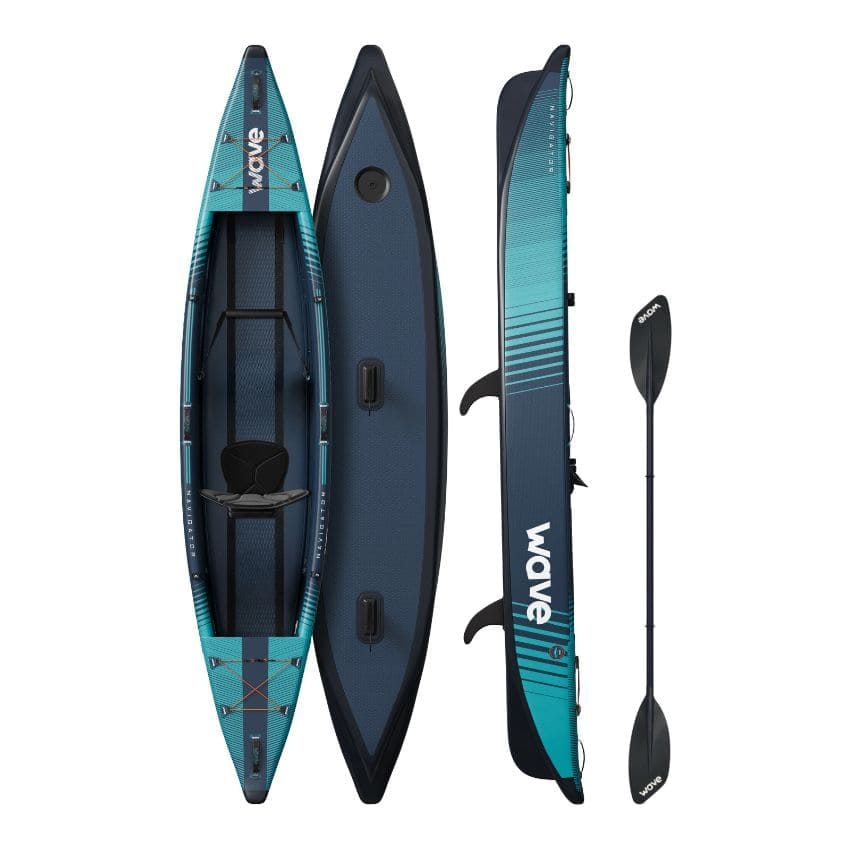
Best for: Solo and tandem paddlers wanting a high-performance drop-stitch kayak with a complete kit included
| Spec | Detail |
|---|---|
| Paddlers | 1–2 (2-seater) or 2–3 (3-seater) |
| Length | 420cm (2-seater) |
| Weight | 16.8kg (2-seater) |
| Max Capacity | 220kg (2-seater) |
| PSI | 15 PSI |
| Construction | Military-grade PVC, drop-stitch core |
| Warranty | 2 year |
| What’s included | Kayak, paddles, pump, carry backpack |
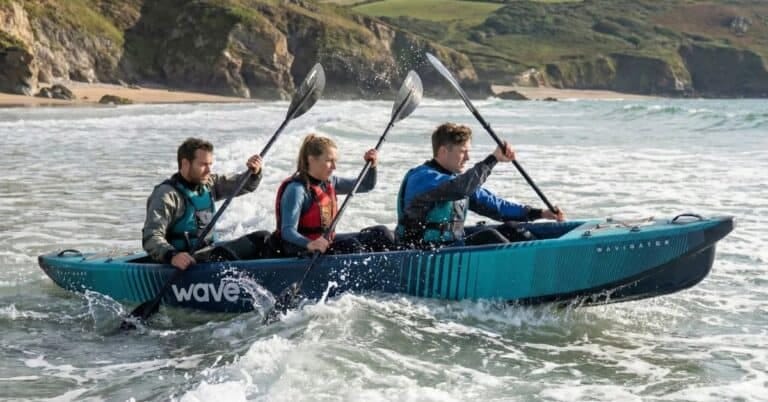
Updated for 2026 as the Navigator 3.0, Wave has refined an already strong kayak with a V-shape bow and stern designed to track straight and shed drag on longer paddles. The drop-stitch construction inflates to 15 PSI, which gives it a rigidity you simply don’t get from standard tube-sided kayaks. On the water it handles well for both solo and tandem use — stable enough for beginners, capable enough for experienced paddlers covering distance.
The kit package is comprehensive — paddles, pump, and carry backpack all included — and the backpack design makes it easy to transport from car to water without a second person. The V-shape hull design helps with tracking in crosswinds, which is one of the biggest practical advantages over cheaper alternatives.
Pros:
- Drop-stitch construction at 15 PSI — genuinely rigid on the water
- V-shape hull tracks well in crosswinds
- Complete kit included including paddles and pump
- Available in 1–2 and 2–3 seater versions
Cons:
- Heavier than some solo alternatives at 16.8kg
Wave make several kayak models at different price points and performance levels. If you’re specifically weighing up the range, my Wave kayaks comparison guide covers each model side by side.
Wave Trailblazer 3.0 — Best for Adventure & Rough Terrain
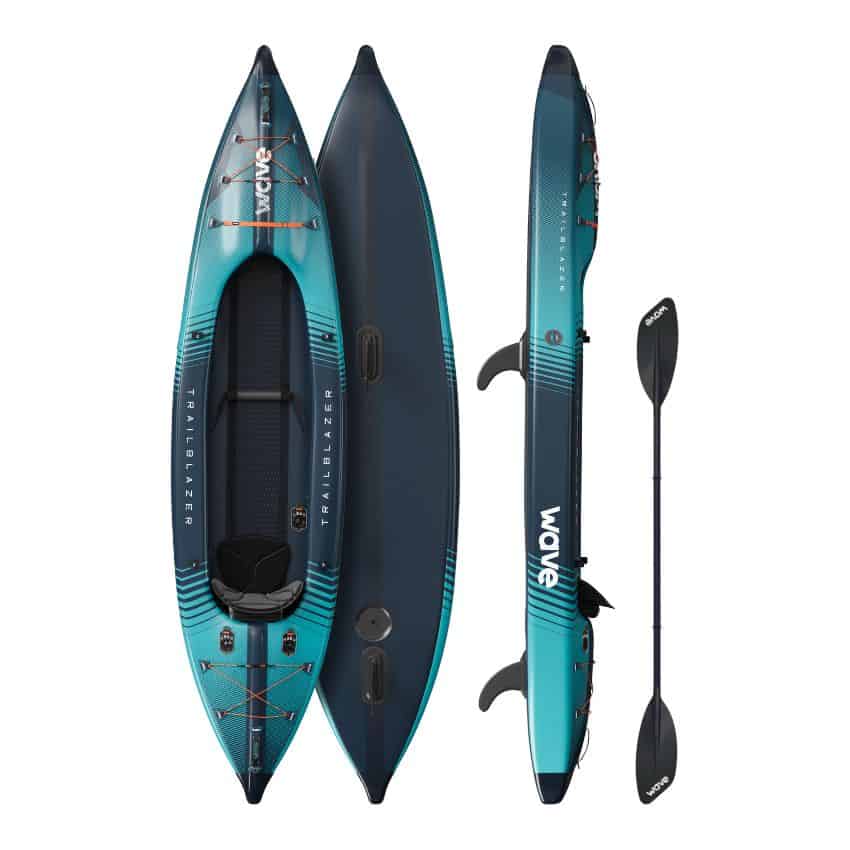
Best for: Paddlers who want to go beyond flat water — rocky launches, shallow rivers, and more demanding conditions
| Spec | Detail |
|---|---|
| Paddlers | 1–2 |
| Length | 426cm (2-seater) |
| Weight | 16.5kg (2-seater) |
| Max Capacity | 220kg (2-seater) |
| Construction | High-density drop-stitch, reinforced puncture-resistant hull |
| PSI | 15 PSI |
| Warranty | 2 years |
| What’s included | Kayak, paddles, pump, carry backpack |
The Trailblazer 3.0 is a different beast from the Navigator — where the Navigator is built for speed and efficiency on flat water, the Trailblazer is built to take punishment. The high-density reinforced hull is designed specifically for rocky riverbanks, shallow launches, and conditions where a standard inflatable would make you hesitate. That’s a meaningful distinction if you’re planning to paddle anywhere other than a calm lake. There’s more detail in my Wave Trailblazer 3.0 review.
The aggressive rocker line and tracking skeg keep it manoeuvrable in moving water while maintaining a straight line on open stretches — a balance that’s hard to achieve in an inflatable at this price. The modular seating system adjusts for weight distribution, which matters more when you’re dealing with current and chop than it does on flat water. If your paddling involves rivers, coastal launches from rocky shores, or any terrain that would make you nervous with a standard inflatable, the Trailblazer is the kayak to look at.
Pros:
- Reinforced hull built for rocky launches and rough terrain
- Rocker line and tracking skeg work across flat water and moving water
- Modular seating for weight distribution in demanding conditions
- Complete kit included
Cons:
- New 2026 model — limited owner reviews available yet
- Not necessary if you’re only paddling flat calm water
Aquaplanet Two-Person Kayak — Best for Beginners & Families

Best for: Families and beginners wanting a straightforward kayak from a trusted UK brand
| Spec | Detail |
|---|---|
| Paddlers | 1–2 |
| Length | 330cm (10’10”) |
| Width | 96cm (38″) |
| Weight | 14kg (full kit) |
| Max Capacity | 160kg |
| PSI | 1.5 PSI |
| Construction | Triple chamber PVC, polyester outer shell |
| What’s included | Kayak, aluminium paddle, pump, 2 seats, footrest, rucksack |
The Aquaplanet two-person kayak sits at the accessible end of the market — a straightforward, easy-to-use option for calm lakes, sheltered rivers, and family days on the water. The triple chamber construction adds a useful safety margin, and the polyester quick-dry outer shell is practical for UK conditions where you’re often packing away a damp kayak.
It’s worth being clear about the 1.5 PSI inflation pressure — this is standard PVC construction rather than drop-stitch, so it won’t feel as rigid underfoot as others. For occasional paddlers on flat water that’s unlikely to matter much. If you want to paddle regularly or cover any real distance, step up to a drop-stitch option. But as a first kayak for summer days out with the family, the Aquaplanet delivers solid value.
Pros:
- Affordable entry point with full kit included
- Triple chamber design adds safety redundancy
- Quick-dry polyester outer shell — practical for UK use
Cons:
- 1.5 PSI standard PVC — noticeably softer than drop-stitch alternatives
- 160kg max capacity is lower than most competitors
- One paddle included — second paddle sold separately for two-person use
Decathlon 100+ — Budget family pick

Best for: Families and beginners wanting a stable, easy-to-use kayak.
| Spec | Detail |
|---|---|
| Paddlers | 1–2 (2-person) or 1–3 (3-person) |
| Length | 365cm (2P) / 410cm (3P) |
| Weight | 16kg (2P) / 18kg (3P) |
| Max Capacity | 195kg (2P) / 245kg (3P) |
| PSI | 5 PSI floor / 3 PSI sides |
| Construction | PVC tarpaulin sides, drop-stitch floor |
| Warranty | 2 years |
| Pump included | No — sold separately |
The Decathlon 100+ sits at the family and beginner end of the market, and it does that job well. The drop-stitch floor at 5 PSI gives it noticeably more rigidity than the old ITIWIT 100 Touring range, while the wide hull and high stability make it genuinely hard to capsize — useful for paddlers nervous about their first time out.
The biggest practical advantage is Decathlon’s in-store support. If something goes wrong, you can walk it back to a Decathlon store rather than posting it to a manufacturer. That’s a genuine differentiator. The caveat is that the pump and paddles are sold separately, which adds to the real cost — budget an extra £30–£60 for Decathlon’s own pump and paddle set.
I reviewed the original ITIWIT 100 — the 100+ is a meaningful upgrade with the drop-stitch floor addition.
Pros:
- Extremely stable — one of the most tip-resistant kayaks at this price
- Drop-stitch floor for added rigidity
- Available in 2 and 3 person versions
- Decathlon in-store returns and support
Cons:
- Pump and paddles sold separately — adds to the real cost
- Lower PSI sides (3 PSI) feel softer than full drop-stitch alternatives
- Heavier than some alternatives at 16–18kg
Aqua Marina Tomahawk — Best Performance Kayak
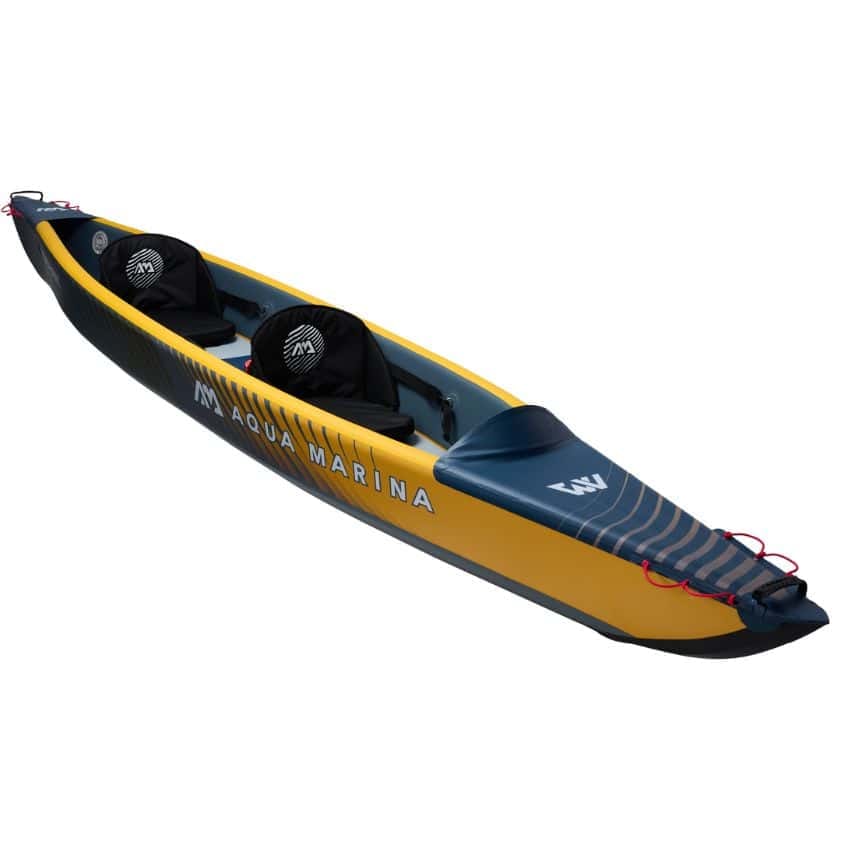
Best for: Confident paddlers who want touring performance and speed from an inflatable
| Spec | Detail |
|---|---|
| Paddlers | 1–3 (varies by model) |
| Length | 440cm (tandem) |
| Weight | 20kg (tandem) |
| Max Capacity | 210kg |
| Construction | Full drop-stitch, double-wall fabric |
| Warranty | 1 year |
| What’s included | Dual-action pump, adjustable seats, fins |
The Tomahawk is a different type of kayak from everything else on this list — it’s a performance inflatable aimed at paddlers who want to cover serious distance or upgrade from recreational kayaking without buying a hard-shell. The full drop-stitch construction inflates to high pressure across the entire hull, not just the floor, which gives it a rigidity that’s closer to a rigid kayak than any standard tube-sided inflatable.
The V-shape inflatable keel under the bow and stern is the standout feature — it improves tracking and speed, and the long waterline means it carries momentum between strokes far better than wide recreational kayaks. It’s not a beginner’s boat — at 20kg (tandem) it needs two people to carry comfortably and the initial wobble on the water takes a session or two to get used to. But for paddlers who want to cover 15+ km days or explore coastal water efficiently, it’s the strongest inflatable option at this price point.
Pros:
- Full drop-stitch construction — most rigid inflatable on this list
- V-shape keel for genuine speed and tracking
- Handles choppy water and moderate conditions well
- Available in various sizes
Cons:
- Heavy — 20–25kg needs two people to carry
- Not beginner-friendly — initial instability on the water
- One of the more expensive options on this list
Wave Voyager — Best Budget Pick
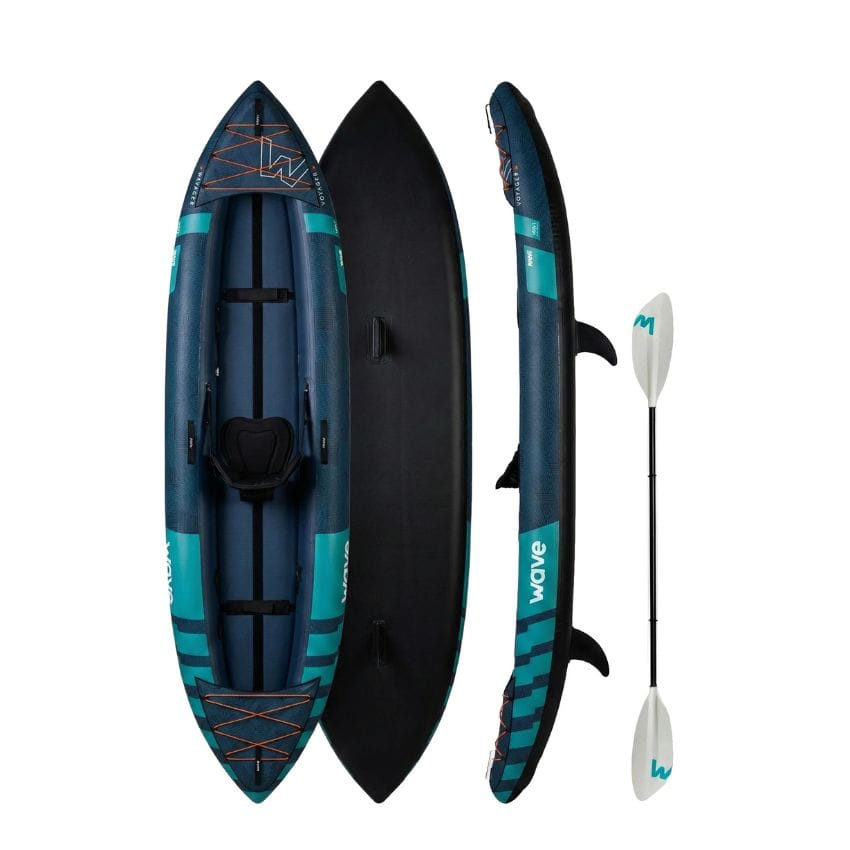
Best for: First-time buyers wanting a capable entry-level kayak from a reputable UK brand
| Spec | Detail |
|---|---|
| Price | £239 |
| Paddlers | 1–2 |
| Length | 340cm |
| Weight | 15.2kg |
| Max Capacity | 190kg |
| Construction | Drop-stitch |
| Warranty | 2 years |
| What’s included | Paddles, pump, carry backpack |
The Voyager is Wave’s entry-level kayak and the lowest price point I’d comfortably recommend to anyone. It uses drop-stitch construction, which puts it in a different performance category from the cheap tube-sided kayaks flooding Amazon at similar and lower prices. It’s stable, reasonably capable on calm water, and comes with a full kit including paddles and pump — important at the budget end where some competitors sell the kayak and accessories separately.
It’s not the kayak to buy if you want to cover serious distance or paddle in challenging conditions — for that, step up to the Navigator or Tomahawk. But as a first kayak for lakes, sheltered rivers, and occasional coastal paddling, it’s a strong entry point from a brand with genuine UK customer support.
Pros:
- Drop-stitch construction at a budget price point
- Complete kit included — paddles and pump in the box
Cons:
- 1-year warranty
- Not designed for challenging water or longer touring
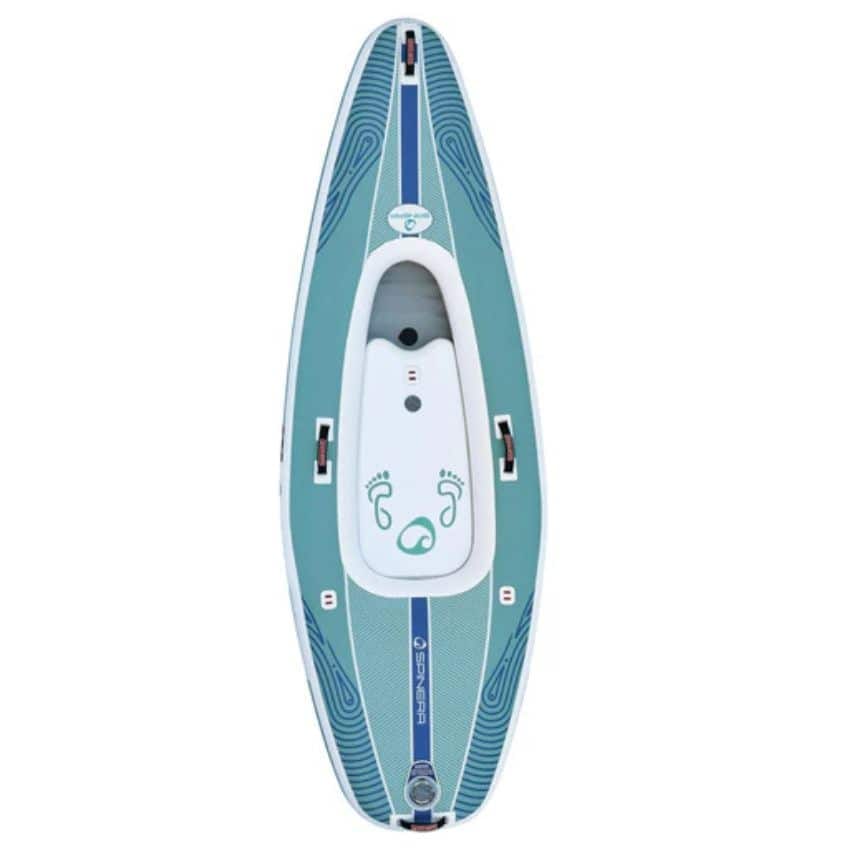
Spinera Supkayak — Best SUP/Kayak Hybrid
Best for: Paddle boarders who also want a sit-down kayaking option without buying two separate craft
| Spec | Detail |
|---|---|
| Price | £490 |
| Paddlers | 1 |
| Length | 305cm |
| Weight | 10kg |
| Max Capacity | 115kg |
| Construction | Full drop-stitch |
| Warranty | 1 Year |
| What’s included | Paddles, pump, carry backpack |
The Spinera Supkayak is a genuinely different proposition from everything else on this list — it’s a wide, stable platform that functions as both a paddleboard and a sit-down kayak. The recessed deck and attachable seat allow it to convert between modes, making it one of the most versatile watercraft at this price point. If you already paddleboard and want the option to kayak on the same outing — or want to introduce kids or less confident paddlers who’d rather sit — this is worth serious consideration.
Performance-wise, it’s not as fast or efficient as a dedicated touring kayak like the Tomahawk or X500, and the width that makes it stable as a paddleboard holds it back on longer kayak paddles. But as a crossover craft for mixed-use recreational paddling, it’s a smart buy.
If the crossover appeal interests you, take a look at my paddleboard accessories guide — a kayak conversion seat lets you do the same with most inflatable SUPs.
Pros:
- Functions as both a paddleboard and a kayak
- Full drop-stitch construction
- Excellent stability for nervous paddlers or mixed ability groups
Cons:
- Not as fast or efficient as dedicated touring kayaks
- Width is a trade-off in crosswind conditions
- Niche use case — best for buyers who genuinely want both functions
Best 2 Person Inflatable Kayak in the UK
For two adults, the Wave Trailblazer 3.0 2-seater is my pick. Its wider, deeper hull handles the extra movement of a second paddler without any concern, and the full kit means you can be on the water the same day. For beginners and families who want something lighter to carry, the Aquaplanet Two-Person is 14kg for the full kit.
Here are the two-person options in this guide:
- Wave Trailblazer 3.0 2-seater: 426cm, 16.5kg, 220kg capacity, £399.99
- Wave Navigator 3.0 2-seater: 420cm, 16.8kg, 220kg capacity, from £349, better suited to flat water and covering distance
- Aquaplanet Two-Person: 330cm (10’10”), 14kg for the full kit, 160kg capacity, £379
- Decathlon 100+ 2-person: 365cm, 16kg, 195kg capacity, £299
- Wave Voyager: 340cm, 15.2kg, 190kg capacity, £239, the cheapest here
Check the capacity against both paddlers plus kit, not just your combined body weight. A 160kg limit fills up quickly with two adults and a dry bag each.
Kayaking in the UK: What You Need to Know
Do you need a licence?
On most tidal waters in the UK — the sea, tidal rivers, and estuaries — no licence is required. On non-tidal rivers, canals, and inland waterways, access rights vary significantly. The Canal & River Trust manages most English canals and requires a watercraft licence. For rivers, access is a patchwork — some are open, many are not. Waterways for All and British Canoeing’s Go Paddling both have up-to-date access maps worth checking before you launch.
Coastal and tidal water safety
UK coastal conditions change quickly. Tides can create strong currents around headlands and estuary mouths, and offshore winds can push an inflatable kayak away from shore faster than you can paddle back. Stick to sheltered bays, check tide tables before you go, and always paddle with someone else or tell someone your plan. A buoyancy aid (not just a lifejacket) is essential.
Saltwater care
If you’re paddling in the sea, rinse your kayak with fresh water after every session. Salt accelerates corrosion on valves, metal fittings, and seam adhesive over time. Five minutes with a hose after each coastal session will extend your kayak’s life significantly.
Final Thoughts
The best inflatable kayak for most UK buyers in 2026 is the Wave Navigator 3.0 — drop-stitch construction, a complete kit, and a hull that genuinely performs across a solid range of conditions. If your paddling takes you anywhere more demanding, the Wave Trailblazer 3.0 is the natural step up, built for terrain where you’d hesitate with a standard inflatable.
For buyers on a tighter budget, the Wave Voyager at £239 is the lowest price point I’d comfortably recommend — drop-stitch construction and a 2-year warranty from a brand with real UK support puts it well clear of the generic alternatives at similar money.
Whatever you choose, avoid the temptation of cheap tube-sided kayaks that look like a bargain on paper. The difference between a 1.5 PSI standard PVC kayak and a proper drop-stitch inflatable is immediately obvious on the water — and it’s not a gap you can paddle through.
Inflatable Kayak FAQs
Are inflatable kayaks any good?
The better ones — particularly full drop-stitch models inflating to 10+ PSI — perform genuinely well on flat water and can handle moderate conditions. They’re not a substitute for a performance hard-shell on challenging water, but for lakes, calm rivers, and sheltered coastal paddling, a quality inflatable is a practical and capable choice.
How long do inflatable kayaks last
A well-maintained drop-stitch kayak from a reputable brand should last 5–10 years with regular use. The biggest risks to longevity are UV exposure (store out of direct sunlight when not in use), salt corrosion if used at sea (rinse after every session), and over-inflation in hot weather (slightly deflate if leaving in the sun).
What’s the difference between drop-stitch and standard PVC
Drop-stitch uses thousands of internal threads that hold the kayak rigid under high pressure (8–15 PSI), producing a firm, hard-feeling hull. Standard PVC tube-sided kayaks inflate to 1–3 PSI and feel noticeably softer and more flexible under load. For any regular paddling, drop-stitch is worth the extra cost.
Do I need a licence to kayak in the UK
On tidal waters (the sea, tidal rivers) generally no. On non-tidal inland waterways, it depends on the specific waterway — canals usually require a licence, rivers vary. Check Go Paddling’s waterway access map before launching somewhere new.
How do I store an inflatable kayak
Deflate fully, rinse if used in salt water, dry completely before packing away — storing wet causes mildew and accelerates seam degradation. Store in a cool, dry place out of direct sunlight. Don’t fold on the same creases every time — rotate the fold points to avoid stress cracking in the PVC.
Can I use an inflatable kayak in the sea
Yes, but choose sheltered conditions — bays, harbours, and calm coastal stretches rather than open water or headlands with tidal currents. Always check tide tables, wear a buoyancy aid, and paddle with a partner or leave a float plan with someone onshore.
Related Guides & Reviews
The resources below cover the basics, common questions, and related kit to help you get more out of your time on the water.
- Wave Tourer SUP Review | New and Improved 3.0 Model
- Wave Pro 3.0 Paddleboard (SUP) Review
- Best Paddle Board for Beginners UK: 8 Top SUPs Compared
- Aquaplanet ALLROUND 10 Review | Best Beginner SUP?
- Bluefin Cruise 10’8 Review
All images courtesy of their respective brands • All Rights Reserved.

Steve Cleverdon
Adventure-driven outdoor gear reviewer and paddleboarder, Steve has spent 20 years exploring rivers, coastlines, and trails across Britain and abroad, sharing what he’s learned along the way. Learn more about Steve or get in touch.