Bluefin has become one of the most recognised names in UK paddleboarding, and it’s not hard to see why. The boards are well built, the warranties are serious, and the full-kit packages mean you genuinely go from box to water without needing to buy anything extra.
I’ve been paddling on Bluefin gear for a few years now — the Cruise has been a regular companion on early morning sessions across Sussex, and I’ve put their accessories through their paces too, from the E-Swift Lite pump to the Dri-Tide deck bag and the 4-piece aluminium paddle. So when I say this breakdown is based on real use, I mean it.
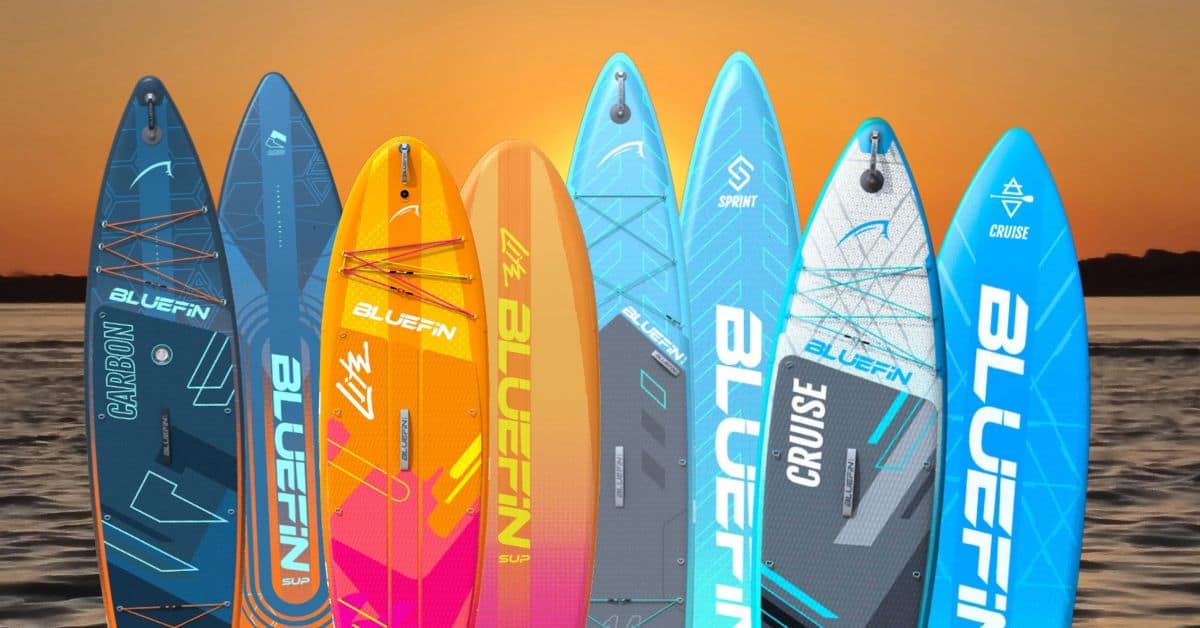
There are 8 distinct Bluefin paddle boards currently available, covering everything from budget all-rounders to tandem boards for two. This guide walks you through every one of them — what they offer, who they’re designed for, and where they sit in the range.
Thanks for your support – I may earn a small commission from affiliate links in this article Learn more
What Sets Bluefin Apart
Before getting into the boards themselves, it’s worth understanding what Bluefin actually builds differently — because the technology affects which board makes sense for you.
ESL Construction — Exo-Surface Laminate Bluefin’s current generation uses a fused multi-layer PVC process rather than traditional glued construction. The result is a lighter board with better rigidity at pressure. The new Cruise is 20% lighter than its predecessor with no reduction in durability — that’s a meaningful change for anyone lugging a board down to the water.
Dual Chamber on the Carbon Range The Carbon series adds a second air chamber as a standalone loop inside the main chamber. If the outer chamber is compromised, you stay afloat. On the water, it also adds stiffness, which you notice at speed. It’s a genuine safety and performance upgrade, not just a marketing line.
5-Year Warranty This is one of the longest warranties in the iSUP market. Confidence in the build quality tends to show in the warranty length — and Bluefin backs it across the full range.
What’s in the Box Every board ships as a complete package: paddle, pump, backpack, leash, fin(s), and repair kit. Some boards include extras like a kayak conversion kit or a carbon paddle at the premium end. You won’t need to buy accessories to get on the water.
Bluefin Paddle Boards: Quick Comparison
| Board | Length | Width | Best For | Price |
|---|---|---|---|---|
| Cruise 10’8″ | 10’8″ | 32″ | Beginners, all-round | from £359.99 |
| Compact Lite 10′ | 10′ | 32″ | Lightweight travel | from £319.99 |
| Carbon 12′ | 12′ | 32″ | Premium all-round | £719.99 |
| Rogue 12’6″ | 12’6″ | 29″ | Touring, intermediate+ | £449.99 |
| New Sprint 14′ | 14′ | 28″ | Racing, advanced | £429.99 |
| Tandem 15′ | 15′ | 34″ | Two paddlers | £479.99 |
| Mammoth 18′ | 18′ | 34″ | Groups up to 500kg | £899 |
| Aura Fit 10’8″ | 10’8″ | 34″ | Yoga, stability | £299 |
Bluefin Paddle Boards: The Full Range
Now, let’s break down the Buefin range and take a closer look at every Bluefin paddle board currently available — what they offer and who they’re for.
Cruise 10’8″

Best For: Beginners and anyone who wants one board that handles everything.
Key Benefits:
- Wide 32″ deck gives you real stability from the first session
- ESL construction — 20% lighter than the previous Cruise
- Built-in camera mount for on-water footage
- Converts to a kayak with the optional Kayak Kit (£19.99 — a proper bargain)
- 5-year warranty and a full accessories kit straight out of the box
The Cruise is Bluefin’s flagship board, and it earns that title. It’s wide and stable enough that a complete beginner gets on it and feels confident almost immediately, but capable enough that you won’t outgrow it quickly. Lakes, rivers, calm coastal water — it handles all of it.
I’ve had the Cruise out on the water more times than I can count. It’s been my go-to recommendation when friends ask me what to buy first, and it’s the board I reach for when I want a relaxed session without any fuss. The ESL update has made a real difference — picking it up and carrying it to the water is noticeably less of an effort than the previous version.
The kayak conversion kit deserves a mention. At £19.99 as an add-on, it’s almost silly value — you get a second blade, foot straps, and a seat, and suddenly you’ve got a kayak as well as a SUP. Families especially get a lot of mileage out of this.
Where it falls short: if you’re after speed and distance touring, the Cruise’s 10’8″ length and wide nose will hold you back compared to a longer, narrower board. It’s not built for chasing PBs.
Available in Blue Original (£359.99), Blue Gecko (£359.99), Orange Sunset (£399.99), Red Current (£399.99), and the 80s Retro Special Edition (£449). The colour choice doesn’t affect performance — buy whatever you’ll enjoy looking at.
Check out my full Bluefin Cruise review for a deep dive into the board’s performance across different conditions.
What’s in the Box: Board, adjustable aluminium paddle, triple-action pump, backpack, coiled leash, centre fin, repair kit.
Pros:
- Genuinely stable for beginners right from the start
- 20% lighter build with no drop in durability
- 5-year warranty — one of the best in the market
- Kayak conversion available for under £20
Cons:
- Not the choice if speed and distance are priorities
- Heavier package than some competitor boards at this price
Compact Lite 10′

Best For: Paddlers who want the lightest possible board, or need something that packs down small.
Key Benefits:
- Lightest board in the Bluefin range
- Fits in a smaller bag than the standard Cruise — genuinely easy to travel with
- Stable 32″ width, suitable for beginners
- Same core ESL construction as the Cruise
The Compact Lite is the answer to a question a lot of paddlers have when they’re starting out: “Can I get one that’s a bit easier to lug around?” The Lite is Bluefin’s stripped-back, lighter alternative to the Cruise — you get the same width and stability on the water, but in a more packable form factor.
You’re not getting the camera mounts or the same accessory depth as the Cruise. The Lite is deliberately pared down — this is about portability first, features second. If you’re walking a distance to your launch spot, or fitting the board in a car that’s already full of camping gear, the Lite makes a lot of sense.
It sits slightly shorter at 10′, which makes it marginally more manoeuvrable but not quite as quick in a straight line. For calm flatwater paddling — which is what most beginners and casual paddlers are doing — the difference is barely noticeable.
Available in Blue Lagoon (£319.99) and Pink Coral (£339.99).
Pros:
- Lightest and most packable Bluefin board
- Good stability for beginners at 32″ wide
- Good entry price for the range
Cons:
- Fewer features than the Cruise at a similar price
- Less versatile if your paddling progresses
Carbon 12′

Best For: Paddlers who want the best all-round board Bluefin makes.
Key Benefits:
- Dual-chamber AIR DUO design — safety and rigidity in one
- Carbon FRS rail reinforcements for significantly reduced flex
- ESL construction: stronger and lighter than standard PVC laminate
- 12′ length hits a sweet spot between tracking ability and versatility
- Carbon paddle included in the package
This is where Bluefin’s construction technology is fully expressed. The Carbon 12′ combines the dual-chamber AIR DUO system with carbon-reinforced rails — the result is one of the stiffest inflatables at this price point. On the water, a stiffer board transfers paddle strokes more efficiently, which translates directly into speed and less effort over distance.
The 12′ length is genuinely useful. It tracks better than a 10’8″ without becoming awkward in tighter spaces, and it handles light chop and coastal conditions more confidently. If you’re planning multi-hour paddle sessions, trips along coastlines, or you just want the best the brand makes, this is it.
The dual chamber is also worth taking seriously as a safety feature, not just a stiffness upgrade. If you’re paddling offshore or in more exposed conditions, knowing the board stays afloat if something goes wrong is reassuring.
The price reflects the technology — at £719.99 it’s double the Cruise. Whether that’s worth it depends on how serious you are about performance. For committed paddlers who are going to use the board regularly across a season, yes. For someone getting started, probably not yet.
Read my full review of the Bluefin Carbon 12 for more details and insights.
Pros:
- Dual chamber — safety and on-water stiffness
- Carbon rails reduce flex noticeably vs standard boards
- 12′ length suits touring and longer sessions
- Carbon paddle included
Cons:
- Significantly more expensive than the rest of the range
- Overkill if you’re a casual, once-a-week paddler
- Heavier package to carry than the Cruise
Rogue 12’6″

Best For: Intermediate-advanced paddlers who want a dedicated touring board.
Key Benefits:
- Touring-specific shape for better glide and tracking
- Ultra-light ESL construction — built for distance without the weight penalty
- 12’6″ length rewards paddlers who want to cover ground
- Rigorously tested for durability in more demanding conditions
The New Rogue is Bluefin’s touring specialist. At 12’6″, it’s the narrowest of the mid-length boards in the range, and that narrower profile is what gives it its advantage — it cuts through the water more efficiently and tracks in a straight line without the constant correction work you get on a wider all-rounder.
This is not a beginner’s board. If you’re new to SUP, the Rogue will feel unstable until your technique is solid. But if you’ve been on the water for a season or two and you’re finding your Cruise or all-round board frustrating on longer paddles, the Rogue is exactly the step up you’re looking for.
The ESL construction keeps the weight sensible for a 12’6″ board — important when you’re transporting it to and from the water regularly. For river touring, open coast paddling, or anyone who wants to build real distance and fitness on a SUP, this one makes a compelling case.
At £449.99, it sits in the middle of the range — meaningfully more capable than the Cruise, without the premium of the Carbon.
Pros:
- Touring shape rewards distance paddling
- Lightweight ESL build for its length
- Strong mid-range price
Cons:
- Not suitable for beginners — needs confident balance
- Less versatile than an all-rounder for mixed-use sessions
New Sprint 14′
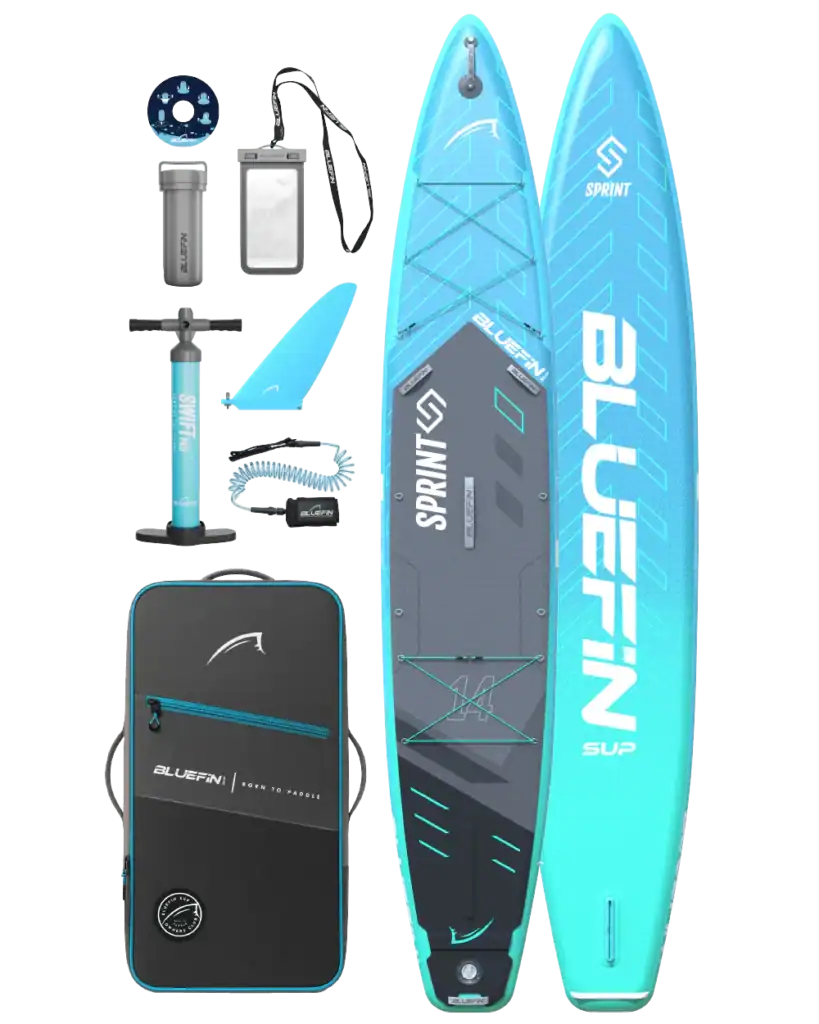
Best For: Advanced paddlers focused on speed, fitness, and performance.
Key Benefits:
- 14′ race-oriented shape for maximum glide efficiency
- Narrow profile to minimise drag
- Built for flatwater racing and serious training sessions
- One of the fastest boards in Bluefin’s range
The Sprint is Bluefin’s performance-focused option, and the 14′ length tells you immediately what it’s built for. At this length and with a narrower race profile, the Sprint doesn’t compromise on speed in favour of versatility — it’s designed to go fast in a straight line.
This is a board for paddlers who have clear goals around fitness, racing, or covering serious distance on flatwater. It’s not comfortable for casual sessions, it won’t suit anyone still developing their balance, and it’s genuinely demanding to paddle well. But for the right paddler, it’s a very capable board at a reasonable £429.99.
Worth noting: there’s also an older Sprint Carbon model visible in the outlet section at £349. If you want the carbon rail upgrade on a Sprint-shaped board and you’re not fussed about having the newest version, it’s worth checking whether stock remains.
Pros:
- 14′ length delivers proper race-oriented glide
- Competitive pricing for a performance touring board
- Good choice for fitness-focused paddlers
Cons:
- Unforgiving for beginners or anyone still building balance
- Limited versatility outside flatwater
Tandem 15′
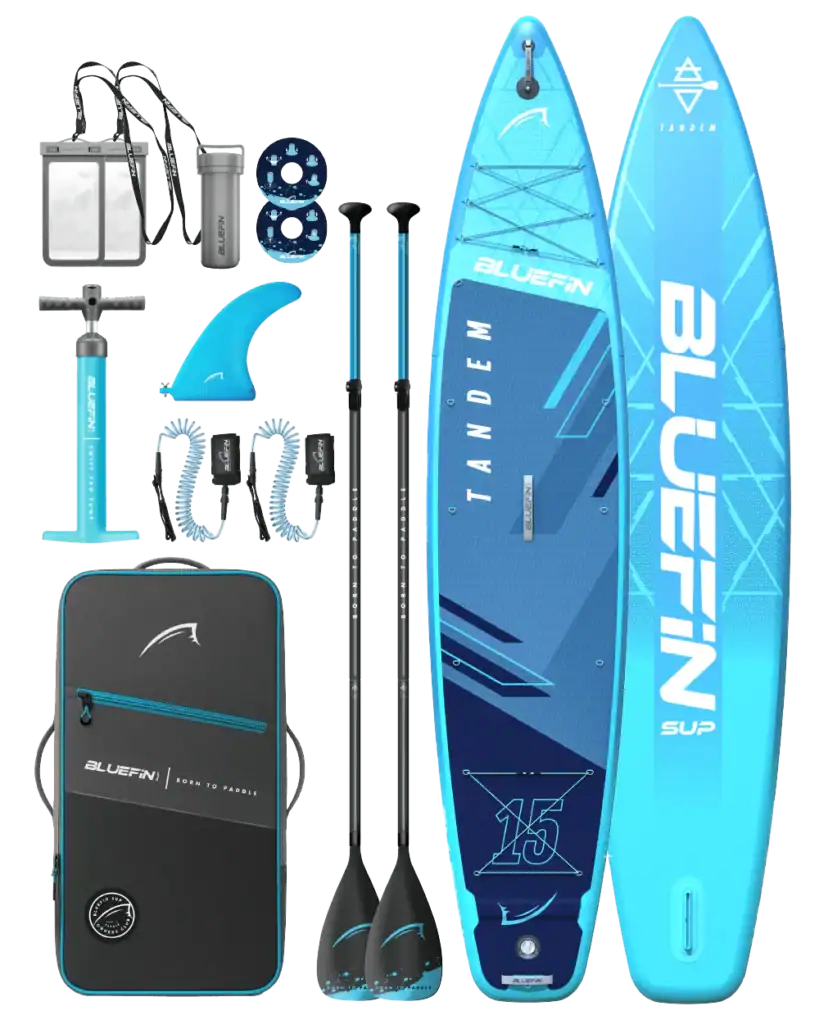
Best For: Two paddlers — couples, parent and child, dog owner with ambition.
Key Benefits:
- Extra-wide 34″ deck accommodates two paddlers comfortably
- 15′ length provides the glide needed to move two people efficiently
- Stable platform suitable for paddlers at mixed skill levels
- Large weight capacity for two adults plus gear
The Tandem is a genuinely different proposition from everything else in the range. It’s not about performance — it’s about shared experiences. The 34″ width and 15′ length create a stable, spacious platform that two people can stand on without feeling like they’re fighting for space.
It works well for couples who want to paddle together, a parent introducing a child to the sport, or frankly anyone who wants to bring a passenger (including a large dog). You’ll cover ground more slowly than a single paddler on a performance board — that’s just physics — but for the experience of being on the water together, the Tandem delivers.
The practical consideration is logistics: a 15′ inflatable in a bag is a significant item. Getting it to the water, inflating it, and managing the storage requires a bit more planning than a standard board. That’s worth knowing upfront.
At £479.99, it’s good value relative to what you’d pay for two separate boards.
Pros:
- Proper two-person platform — not a compromise
- Stable and welcoming for mixed-ability pairings
- Good value compared to buying two boards
Cons:
- Large deflated package to manage and transport
- Slower than solo boards — not suitable for performance paddling
Mammoth 18′
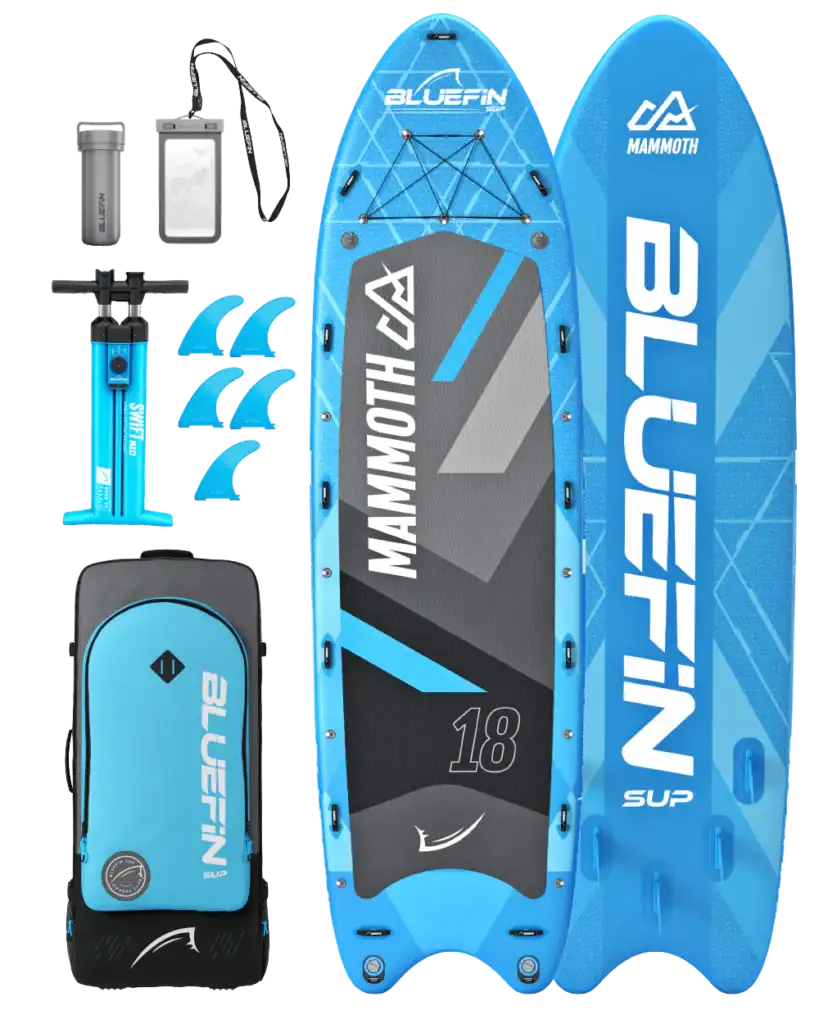
Best For: Groups, team activities, paddleboard yoga classes, family gatherings on the water.
Key Benefits:
- Huge 18′ deck supports multiple paddlers simultaneously
- 500kg weight capacity — the most in the range by a significant margin
- Wide enough to use as a floating platform
- Good for schools, hire fleets, and group fitness sessions
The Mammoth is a genuine novelty — until you get it on the water with a group of people and realise how much fun it actually is. At 18′ and rated to 500kg, this is a floating platform you can fit 6-8 people on at once. Kids absolutely love it.
For the right use case — SUP yoga classes, outdoor education centres, large family holidays — the Mammoth earns its price. For most individual buyers, it’s a harder sell at £899. This is a board you buy when you need it for a specific purpose, not as your everyday paddle.
Pros:
- 500kg capacity — nothing else comes close
- A lot of fun for group activities and family sessions
- Useful for commercial operators and hire fleets
Cons:
- Significant investment for occasional group use
- Demands planning and space to inflate and deploy
- Not a practical everyday board
Aura Fit 10’8″
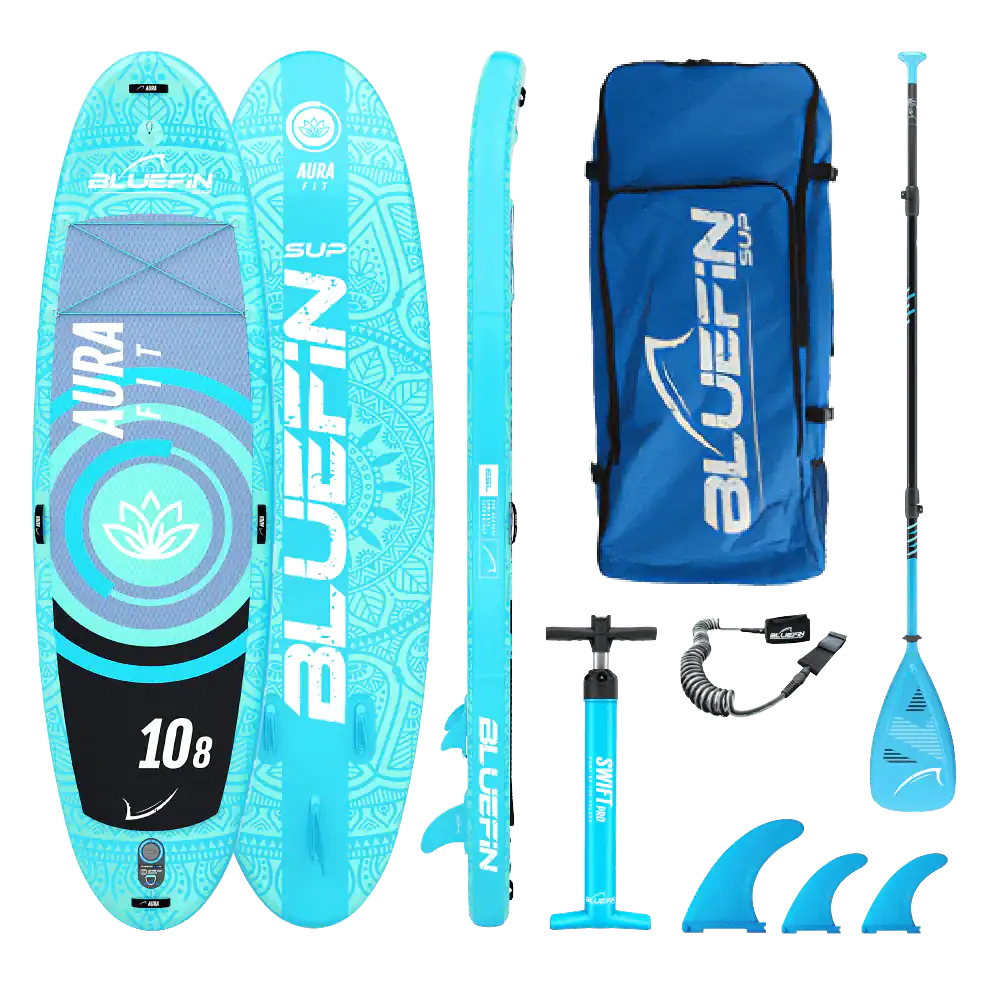
Best For: SUP yoga, fitness sessions, and paddlers who prioritise stability above all else.
Key Benefits:
- Extra-wide 34″ deck for maximum stability during movement
- Designed specifically for yoga and fitness use on the water
- 10’8″ length keeps it manageable for solo use
- Good entry-level price at £299
The Aura Fit answers a specific question: what if you want to do yoga, stretches, or balance exercises on a paddleboard? The 34″ width is the widest of any single-person board in the range — noticeably more stable than the Cruise when you’re moving around on the deck.
Beyond yoga, it suits anyone who is nervous about balance and would rather trade a bit of speed for a more planted platform. The wider stance feels reassuring, particularly in the early sessions when you’re still finding your feet.
At £299, it’s the joint most affordable board in the current range. If stability is your priority and you’re not bothered about covering distance quickly, the Aura Fit is a strong option.
Pros:
- Widest single-person board in the range at 34″
- Purpose-built for yoga and fitness paddling
- Affordable entry point to Bluefin’s range
Cons:
- Slower than narrower boards due to the extra width
- Not the right choice if touring or speed are goals
My Take on Bluefin SUPs
Bluefin has built a solid range. What stands out is the consistency — every board ships with a proper kit, the construction quality is reliable across price points, and the 5-year warranty is the kind of confidence in the product that earns trust over time.
The Cruise 10’8″ is the right answer for most people reading this page. It’s the brand’s bestseller for good reason — wide enough to be approachable, capable enough to grow with your paddling, and priced sensibly for what you get. I’ve used mine enough to have an opinion, and that opinion is: it’s a genuinely good board.
The Carbon 12′ is for paddlers who’ve been on the water for a season or two and want the best Bluefin makes. The dual chamber and carbon rails are real performance upgrades, not marketing — you feel the difference at speed. If you’re doing regular longer paddles and you want a board that keeps up, it’s worth the extra spend.
The Rogue and Sprint fill the touring and performance gaps well. Neither is a board I’d recommend to someone still finding their feet on a SUP, but for paddlers with specific goals around distance or speed, they make a strong case.
Where Bluefin is sometimes criticised is weight — the full kit packages are on the heavier side, and if you’re travelling on foot to your launch spot, that matters. The ESL update has helped, but it’s still something to factor in if you’re comparing against lighter rivals.
For the money, Bluefin boards remain among the better-value options in the UK iSUP market. The warranty, the accessory quality, and the construction have all earned them a strong reputation — and in my experience, that reputation is deserved.
Bluefin Paddle Boards FAQs
Related Guides & Reviews
The resources below cover the basics, common questions, and related kit to help you get more out of your time on the water.
- Best Budget Paddle Boards in the UK
- Best Paddle Board Accessories: Best SUP Gear
- Wave Paddle Boards Compared: Complete Guide to Every Wave 3.0 SUP
- Wave Tourer vs Bluefin Cruise: Which Paddleboard Is Worth Your Money?
- Aquaplanet Paddle Boards Compared: Full Range Guide
All images courtesy of Bluefin • All Rights Reserved.

Steve Cleverdon
Adventure-driven outdoor gear reviewer and paddleboarder, Steve has spent 20 years exploring rivers, coastlines, and trails across Britain and abroad, sharing what he’s learned along the way. Learn more about Steve or get in touch.