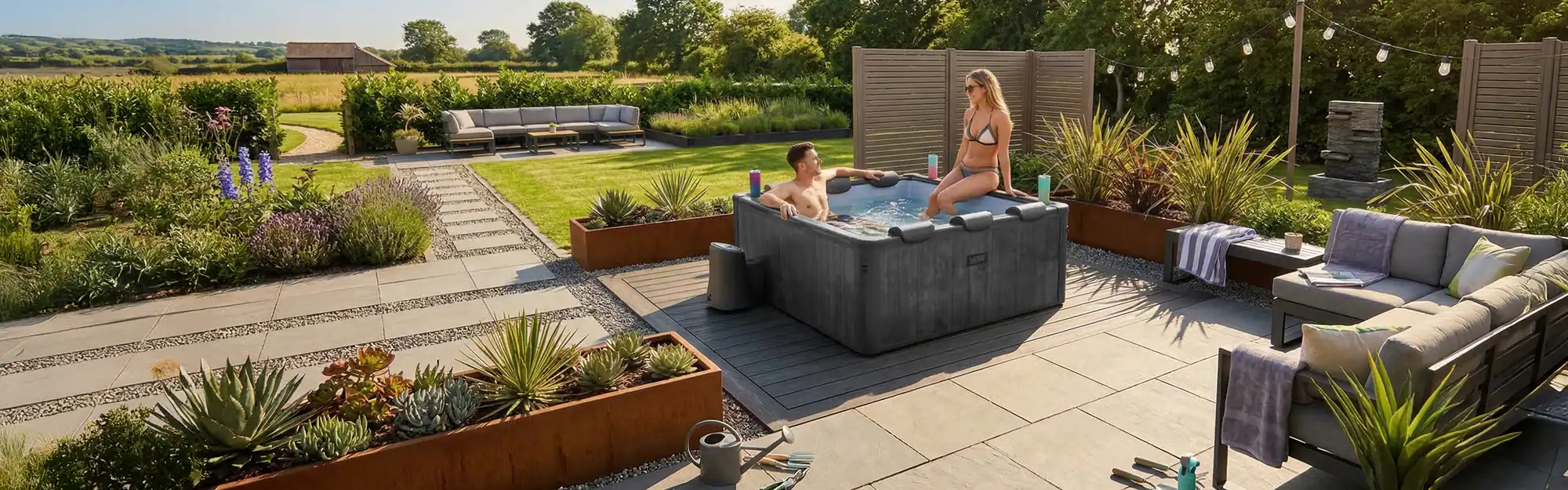
Most hot tub guides sell you a lifestyle: candles, a glass of something, the spa as a luxury object that sits in the garden looking expensive. That is not why a hot tub earns its keep around here. If you hike, paddle, wild camp, or just spend your weekends pushing your body around outdoors, a hot tub is a recovery tool. Warm water, buoyancy that takes the load off tired joints, and jets working into the muscles you battered on Saturday — that is the part that matters, and it is the part nobody seems to write about.
Wave Spas are a good fit for that way of thinking. They span a wide range of budgets and constructions — from a sub-£300 inflatable you can pack away for winter to a rigid aluminium-frame spa built to sit out all year. The range covers eight hot tubs across four build types: inflatable, drop-stitch, eco foam, and frame.
This guide covers all eight models — the specs, the jets, the running costs, and which one suits the kind of person who treats a soak as the back half of a training day rather than a treat. No competitor brands, just the full Wave line-up and where each one fits.
Thanks for your support – I may earn a small commission from affiliate links in this article Learn more
What Sets Wave Apart
Four constructions, one job – The range is split across inflatable, drop-stitch, eco foam, and aluminium frame builds.
- Inflatables (Atlantic, Pacific, Aegean) are the budget, pack-away option.
- Drop-stitch (Ontario) gives you rigid, slim walls without a frame.
- Eco foam (Tahoe, Garda, Como) wraps the tub in WaveEco insulation for year-round use.
- The frame spa (Adriatic) is the permanent, efficiency-first option.
The common thread is that every model is built to be set up by one person on a standard socket, which is what makes them realistic for someone who would rather be outdoors than plumbing in a spa.
Heat retention is the headline spec – For recovery, the number that matters is not how hot the water gets — they all reach 40°C — but how cheaply you can keep it there. Wave quotes the foam and frame models as roughly 60–70% more energy efficient than inflatables, with running costs from around £2 a day against £4 a day for the inflatable and drop-stitch tubs. If you want a soak waiting for you after every long ride or paddle through autumn and winter, insulation is what makes that affordable rather than a once-a-week luxury.
Bubble-jet massage as standard – Every model carries a bubble-jet (air) massage system, ranging from 70 jets on the smallest foam tubs up to 130 on the larger inflatables and the Aegean. These are air jets rather than the high-pressure water jets you get on a £6,000 acrylic spa, so manage expectations — they are good for general circulation and easing tension across the back and legs, not targeted deep-tissue work. For post-exercise recovery, the warmth and buoyancy do most of the heavy lifting; the jets are the finishing touch.
Designed for British weather – All models include FrostFree (also branded Shield Anti-Freeze) protection that keeps the water moving and the equipment safe on cold nights, plus integrated heaters on every tub except the Ontario, which uses an external heater unit. This is the feature that makes year-round recovery viable in the UK — the tub looks after itself overnight so it is ready when you get home from a frozen-fingered winter walk.
Smart control on most models – The foam tubs (Tahoe, Garda, Como) ship with SmartSpa Wi-Fi control built in, so you can start heating from your phone on the drive home. The inflatables and drop-stitch are Wi-Fi compatible, but the controller is sold separately. Being able to bring the tub up to temperature remotely is a real advantage when your recovery window is the hour after you walk through the door.
Wave Hot Tubs: Quick Comparison
| Model | Build | Fits | Holds | Jets | Running cost | Price (from) |
|---|---|---|---|---|---|---|
| Atlantic | Inflatable, round | 4/6 | 800L/1000L | 110/130 | £4/day | £289.99 |
| Pacific | Inflatable, square | 4/6 | 600L/910L | 110/130 | £4/day | £369.99 |
| Aegean | Inflatable, round | 6 | 910L | 130 | £4/day | £429.99 |
| Ontario | Drop-stitch, round | 4/6 | 825L/1100L | 110/120 | £4/day | £449.99 |
| Tahoe | Eco foam, round | 4/6 | 650L/985L | 70/90 | £2/day | £809.99 |
| Garda | Eco foam, square | 4/6 | 825L/1100L | 70/90 | £2/day | £989.99 |
| Como | Eco foam, octagonal | 6 | 985L | 90 | £2/day | £989.99 |
| Adriatic | Aluminium frame, square | 6 | 985L | 80 | £2/day | £1,699.00 |
Prices are the lowest current Wave listings as of June 2026 and move with sales and bundles. Running costs are Wave’s own estimates and depend on how often you use the tub, the weather, and whether you fit a thermal cover.
Wave Atlantic
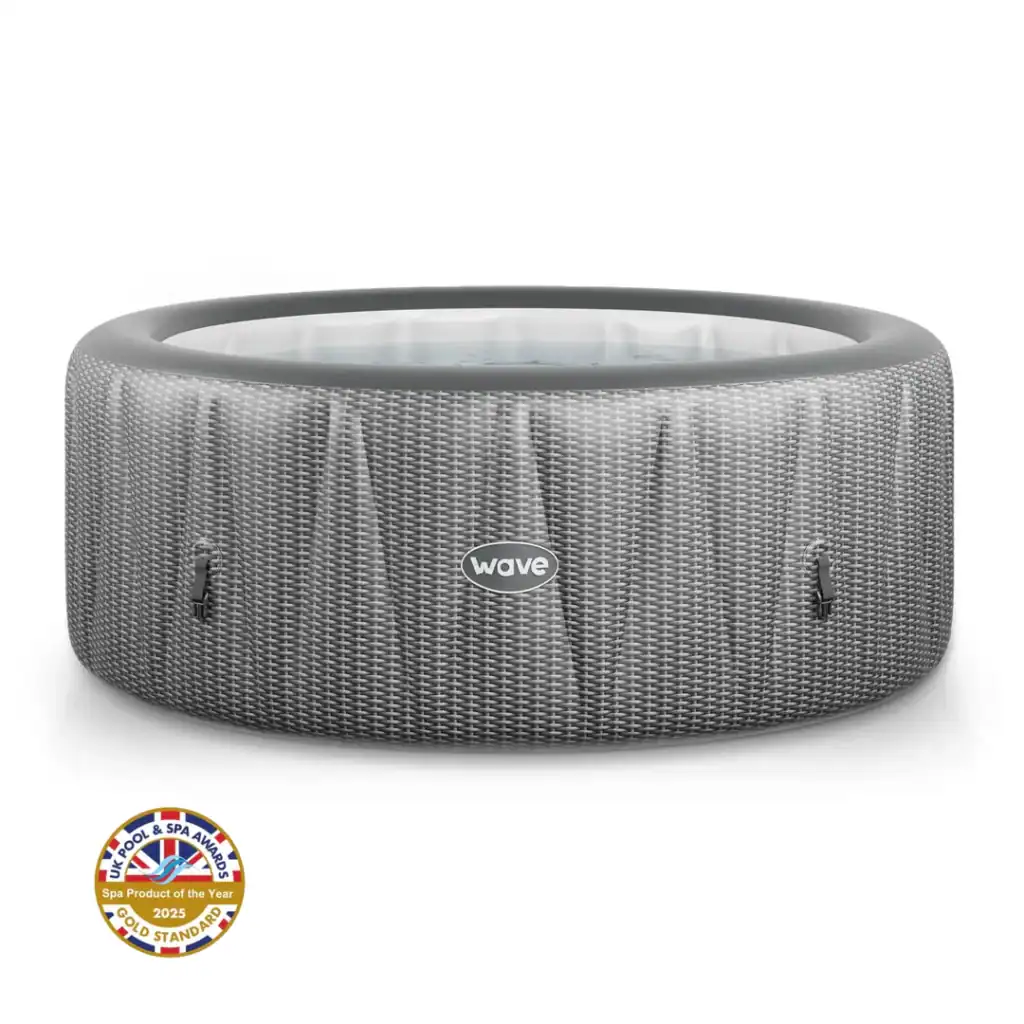
Best For: The cost-conscious outdoor type who wants a big six-seat soak for recovery without committing to a permanent install.
Atlantic — from £289.99 | 4 Person (180x65cm) and 6 Person (208x65cm)
Key Benefits:
- Cheapest way into the range, with a six-person version at one of the lowest prices for a tub this size
- Generous 208cm diameter on the six-seater — the roomiest footprint of any round Wave tub
- 110/130 bubble jets for all-over circulation after a long day on your feet
- Tri-layer laminated PVC with an integrated heater tucked into the liner, so no bulky external box
- Round, ergonomic interior that suits a solo recovery soak as easily as a group
- Packs away at the end of the season if you only want it spring to autumn
The Atlantic is the entry point, and for a lot of active people it is all the tub they need. The six-person model gives you a 208cm interior — wide enough to actually stretch your legs out, which matters when you are trying to let your hamstrings decompress after a long hike. The integrated heater takes it to 40°C and the 110/130-jet system gives you a broad, gentle massage rather than anything targeted.
The trade-off for the low price is efficiency. As an inflatable, it sits in the 50%-less-efficient camp, with running costs around £4 a day and longer heat-up times, so it is happiest as a spring-to-autumn tub or somewhere sheltered. The Wi-Fi controller is also sold separately, so factor that in if remote heating is part of the appeal. For pure cost-per-soak in the warmer months, though, nothing else in the range undercuts it.
Pros:
- Lowest entry price in the range
- Largest round interior (208cm) on the six-seater
- High jet count for the money
- Packs away for winter storage if you want it to
Cons:
- Least efficient build, so highest running costs
- Wi-Fi controller costs extra
- Inflatable walls feel less solid than the foam or frame tubs
Wave Pacific
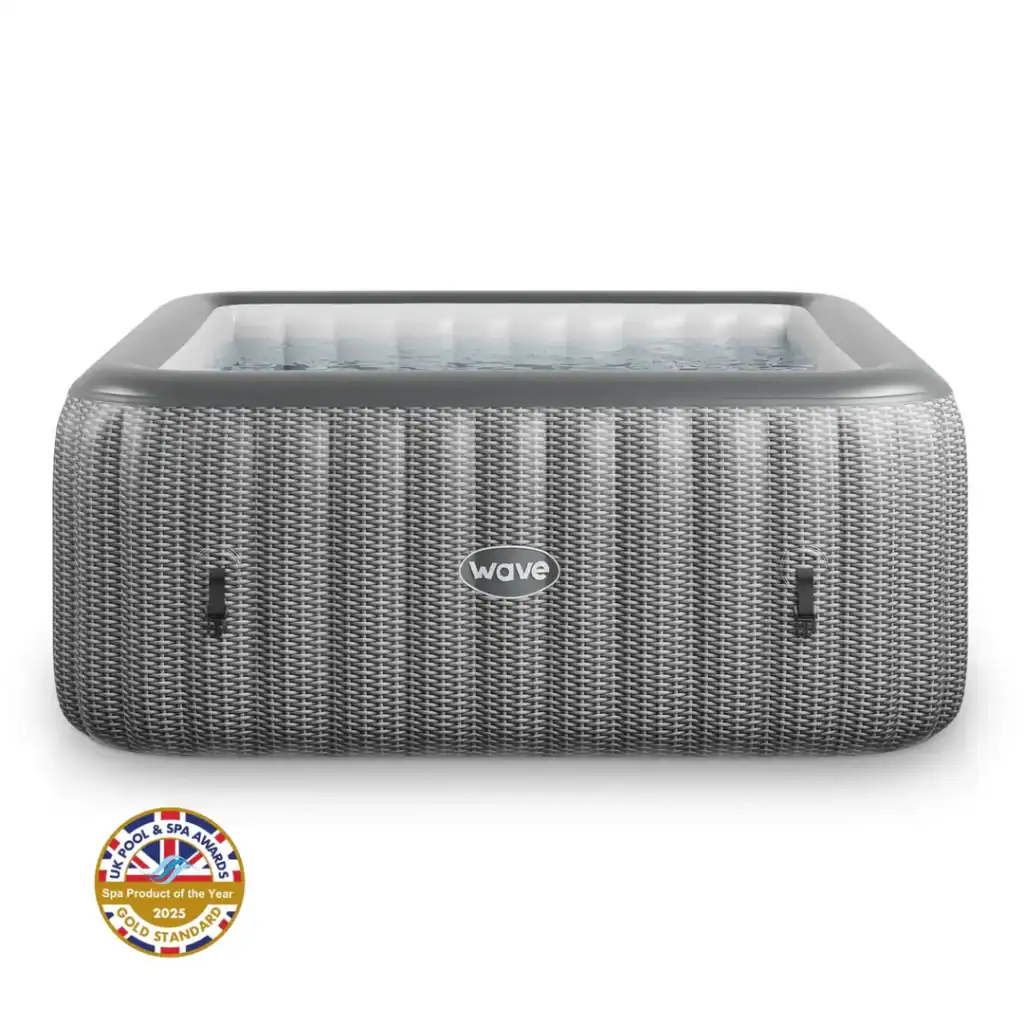
Best For: Smaller gardens and patios where a square footprint and corner seating make better use of tight space.
Pacific — from £369.99 | 4 Person (155x65cm) and 6 Person (185x65cm)
Key Benefits:
- Square design with corner seating that fits a patio or decked area more neatly than a round tub
- 110/130 bubble jets driven by an integrated, liner-mounted heater
- Compact 155cm four-person version for couples or solo recovery in a small space
- Tri-layer laminated PVC construction with a five-minute, tool-free setup
- AquaBubble massage system aimed at easing tired muscles
- Wi-Fi compatible if you add the optional controller
The Pacific is the square sibling to the Atlantic, and the shape is the whole point. Corner seating and a square outline tuck into a patio or against a fence far better than a circle, so if your recovery spot is a tight courtyard rather than an open lawn, this is the inflatable to look at. The four-person 155cm version is the most compact tub in the range, which suits a single user who just wants somewhere warm to sit and unknot after training.
Capacities are a touch smaller than the Atlantic at the same person count (600L versus 800L on the four-seaters), reflecting the squarer, more upright seating. As with the other inflatables, efficiency is the compromise — around £4 a day to run, controller sold separately. But for the combination of low price, space-efficient shape, and quick setup, the Pacific is one of the most practical tubs here for ordinary-sized gardens.
Pros:
- Space-efficient square footprint and corner seating
- Truly compact four-person option
- Fast, tool-free setup
- Strong jet count for the price
Cons:
- Smaller water volume than the round tubs at the same seat count
- Inflatable efficiency means higher running costs
- Wi-Fi controller is an added cost
Wave Aegean
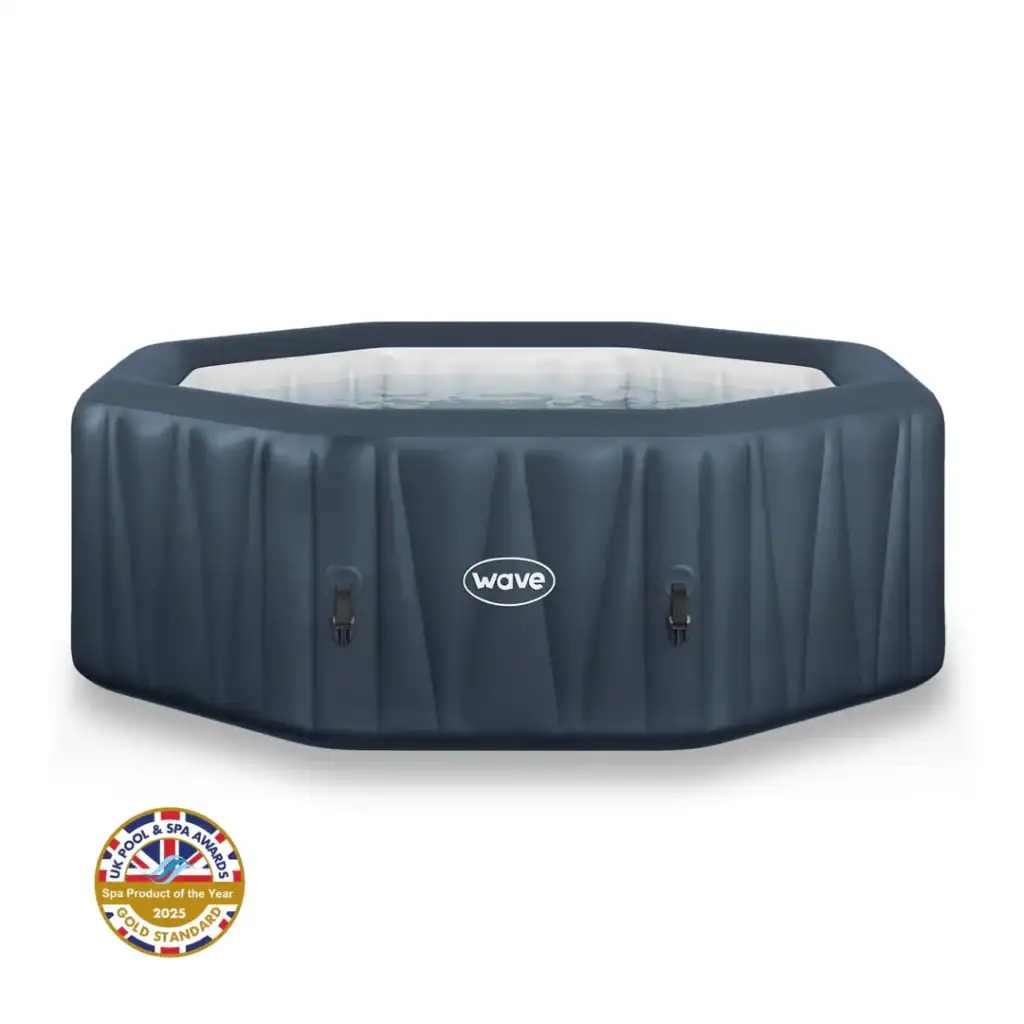
Best For: A dedicated six-person inflatable with the highest jet count for the money, for households that recover together.
Aegean — from £429.99 | 6 Person (195x65cm)
Key Benefits:
- 130 bubble jets — the joint-highest jet count in the range
- Six-person round interior at 195cm in a single, simple configuration
- Twenty-minute, tool-free setup from box to filling
- Integrated liner-mounted heater reaches 40°C without an external kit
- FrostFree protection for colder-month use
- One of the better-value six-seaters once you account for the jet system
The Aegean strips the choices back — one size, one job. It is a six-person round inflatable with a 130-jet Bubblejet system, which is the most aggressive air massage of any tub in the line-up. If the social side of recovery matters to you — the whole household piling in after a day on the hills, rather than a solo soak — the Aegean gives you the seats and the jets without stepping up to the foam tubs’ price.
It sits in the same efficiency band as the other inflatables, so plan for roughly £4 a day and the separate Wi-Fi controller. There is no four-person option, so if you mostly soak alone this is more tub than you need and the Pacific or Atlantic four-seaters make more sense. But as a value six-seater built around its jet system, the Aegean is well judged.
Pros:
- Highest jet count alongside the larger inflatables
- Simple, single-size buying decision
- Quick tool-free setup
- Good value for a six-person tub
Cons:
- No smaller option for solo or couple use
- Inflatable running costs
- Controller sold separately
Wave Ontario
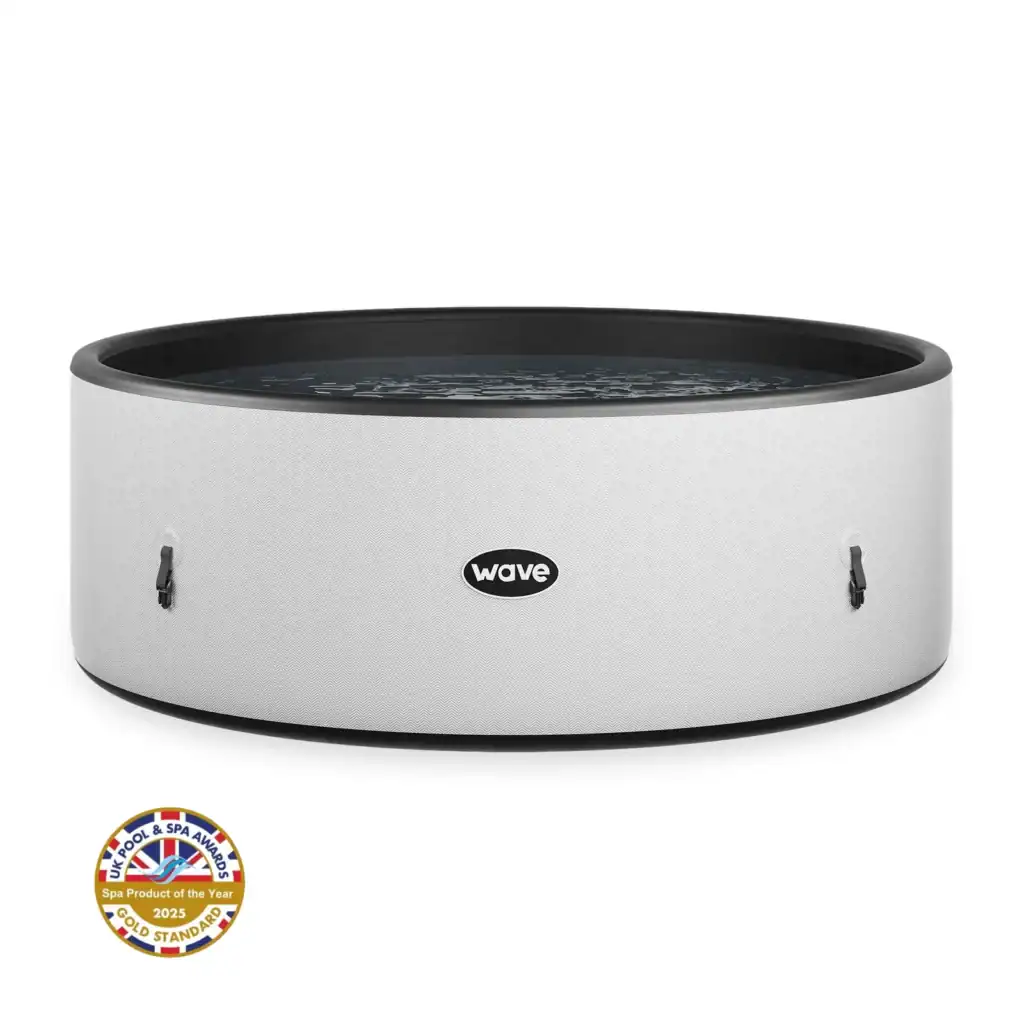
Best For: Anyone who wants a rigid, solid-walled tub feel without paying foam-tub money — the value pick of the range.
Ontario — from £449.99 | 4 Person and 6 Person (round, drop-stitch)
Key Benefits:
- Drop-stitch construction gives rigid, slim walls and a firm, sit-on edge you can lean on
- Up to 110/120 bubble jets — strong massage for a mid-priced tub
- Large 825L/1100L water volumes, matching the bigger foam tubs
- Stylish herringbone print that stands out from the plain inflatables
- Quick heating at around 1.5°C per hour via a high-performance external heater unit
- Noticeably more stable than a standard inflatable, while staying portable
The Ontario is the clever middle ground. Drop-stitch is the same construction used in Wave paddleboards — thousands of internal threads that let the walls inflate hard and stay rigid, so you get a tub that feels closer to a solid-walled spa than a bouncy inflatable, for around the price of a mid-range inflatable. For anyone who has spent time on a hard inflatable SUP, the feel will be familiar: it holds its shape and you can perch on the rim.
The heater is external rather than integrated, which is the main practical difference from the foam tubs — it heats quickly but the unit lives outside the tub. Efficiency sits in the 50%-better, roughly £4-a-day band, below the foam models, so it is not the cheapest to run long-term. But for the combination of a rigid feel, big water volume, and a strong jet count at under £500, the Ontario is the value sweet spot of the range.
Pros:
- Rigid, solid feel at a mid-range price
- Large water capacity rivalling the foam tubs
- High jet count
- Fast heating
Cons:
- External heater rather than integrated
- Running costs closer to the inflatables than the foam tubs
- Shorter liner warranty than the integrated-heater models
Wave Tahoe
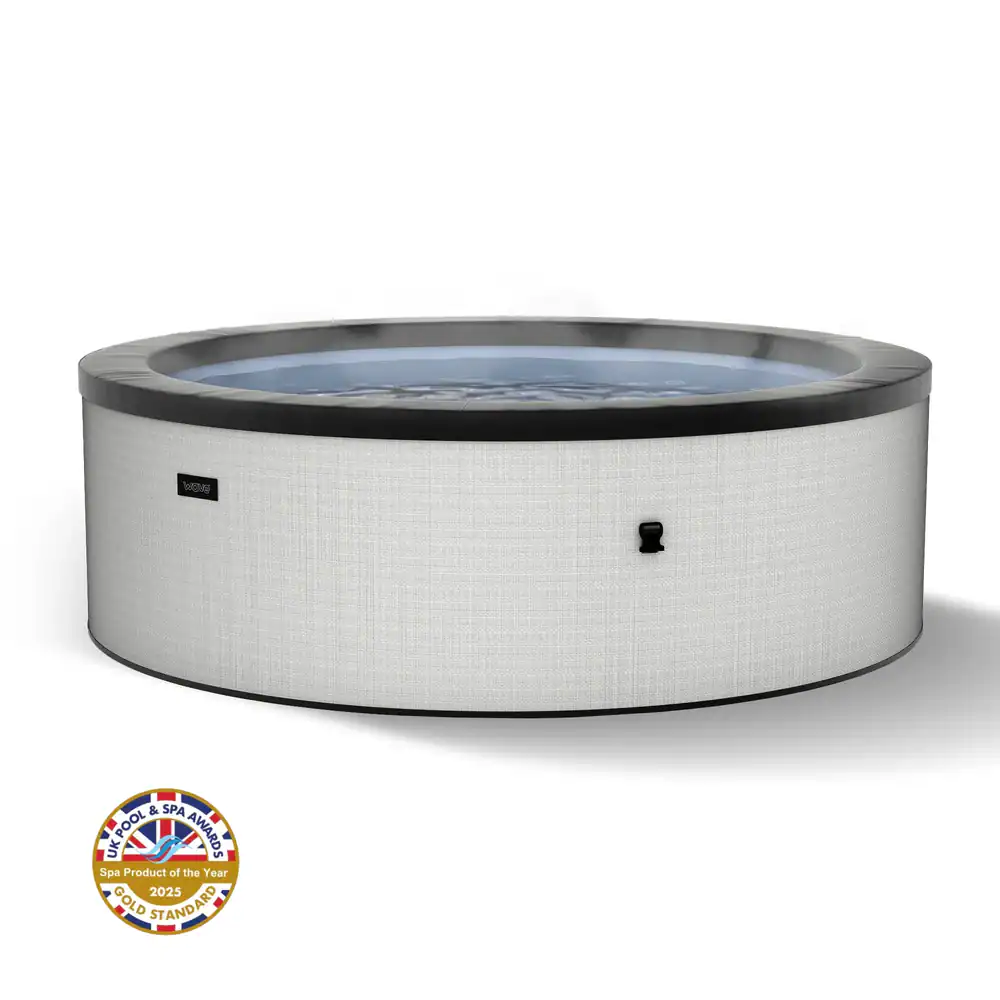
Best For: The first serious year-round recovery tub — the cheapest way into the efficient foam range.
Tahoe — from £809.99 | 4 Person (156x70cm) and 6 Person (184x70cm)
Key Benefits:
- WaveEco foam walls, around 60% more efficient than inflatables, for roughly £2 a day to run
- Classic round shape with a deep 70cm wall for a full shoulders-under soak
- 70/90 bubble jets with a built-in integrated heater
- SmartSpa Wi-Fi control as standard — start heating from your phone
- Built for all-season use with FrostFree protection
- Lowest price of the three foam tubs
The Tahoe is where the range shifts from seasonal toy to recovery tool you can run all winter. The WaveEco foam shell roughly halves the running cost against the inflatables and holds heat far better overnight, which is the difference between a tub you fill up occasionally and one that is always ready after a cold, wet day outdoors. The 70cm walls are deeper than the inflatables, so you sit lower and get more of your back under the water — better for easing out a tired upper body.
At 650L/985L it holds a little less than the square Garda at the same seat count, a function of the round shape, but for most people that means faster heating for no real loss of room. The built-in SmartSpa Wi-Fi is the quality-of-life feature here: schedule it or warm it remotely so your recovery window is not spent waiting for the water. For a first all-year tub, the Tahoe is the natural starting point.
Pros:
- Efficient foam build at the lowest foam-tub price
- Deep walls for a fuller soak
- Wi-Fi control included
- A real all-year tub, not a summer-only one
Cons:
- Slightly lower water volume than the square Garda
- A step up in price from the inflatables and drop-stitch
- Air jets only, like the rest of the range
Wave Garda
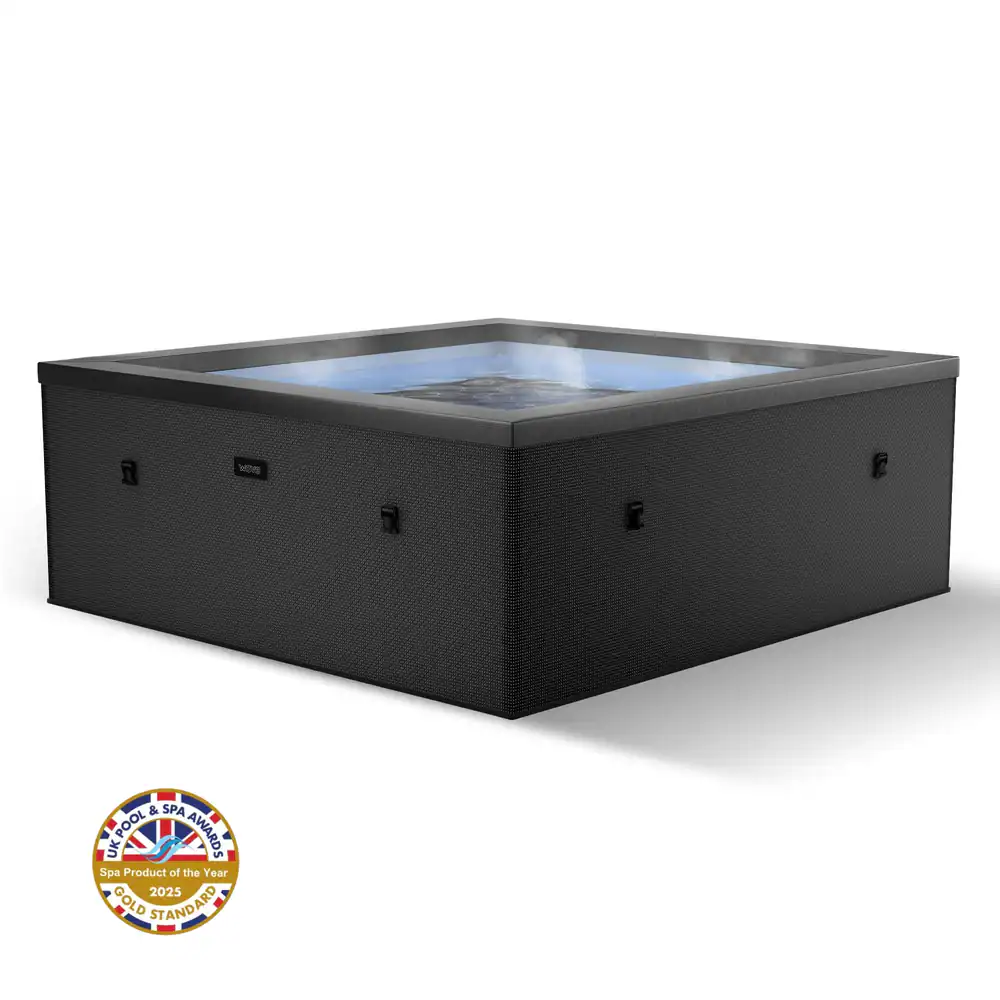
Best For: A square, modern-looking foam tub with maximum water volume for serious, regular year-round recovery.
Garda — from £989.99 | 4 Person (160x70cm) and 6 Person (180x70cm)
Key Benefits:
- Square WaveEco foam build with the largest volumes in the foam range (825L/1100L)
- 70/90 bubble jets and a built-in integrated heater
- Around 60% more efficient than inflatables, from roughly £2 a day to run
- SmartSpa Wi-Fi control and Waveflow filtration as standard
- Optional EnergySave bundle for a further claimed 30% saving on running costs
- Four colour finishes to suit a modern garden
The Garda is the square, higher-capacity foam tub. The straight sides give you more usable water and a contemporary look that sits well against decking or a modern fence line. At 1100L on the six-seater, it carries the most water of any foam tub here, which means a more stable, slower-cooling soak — useful if several of you are using it back-to-back.
Mechanically, it is close to the Tahoe — same foam efficiency, same Wi-Fi control, same 70/90 jets — so the decision between them comes down to shape and volume. The Garda’s square form and larger capacity make it the better pick if you have the space and want the more substantial soak; the round Tahoe is cheaper and quicker to heat. Add the EnergySave bundle if you plan to run it hard through winter, where the extra insulation pays for itself.
Pros:
- Largest water volume in the foam range
- Efficient, low running cost
- Wi-Fi control and Waveflow filtration included
- Modern square design with colour choices
Cons:
- More expensive than the Tahoe for similar core features
- Larger volume means slightly longer heat-up
- Air jets only
Wave Como
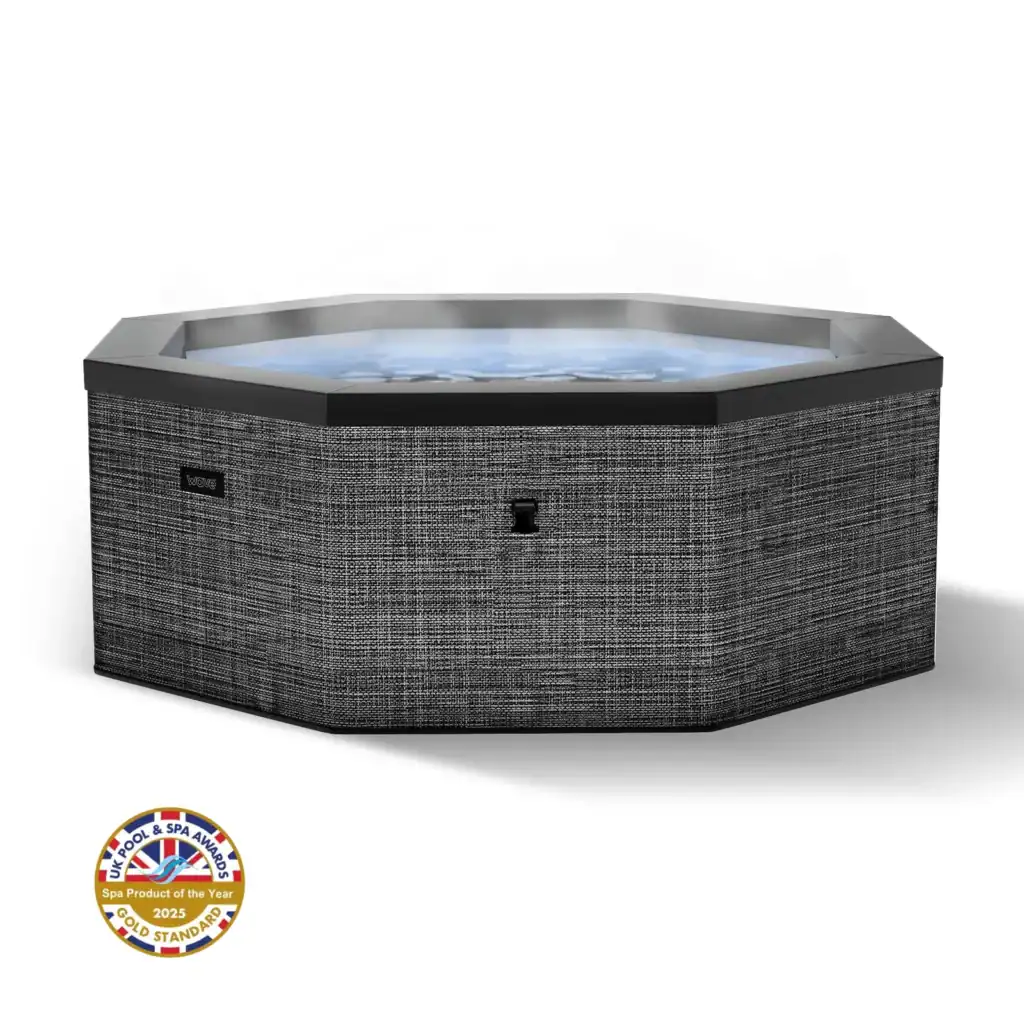
Best For: Six-person socials — the most comfortable, sociable seating layout in the range.
Como — from £989.99 | 6 Person (195x70cm)
Key Benefits:
- Eight-sided octagonal shape that maximises legroom and face-to-face seating for six
- WaveEco foam build, around 60% more efficient than inflatables, from roughly £2 a day
- 90 bubble jets with a built-in integrated heater
- SmartSpa Wi-Fi control and FrostFree protection as standard
- 985L capacity with a deep, comfortable 70cm wall
- The most generous shared layout of any Wave tub
The Como is the social one. The octagonal shape is not just for looks — it spreads six people out with more legroom and a layout where everyone faces in. It shares the Garda and Tahoe’s foam efficiency, Wi-Fi control, and integrated heater, so the running costs and year-round usability are the same; what you are paying for is the seating geometry.
It comes in one six-person size only, so it is not the tub for a solo user — at 195cm across, it is a lot of water to heat for one person. But for a household or a group that recovers together, the Como’s layout is the most comfortable in the range, and at the same starting price as the Garda, it is an easy call if sociable seating beats raw capacity for you.
Pros:
- Best seating layout for six
- Efficient foam build with low running costs
- Wi-Fi control included
- Distinctive octagonal design
Cons:
- Six-person size only — overkill for solo use
- Slightly fewer jets than the Garda’s six-seat figure
- Air jets only
Wave Adriatic
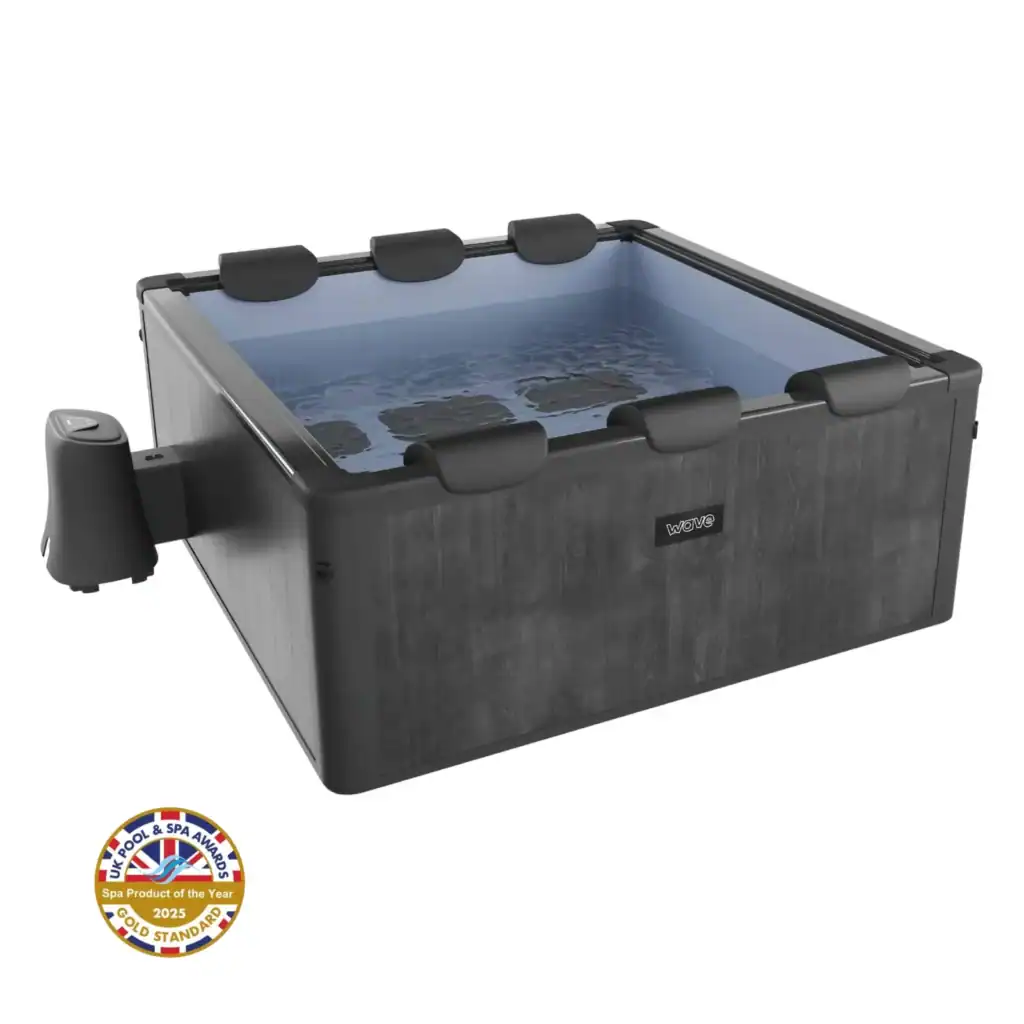
Best For: The buyer who wants a permanent, lowest-running-cost spa that looks like a fixed installation rather than a portable tub.
Adriatic — £1,699.00 | 6 Person (160x160x75cm)
Key Benefits:
- Aluminium frame with a black wood-effect finish — looks like a built-in spa, not an inflatable
- Wave’s most efficient model, around 70% more efficient than inflatables, from roughly £2 a day
- Advanced thermal construction for the fastest, cheapest heat retention in the range
- Bubble-jet massage system and Waveflow filtration
- Drop-stitch insulated cover designed to stop water pooling
- Rigid, fixed-feel structure that comfortably seats six
The Adriatic is the top of the range and a different proposition to everything below it. The aluminium frame and wood-effect panels give it the look of a permanent garden feature, and the thermal construction makes it the most efficient tub Wave builds — the lowest running cost and the best heat retention, which is exactly what you want if the tub is going to live outdoors and be used year-round for recovery. At 160x160cm with a 75cm height, it is a substantial, six-person square spa that sits and stays put.
The price is the obvious consideration — at £1,699 it is more than double any foam tub — and it is a fixed installation rather than something you pack away. The jet system is a bubble massage rather than high-pressure water jets, so as with the rest of the range, the value is in the warmth, the efficiency, and the build quality rather than spa-resort hydrotherapy. If you want the most permanent, best-insulated tub in the line-up and the budget is there, the Adriatic is the one built to be left out and used hardest.
Pros:
- Most efficient, lowest running cost in the range
- Premium, permanent, built-in look
- Rigid aluminium-frame structure
- Insulated drop-stitch cover included
Cons:
- By far the most expensive model
- Not portable — this is a fixed install
- Bubble jets rather than high-pressure water jets at this price
My Take on the Wave Range
Taken as a whole, the Wave range is well structured for the way I would actually use a hot tub — as recovery, not decoration. There is a clear ladder from “seasonal and cheap” up to “permanent and efficient”, and the right model depends almost entirely on how often you will use it through the cold months.
If you mostly want warm-weather recovery and the lowest possible price, the Atlantic is the obvious entry point — the most water for the money, packs away in winter. For a small or awkwardly shaped garden, the square Pacific uses the space better. The Aegean is the value six-seater if you recover as a group and want the most jets.
The Ontario is the one I would point most people toward as the smart-money pick. Drop-stitch gives you a rigid, solid-walled feel and big water volume for under £500, and if you already own an inflatable paddleboard, you will recognise and trust the construction. It costs a bit more to run than the foam tubs, but the upfront saving is large.
For genuine year-round recovery, though, the foam tubs are where the value lies over time. The Tahoe is the cheapest way in and the one I would buy first — efficient, deep, Wi-Fi controlled, and viable all winter. Step up to the Garda if you want more water and a square modern look, or the Como if your soaks are sociable and seating layout matters more than raw capacity. The Adriatic is the long-game choice: if the tub is going to live outside and get used hard every week of the year, its efficiency and build justify the price, but it is a big jump in cost and a permanent commitment.
One thing worth adding for the recovery-minded: Wave also makes the Antarctic ice bath, which uses the same drop-stitch construction as the Ontario. If you are into contrast therapy — alternating hot and cold after hard training — a tub and an ice bath together is a more complete recovery setup than either on its own.
Wave Spas FAQs
Which Wave hot tub is best for muscle recovery after exercise?
For recovery, prioritise heat retention over jet count, because the warmth and buoyancy do most of the work and a tub you can afford to keep hot is one you will actually use. That points to the eco foam models — the Tahoe is the most affordable entry, the Garda and Como step up on volume and seating. All of them run at roughly £2 a day and hold heat well enough for year-round use, which is what makes daily or post-training soaks realistic.
What is the difference between the inflatable, drop-stitch, foam and frame tubs?
Inflatables (Atlantic, Pacific, Aegean) are the cheapest and pack away, but cost the most to run. Drop-stitch (Ontario) uses rigid, hard-inflated walls for a solid feel at a mid price. Eco foam (Tahoe, Garda, Como) wraps the tub in insulation for roughly 60% better efficiency and all-year use. The aluminium frame Adriatic is the most efficient and permanent, with a built-in look, at the highest price.
Can a Wave hot tub be used through winter?
Yes. Every model includes FrostFree (Shield Anti-Freeze) protection that keeps the water circulating and the equipment safe on cold nights. The foam and frame tubs are the most cost-effective for winter because they retain heat far better — Wave quotes them as 60–70% more efficient than the inflatables. Fitting an EnergySave thermal cover cuts heating time by around 40% and helps on any model.
How long do Wave hot tubs take to heat up?
Wave quotes all models heating from around 15°C to 40°C in roughly 14–23 hours, at about 1.5°C per hour. Smaller four-person tubs heat around 15% faster than six-person ones, summer is quicker than winter, and a thermal cover makes a meaningful difference. The Wi-Fi control on the foam tubs lets you start heating remotely so the tub is ready when you get home.
Are the jets strong enough for hydrotherapy?
Every Wave tub uses an air-bubble massage system rather than the high-pressure water jets found on expensive acrylic spas, with counts from 70 up to 130 jets. They are good for general circulation and easing overall tension, which is what most people want after a hike or paddle, but they are not targeted deep-tissue jets. For recovery, the warm water and buoyancy matter more than the jets.
What warranty do Wave hot tubs come with?
Models with an integrated heater (the inflatables, foam tubs and the Adriatic) carry a two-year warranty on the heater and a 12-month warranty on the liner. The Ontario, which uses an external heater, has a 12-month heater warranty and a six-month liner warranty. Warranties cover manufacturing faults and apply to purchases from Wave or official UK retailers. Always check the current terms on Wave’s warranty page before buying.
Should I add an ice bath for contrast therapy?
If you are into recovery seriously, contrast therapy — alternating hot and cold — is worth considering. Wave’s Antarctic ice bath uses the same drop-stitch construction as the Ontario hot tub, so a tub-and-bath pairing is a coherent setup. Hot for circulation and muscle relaxation, cold for reducing the feeling of post-exercise soreness; many active people find alternating the two more effective than either alone.
Related Guides & Reviews
The resources below cover the basics, common questions, and related kit to help you get more out of your time on the water.
- Wave Paddle Boards Compared: Complete Guide to Every Wave 3.0 SUP
- Wave Cruiser vs Wave Tourer: Which Wave Board Should You Buy?
- Wave Pro SUP 3.0 Review
All images courtesy of Wave Spas • All Rights Reserved.

Steve Cleverdon
Adventure-driven outdoor gear reviewer and paddleboarder, Steve has spent 20 years exploring rivers, coastlines, and trails across Britain and abroad, sharing what he’s learned along the way. Learn more about Steve or get in touch.