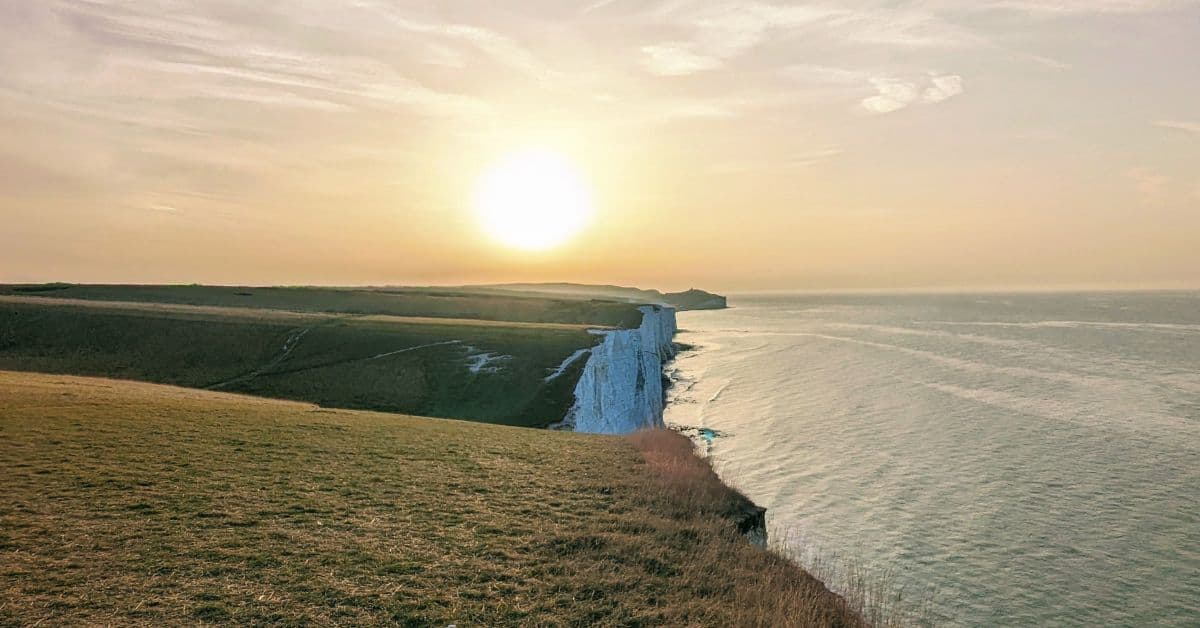
The Seven Sisters walk is one of the finest coastal routes in England — and if you’re looking for a day out that genuinely delivers on the hype, this is it. Striding along the tops of these brilliant white chalk cliffs above the English Channel, with nothing but sky, sea, and the rolling South Downs ahead of you, there aren’t many walks in the country that come close.
I’m lucky enough to live in East Sussex, which means I’ve done this walk more times than I can count, in all seasons and in all weathers. Whether you’re starting from Alfriston along the river, dropping in at Exceat by the visitor centre, or tackling the full route from Seaford to Eastbourne Pier, like I’m going to walk you through here, you’re in for a treat.
This guide covers everything you need to plan and enjoy the walk, from transport and parking to the highlights, the history, and a few personal notes from the trail.
Thanks for your support – I may earn a small commission from affiliate links in this article Learn more
Route Specifications
| Distance | Approx. 20km (12.5 miles) Seaford to Eastbourne — shorter options available |
| Duration | 5-7 hours depending on pace and stops |
| Difficulty | Moderate — sustained but manageable for most adults of average fitness |
| Highest Point | 162m at Beachy Head — Britain’s highest chalk sea cliff |
| Start | Seaford seafront near the Martello Tower (or Alfriston / Exceat) |
| Finish | Eastbourne Pier (recommended endpoint) |
| Route Type | Point-to-point (bus return available) |
| Amenities | Cuckmere Inn, Birling Gap NT cafe, Beachy Head pub; shops in Seaford and Eastbourne |
| Dog-friendly | Yes — keep on leads near livestock and cliff edges |
| OS Map | Explorer OL25 — Eastbourne & Beachy Head |
Getting There and Parking
Because this is a point-to-point walk rather than a circular route, it pays to think through your logistics before you set off. My preferred approach when walking with a small group is to park at the finish in Eastbourne and take the bus to the start — that way, you walk at your own pace without watching the clock for a return bus.
Route Options and Starting Points
- Seaford (Martello Tower) — the full coastal experience, adds a quieter stretch before Cuckmere Haven
- Exceat (Seven Sisters Country Park visitor centre) — straight onto the Cuckmere Haven section, a good middle-ground start
- Alfriston — adds a lovely stretch along the River Cuckmere first; also on the South Downs Way
- Eastbourne — walk it in reverse if you prefer, though west-to-east gives the best views
Parking
Parking is straightforward at either end. In Eastbourne, there’s road parking along the seafront and a pay-and-display car park near the station. In Seaford, there’s road parking along the front and a pay-and-display car park a short walk from the Martello Tower start point (Richmond Road Parking). If starting from Exceat, there are two large pay-and-display car parks at the visitor centre. Alfriston has village car parks too.
Getting the Bus
The Coaster 12, 12A and 12X buses run between Eastbourne and Seaford, stopping at Seven Sisters Country Park (Exceat) along the way. Buses run roughly every 15-20 minutes on weekdays and every 30 minutes on Sundays. The journey from Eastbourne to Seaford takes around 45 minutes. Single fares are currently capped at £3 under the National Bus Fare Cap.
On Sundays and in summer, the 13X service also stops at Birling Gap and Beachy Head itself — useful if you want to bail out early or get dropped closer to the cliffs.
Park in Eastbourne, take the bus to your starting point, and walk back. You’ll never need to worry about return transport and can stop wherever takes your fancy along the way.
Walking the Seven Sisters via Beachy Head Guide
Starting Out: Seaford to Cuckmere Haven
Get dropped off or alight the bus near the Martello Tower at the eastern end of Seaford seafront. This circular Napoleonic War fort — number 74 of 103 built along the English coast during the French Revolutionary Wars — is a fitting piece of history to start the walk with.
From here, head east along the seafront and up onto Seaford Head. The path climbs steadily alongside the golf course, and it’s a proper ascent to begin with — the longest single climb on the whole route. You’re rewarded quickly though, with sweeping views back over Seaford and along the coast as you gain height.
Following the clifftop path east across Seaford Head Nature Reserve, you’ll pass Hope Gap — a small beach below the cliffs. Note that the Hope Gap steps have been closed since 2023 due to cliff erosion damage, so check current access before relying on them. Shortly after, the path descends toward Cuckmere Haven.
Stay well back from the cliff edge throughout. Chalk is brittle and falls can happen without warning — sections of path have disappeared overnight before now.

Cuckmere Haven
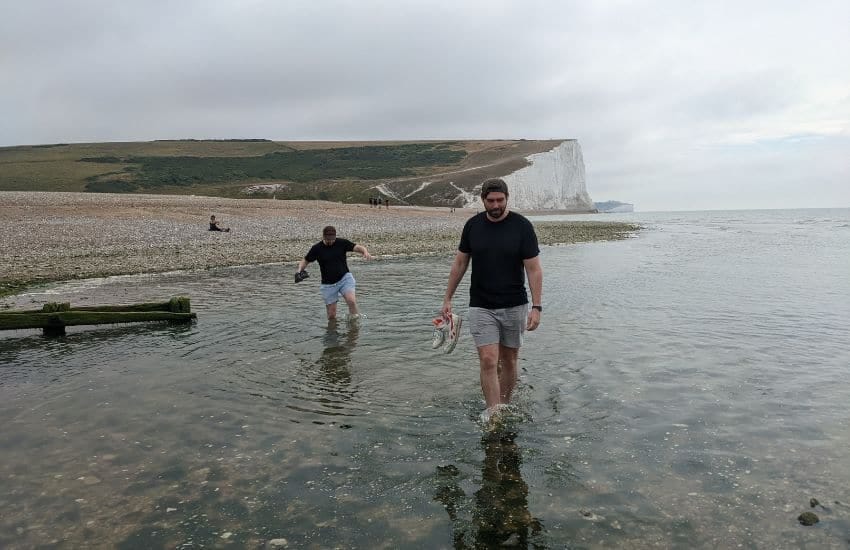
When you reach the Cuckmere River, you have two options. If the tide is out, you can take your boots off and wade across the river mouth to reach the beach — one of those simple pleasures that makes a walk feel like a proper adventure.
I’ve crossed it more times than I can count over the years, once memorably carrying a bicycle over the water on a bike ride from home. If the tide is in, follow the path up alongside the river towards Exceat Bridge, cross via the road, and the Cuckmere Inn is right there — my usual first stop on the walk. A coffee if it’s early, a cold pint if the timing’s right.
If you want to skip the meanders and get straight onto the coastal path, you can head directly from Exceat to the cliff base. But the better option — if you have the time and legs — is to take the high path from Exceat first. The view you’re rewarded with from up there is my personal favourite on the entire route.

From this vantage point, you can see the full sweep of the Cuckmere meanders below you, the river looping and winding through the valley floor on its way to the sea. It’s simply spectacular — and completely different from anything you see on the cliff section itself.
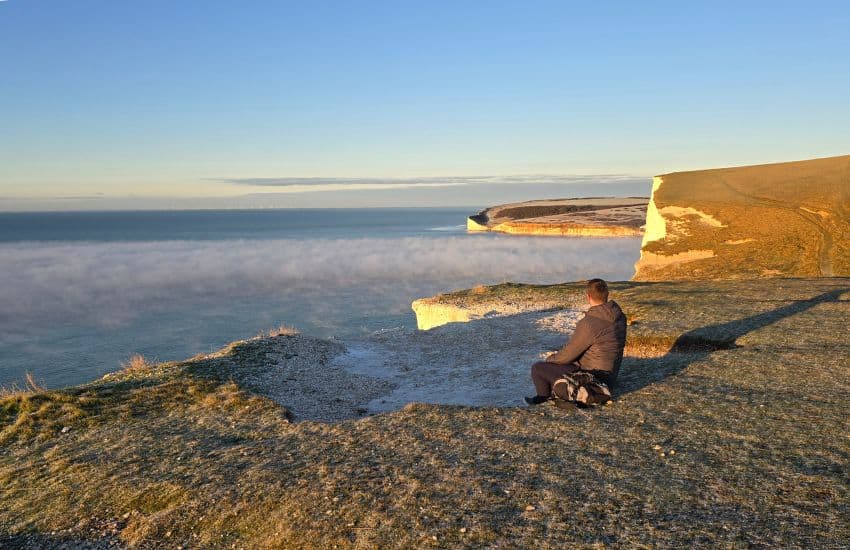
My most memorable experience of that view came on a winter morning that started as a kayak trip. We launched fine — there were swans swimming, so the water was clear. It was only once we paddled around the corner that we realised the meanders had frozen solid overnight.

We ended up smashing our paddles through the ice before admitting defeat and heading up onto the hills instead. The valley below was completely filled with cloud — a thick white blanket sitting in the basin — and up on the high path we were walking above it. It wasn’t blue sky; it was an early winter morning, all gorgeous pinks and oranges above the cloud. One of those unexpected moments that turns a failed plan into something better.
If you’re interested in coming back to explore Cuckmere Haven by water, the meanders here are excellent for paddleboarding. I’ve written a full guide to paddleboarding on the Cuckmere, which covers the best spots, access points, and what to expect.
The beach at Cuckmere Haven is one of the most photographed spots in Sussex. Those iconic coastguard cottages have featured on countless postcards, in film and TV productions, and as a default screensaver on LG TVs worldwide. Worth a wander when you get down to it.

Wildlife Along the Route
This walk passes through some genuinely exceptional wildlife habitat, and if you keep your eyes open, you’ll see far more than just cliffs and views.
Down at Cuckmere Haven, the river and its meanders are a haven for birds. Little egrets are a regular sight here — elegant white herons that wade the shallows — along with mute swans, mallards, lapwings, and wigeon in winter.
Over 200 species of birds have been recorded across the area, and on a good day, you might spot a kingfisher along the river, a peregrine falcon over the cliffs, or a kestrel hovering above the grassland. Skylarks are a constant presence on the downs, their song filling the air on spring and summer days.
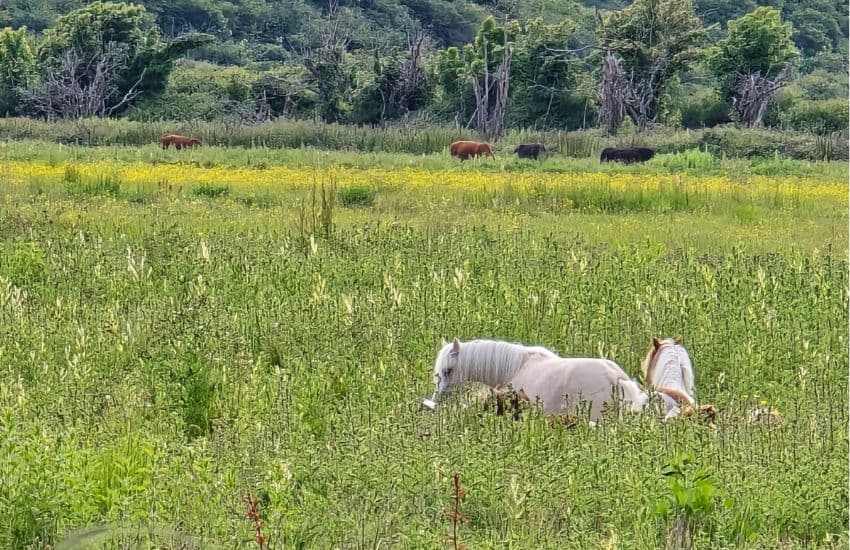
On the chalk grassland of the clifftops, look out for Sussex cattle and Shetland ponies grazing — introduced to manage the rare chalk grassland habitat. You’ll also see sheep throughout.
The chalk grassland here is considered one of the richest habitats in Europe, with a single square metre potentially containing more than 20 butterfly species and 40 different wildflowers. In summer, look out for the chalkhill blue butterfly, bee orchids, and common spotted orchids along the path.
Keep dogs on leads at all times near livestock, and avoid letting dogs into the meanders and lagoons at Cuckmere Haven — these are important nesting habitats for ground-nesting birds and sensitive wetland species.
Walking the Seven Sisters
From Cuckmere Haven, the path climbs up onto the first of the Seven Sisters, and the walk really begins in earnest. There are two routes up: the lower path along the beach gives a steep initial climb straight up the face of the first cliff, while the higher path from Exceat offers a more gradual approach. Either way, once you’re on the clifftops, you’re in for something special.

The Sisters are officially named (west to east): Haven Brow, Short Brow, Rough Brow, Brass Point, Flat Hill, Bailey’s Hill, and Went Hill. Technically, there are now eight cliffs — erosion has created a new one called Flagstaff Brow — but seven is the name that’s stuck. Don’t bother counting too carefully; you’ll be too distracted by the views.

You can walk right along the cliff edge, and the views are stunning in both directions — looking back west over Cuckmere Haven with the meanders below, and east towards Birling Gap with the white cliffs ahead.
This is what the walk is about. Keep well back from the edge, though; the chalk crumbles without warning. Keep dogs on leads up here without exception — especially if yours is an excitable spaniel with no fear of heights.
The ups and downs come thick and fast on this section. Each dip feels like progress undone as you face the next rise. Just keep going. As you walk, keep an eye out for WW2 pillboxes on the hillsides — part of the coastal defences built when invasion along this coast was genuinely expected.
Birling Gap: The Ice Cream Stop
Birling Gap is the ice cream stop. There’s a National Trust cafe here — the pub that used to be here is long gone — and in summer, an ice cream van parks out front. After the ups and downs of the Sisters, you’ve well and truly earned it.
There are steps down to the beach if you want a rest at sea level, a paddle, or a fossil hunt at low tide. Birling Gap is also a stark illustration of just how serious the erosion problem is here. Houses have been demolished over recent years as the cliff face retreats. The National Trust visitor centre has displays showing how quickly the coastline is being lost — it’s sobering stuff.

Birling Gap is a natural bail-out point if anyone’s struggling. The 13X bus stops here on Sundays and in summer, and East Dean village is a short walk inland for the Tiger Inn if you’d rather a pub than a cafe.
Belle Tout to Beachy Head
From Birling Gap the path climbs up past Belle Tout lighthouse — the squat grey lighthouse on the clifftop that you’ll have been spotting in the distance. Walk around its landward side and pause to take in the view back over the Sisters.
On a clear day, you can see the full sweep of cliffs in both directions, with the distinctive red and white stripe of Beachy Head lighthouse sitting at the base of the headland ahead. It’s a view that ends up on postcards for good reason.

This final leg up to Beachy Head is the most tiring part of the walk. Unlike the quick ups and downs of the Sisters, this is a long, steady, relentless climb. There’s no clever way around it — you put your head down and plod. The Beachy Head pub is waiting at the top, and a burger and a pint taste considerably better after you’ve properly earned it.
Near the summit, look out for the Bomber Command memorial — a bench and plaque honouring the RAF aircrew of the Second World War, many of whom flew their last missions over this headland. Worth a moment’s pause.
Navigation from Cuckmere Haven all the way to Beachy Head is about as simple as walking gets. You’re following the cliff edge. It’s genuinely very hard to get lost.
Beachy Head
At 162 metres, Beachy Head is the highest chalk sea cliff in Britain. The views from the top are the payoff for everything you’ve climbed. On a clear day you can see east towards Dungeness and west towards the Isle of Wight.
Below you, the red and white striped lighthouse sits at the base of the cliff — built in 1902 to replace Belle Tout, which kept getting obscured by sea mist. That contrast of the bright lighthouse against the brilliant white chalk is genuinely iconic.

The Beachy Head pub is right here and is a proper stop for food and drink. Next door, the Beachy Head Story is a free exhibition covering the history of the headland from Roman times to the present — well worth a look.
The Descent into Eastbourne
From Beachy Head, there are a couple of options down into Eastbourne. The most straightforward is to continue along the clifftop path, coming down past Beachy Head Road and the school. Alternatively, drop down earlier and come along the lower path past the sports fields.

My personal favourite, if the tide is right, is to drop down to the beach at Holywell and walk in along the promenade to the seafront. There’s something very satisfying about finishing a long walk by arriving at the sea.
The endpoint I always aim for is Eastbourne Pier. It’s an iconic landmark, a clear target from distance, and it just feels like the right place to finish. Get yourself fish and chips from the seafront and call it a very good day.
What to Pack
A standard day pack is all you need for this walk — you’re never far from a road. But the exposure on the clifftops is real, so don’t pack too light.
- Layers and a windproof jacket — it can be breezy even on a warm sunny day
- Waterproof jacket — it’s England
- Sun cream and a hat — when the sun’s out there’s no shade on the clifftops
- Plenty of water
- Snacks — I always bring a thermos of coffee and a decent packed lunch
- Sturdy footwear — trail shoes or boots; chalk paths get slippery after rain
- First aid basics
- Head torch — just in case
- OS Explorer OL25 or a navigation app with the route downloaded offline
Safety Considerations
- Stay well back from the cliff edge — chalk crumbles without warning
- Check the weather before you go — fully exposed to coastal wind and rain
- Keep dogs on leads near cliff edges and livestock at all times
- Tell someone your planned route and expected return time
- Mobile signal can be patchy — download maps offline before you leave
- Be honest about fitness — 20km with sustained climbing is a full day out
Wild Camping and Wild Swimming
Wild Swimming
There are several good spots along the route. Cuckmere Haven beach is the most scenic, with chalk cliffs rising above you and the river mouth nearby. Birling Gap has beach access via the steps. At the Eastbourne end, Cow Gap between Birling Gap and Eastbourne is worth dropping down to at low tide — both for a swim and for the chance to see Beachy Head lighthouse from the water, which is a completely different perspective on an iconic view.

Wild Camping
Technically, wild camping isn’t permitted in England, but if you follow Leave No Trace principles — camp late, leave early, stay out of sight and out of the way — it’s generally tolerated in remote spots. I camped on top of the first of the Seven Sisters one September, on my own.
One of those easy overnight trips where I headed up once the kids were in bed and was back early before they woke. The golden rules: go late, leave early, leave absolutely no trace. I sat on the clifftop with a freshly brewed coffee and watched the sunrise over Beachy Head. Completely worth it. If you’d rather a proper site, Cuckmere Camping Pods overlooks Cuckmere Haven directly and is hard to beat for location.
Best Time to Visit
I’ve done this walk in every season and enjoy it year-round.
Spring (March-May): Longer days, wildflowers on the clifftops, fewer crowds. The light is often beautiful.

Summer (June-August): The most popular time — long days and warm weather. But the clifftops are completely exposed with no shade, and it gets very hot. Sun cream and a hat are non-negotiable. Expect crowds near Birling Gap and Beachy Head.
Autumn (September-November): Fewer people, golden light, dramatic sea. My favourite time to do it.

Winter (December-February): Absolutely do it. A clear frosty morning on these cliffs, with mist lying in the Cuckmere valley below, is one of the best things you can do in Sussex.
I did this walk in early 2013, not long after breaking my neck, still in a neck brace. My dad made it as far as Birling Gap before claiming I was trying to kill him and stopped for a hot chocolate while we pressed on for the final leg. It was my first proper long walk after the injury. Finishing on top of Beachy Head that day meant something.
Regardless of season, walk west-to-east (Seaford toward Eastbourne). You’ll tend to have the wind at your back and build toward the spectacular finish at Beachy Head.
Nearby Highlights
Things to Do at Exceat
If you’re using Exceat as your starting point, or want to make a full day of it, there’s more on offer here than just the walk. Buzz Active runs kayaking, canoeing, and paddleboarding sessions from the canoe centre at the end of the car park — a brilliant way to explore the Cuckmere meanders from the water.
Across the road from the visitor centre, Cuckmere Cycle Co hires out bikes if you’d rather explore the valley on two wheels. Between the walk, the water, and the cycling, you could easily fill an entire day here without covering the same ground twice.
Paddleboarding on the Cuckmere
If this walk makes you want to come back and explore Cuckmere Haven from a completely different angle, the meanders are a brilliant paddleboarding destination. The calm water, the wildlife, and the access into the heart of the valley make it one of the best SUP spots in East Sussex.
I’ve written a full guide to paddleboarding on the Cuckmere, which covers the best spots, access points, and what to expect.
The Tiger Inn, East Dean
A short detour inland from Birling Gap, the Tiger Inn is a classic flint-walled Sussex pub on the village green in East Dean. A little off the main track but well worth the detour — especially with a local ale either on the green in summer or by the fire in winter.
Alfriston
If you want to add a river section to the walk, start at Alfriston. One of the most well-preserved villages in East Sussex, it is worth arriving early to explore before heading out to the coast.
Eastbourne Pier and Seafront
The natural endpoint and a classic English seaside experience. Fish and chips on the front are extremely well earned after a day on the cliffs.
A Bit of History
This stretch of coastline has more layers of history than the chalk cliffs themselves. The site where the visitor centre now stands at Exceat was once a Saxon fishing village and one of King Alfred’s naval bases — up until the 1400s, an entire settlement sat here before it was eventually abandoned.
The cliffs and the headland at Beachy Head have always been a landmark for sailors in the English Channel, referenced in old sea shanties and naval charts for centuries. The name Beachy Head itself has nothing to do with beaches — it derives from the old French beau chef, meaning ‘beautiful headland.’
The area played a significant role in both World Wars. During the Second World War, the RAF established a forward relay station at Beachy Head to improve radio communications with aircraft. A Bomber Command memorial now stands on the headland, honouring the 110,000 aircrew who served — over half of whom lost their lives — with many missions departing over these very cliffs.
As you climb up onto the Sisters, keep an eye out for WW2 pillboxes still dotting the hillsides, built in 1940 when invasion along this stretch of coast was considered a real and immediate possibility. On the foreshore near Birling Gap at low tide, you can even make out the remains of a WW1 German submarine.
Belle Tout lighthouse, which you’ll pass on the walk, has its own remarkable story. Built in 1829 and decommissioned in 1902, it famously had to be moved 17 metres inland in 1999 as the cliff edge crept ever closer. It now operates as a boutique B&B.
The ongoing story here is one of erosion. The cliffs lose an average of 0.4 metres per year, with Birling Gap losing as much as 0.7 metres annually. Houses at Birling Gap that once stood well back from the edge have had to be demolished or relocated over the years as the sea claims more of the cliff.
The Seven Sisters has also recently been formally declared a National Nature Reserve — home to globally rare chalk grassland, floodplain meadows, and hundreds of species of birds, butterflies and wildflowers.
When you join the route at Exceat, you’re also stepping onto the final leg of the South Downs Way — a 100-mile National Trail running from Winchester to Eastbourne, walked for over 8,000 years.
On Screen: Film and TV History
One of the reasons this stretch of coastline looks so familiar is that it has appeared on screen more times than you might expect. Because the Seven Sisters are kept naturally white by ongoing erosion — unlike the increasingly green-covered White Cliffs of Dover — they’re the go-to stand-in for filmmakers who want that iconic chalk cliff backdrop without modern development in shot.
My own earliest memory of seeing these cliffs on screen is from Chitty Chitty Bang Bang as a kid. The 1968 film used Beachy Head for the scene where Chitty falls from the cliffs and takes flight for the first time — you can see the lighthouse below as she gains altitude. That image has stuck with me ever since, which made it all the more special walking that same coastline years later.
The list of productions filmed here is long: James Bond’s The Living Daylights (1987) used Beachy Head for its opening cliff sequence; Harry Potter and the Goblet of Fire featured the cliffs in the Quidditch World Cup scene; Robin Hood: Prince of Thieves opened here; and Atonement used Cuckmere Haven beach for one of its most memorable scenes.
On the TV side, Luther — the BBC crime series with Idris Elba — filmed here, as did the Netflix series 3 Body Problem, which used the iconic coastguard cottages overlooking Cuckmere Haven as a key location. The Anatomy of a Scandal Netflix series also shot here. And if you have an LG TV, there’s a decent chance that very view of the white cliffs and cottages has appeared as one of your default screensavers.
Frankly, if you’ve watched British TV or film in the last 50 years, you’ve probably seen these cliffs without realising it.
Final Thoughts
The Seven Sisters walk via Beachy Head is the best day walk in East Sussex — and I’d put it up against anything in the south of England. Spectacular scenery, genuine history, a pub at the top, and the kind of views that make you glad you got off the sofa.
Accessible to most adults of average fitness, but don’t take it lightly — 20km with sustained climbing is a full day out. If you’re bringing younger children, a shorter version starting from Exceat or finishing at Birling Gap is a sensible option. At 6 and 8, mine aren’t quite ready for the full route just yet.
Walk it west-to-east, park in Eastbourne, take the bus to Seaford, don’t skip the ice cream at Birling Gap, and use Eastbourne Pier as your finish line. You’ll thank yourself.
Seven Sisters Walk FAQs
Related Guides & Reviews
The resources below cover the basics, common questions, and related kit to help you get more out of your time on the water.
- Old Man of Coniston: Lake District Trail Guide
- The Ultimate Hiking Equipment List: Hiking Gear Checklist
- Best Waterproof Hiking Boots UK Buying Guide
- How to Break in Hiking Boots Without Blisters
- Best Hikes in the UK: 7 Most Adventurous Walking Trails

Steve Cleverdon
Adventure-driven outdoor gear reviewer and paddleboarder, Steve has spent 20 years exploring rivers, coastlines, and trails across Britain and abroad, sharing what he’s learned along the way. Learn more about Steve or get in touch.