
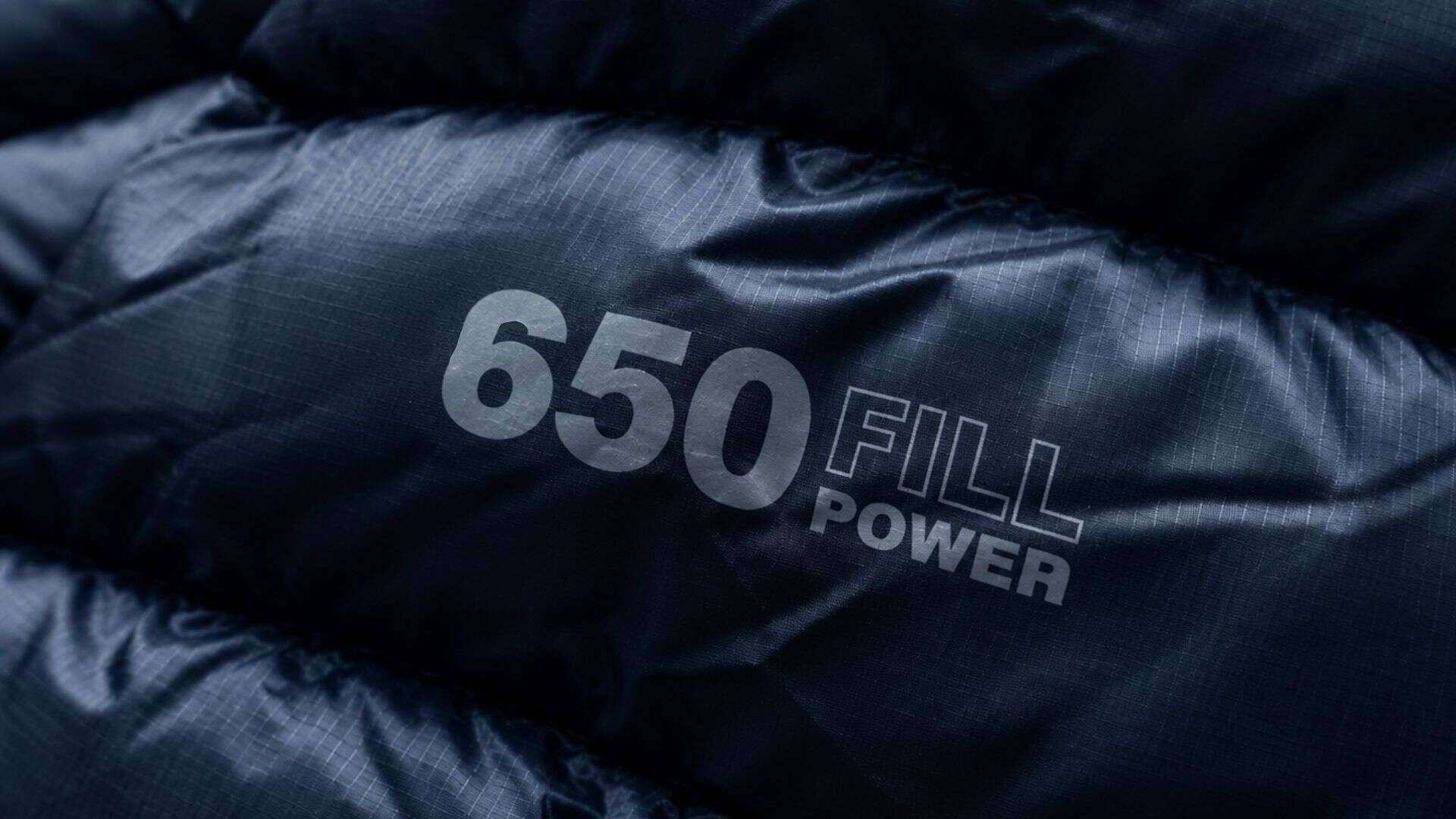
When you’re shopping for a down jacket, you’ll notice almost every one advertises its fill power: 600, 700, 800, sometimes 900 or more. The bigger numbers usually come with bigger price tags, and it isn’t always clear what the extra money gets you. So, what is down fill power, and how much should it matter when you’re choosing a jacket?
Fill power measures how much space one ounce of down fills when it lofts, in cubic inches, so 700 fill down expands to 700 cubic inches per ounce. The higher the number, the better the down traps warm air for its weight. What it doesn’t tell you is how warm a jacket is, because that depends just as much on how much down is inside.
This guide covers how fill power is measured, what the common numbers mean in practice, why European and US figures don’t match, and what fill power is worth paying for depending on how you’ll use the jacket. If you’re still deciding between down and synthetic, my down vs synthetic jacket guide covers that first.
Thanks for your support – I may earn a small commission from affiliate links in this article Learn more
The Short Answer
- What it measures: down quality, or loft per ounce. It does not measure warmth on its own.
- What’s good: 550 to 650 is fine for everyday wear, 700 to 750 is a good all-rounder, and 800 and above is premium down for light, packable kit.
- What to check alongside it: the fill weight (grams of down) and, if you can find it, the down-to-feather ratio.
- What to watch for: European-tested figures read lower than US ones, so a Euro 660 is roughly a US 725.
How Is Down Fill Power Measured?
Fill power is measured in a lab by letting a sample of down loft inside a clear cylinder, pressing it with a light weighted plate and measuring the volume it holds. That volume is then expressed as cubic inches per ounce.
The basic process looks like this:
- The down is conditioned first, with steam or tumble drying, so it’s fully lofted and at a set humidity.
- A measured sample goes into the cylinder.
- A weighted plate is lowered onto it and left to settle.
- The height the plate settles at gives the volume, which is converted to cubic inches per ounce.
Because the result depends on the down lofting freely, anything that stops it doing that, such as moisture or compression over years of use, lowers how well it performs in a jacket, even though the number on the label stays the same.

Why do European and US fill power numbers differ?
European and US labs use different standards. Europe uses BS EN 12130, while US-style figures follow the International Down and Feather Bureau (IDFB) method. The conditioning and sample sizes differ, and the US method gives higher numbers for the same down.
UK retailer Needle Sports gives these rough equivalents:
- Euro 560: about US 610
- Euro 660: about US 725
- Euro 750: about US 850
Most brands now quote US figures. If a label doesn’t say which standard it uses, it’s safest to assume it’s US. When you compare two jackets, check you’re comparing like with like.
What Do Down Fill Power Numbers Mean?
Most outdoor down sits between about 550 and 900 fill power. Each step up gives the same warmth from less down, so the jacket gets lighter and packs smaller. It also costs more. As a rough guide, using US figures:
- Below 550: lower-quality down with more feather in it. You’ll find it in cheaper high-street puffers and bedding. It works, but you need a lot of it.
- 550 to 650: solid everyday down. Fine for a winter coat or a jacket for town and dog walks, where weight and pack size don’t matter much.
- 700 to 750: a good all-round level for hiking and camping. Light enough to carry in a pack without the premium price.
- 800 to 900+: premium down for ultralight and technical kit, such as summit jackets, fast-and-light trips and high-end sleeping bags.
The jump in price between bands is often bigger than the jump in performance. Going from 800 to 900 fill saves a small amount of weight and bulk, which matters to someone counting grams on a long walk but makes little difference to a jacket you wear around town.
The OEX Kintra I’ve worn for the past few winters uses 700 fill duck down with a 90/10 down-to-feather ratio. It’s been a good all-rounder for dog walks, day hikes and camping trips, and kept me comfortable at 0°C with a base layer and fleece underneath.

For most people in the UK, 600 to 750 fill is the sensible range. If you’re choosing between two similar jackets, a lower fill power with more grams of down is often a better buy than a higher one with less. For my picks across both down and synthetic, see my guide to the best insulated jackets.
Down Fill Power vs Fill Weight: Which Matters More for Warmth?
For warmth, fill weight usually matters more. Fill power tells you the quality of the down. Fill weight tells you how much of it is in the jacket, in grams. You need both to judge how warm a jacket will be.
REI’s fill power guide gives a clear example: a jacket with 30g of 900 fill down won’t be as warm as one with 100g of 450 fill down. In theory, 50g of 900 fill gives about the same warmth as 100g of 450 fill, but at half the weight and pack size. That’s what you’re paying for with higher fill power.
The catch is that many brands don’t publish fill weight. If you can’t find it, the jacket’s overall weight, how thick the baffles look and the brand’s own description of its intended use are the next best clues. When two jackets list the same fill power, the one with more grams of down will be warmer.
Construction also plays a part. Sewn-through baffles leave thin cold spots along the stitch lines, while box-wall baffles let the down loft evenly. The shell fabric, hood and cuffs all affect how much heat you keep in too.
Does Higher Down Fill Power Mean a Warmer Jacket?
Not on its own. Higher fill power means warmer for the weight, not warmer overall. A higher-fill jacket with the same amount of down will be warmer, but brands often use the better down to make a lighter jacket rather than a warmer one.
A few other things on the label affect what the number means.
Duck down vs goose down
Goose down clusters tend to be larger than duck down, so goose down usually reaches higher fill powers and costs more. The fill power number is what counts, though. A 650 duck down and a 650 goose down loft by the same amount in the test.
Down-to-feather ratio
The ratio, such as 90/10 or 80/20, tells you how much of the fill is down clusters and how much is small feathers. More down means more loft and less weight. 90/10 is common in outdoor jackets, and 80/20 is a sensible minimum for a winter jacket.
What happens when down gets wet?
Down loses most of its loft when it’s wet, whatever the fill power. A high number won’t help in drizzle or damp air. This matters in the UK, where winters are more often wet and mild than cold and dry. Hydrophobic (water-resistant) treated down helps it cope with damp and dry faster, but it isn’t waterproof. If you’ll be out in rain, wear a waterproof over a down jacket, or look at synthetic insulation such as PrimaLoft instead. My guide to the best Gore-Tex jackets covers the waterproof layer.

Final Thoughts
So, what is down fill power in practice? A useful number, but a measure of down quality, not a warmth rating. Read it alongside the fill weight, check whether it’s a European or US figure, and match it to how you’ll use the jacket.
For most UK hiking and camping, a good mid-range fill with enough down in it will serve you better than chasing the highest number on the rack.
Related Guides & Reviews
If you’re choosing or caring for an insulated jacket, these will help:
- Down vs synthetic jacket: which should you buy?
- Best insulated jackets
- What is PrimaLoft?
- How to wash a puffer jacket
- OEX Kintra down jacket review

Steve Cleverdon
Adventure-driven outdoor gear reviewer and paddleboarder, Steve has spent 20 years exploring rivers, coastlines, and trails across Britain and abroad, sharing what he’s learned along the way. Learn more about Steve or get in touch.