
Looking for the perfect inflatable paddleboard? Wave SUPs has built a solid reputation in the UK for quality boards that actually deliver on their promises. I’ve spent countless hours on my Wave paddle boards, and this guide breaks down exactly what each model offers.
There are six distinct models of Wave paddle boards, each designed for different paddling styles. Whether you’re just starting out or chasing personal bests, there’s likely a Wave board that fits your needs and budget.
Psst… Automatically score an extra 10% off at checkout when you click through any of my links on this page. It’s a decent discount that makes these already well-priced boards even better value.
This article contains affiliate links. If you buy through them, I may earn a commission at no extra cost to you. Learn more here
What’s New in the Wave 3.0 Range
Before diving into individual boards, it’s worth understanding what’s actually changed across the whole range — because several of the improvements apply to every board in the 3.0 lineup.
WST™ — Welded Seam Technology The biggest structural change. Rather than traditional glued seams, Wave now heat-fuse the military-grade PVC layers together across the entire range. The result is a more rigid board at pressure, with less chance of seam separation over time. On the water, it translates to less flex and more confidence at speed.
WQR™ — World’s Quickest Release Leash Wave’s new leash system uses a push-button release mechanism rather than the traditional velcro/buckle combo. Anyone who’s ever fumbled with a leash in cold water will appreciate this more than the marketing copy suggests.
10% Lighter Across the Core Range Wave has shaved roughly 10% off the weight of the Cruiser and Tourer lines. That might not sound dramatic, but when you’re lugging your board to the water’s edge, every gram counts.
Quick-Release Fins Tool-free setup and clip-in fins across the range. The 2.0 fins required a bit more fiddling. Small thing, big quality-of-life improvement.
New Boards Two brand new additions: the Surf 3.0 (Wave’s first dedicated surf SUP) and the Hopper 3.0 (an inflatable bodyboard). More on both below.
What Sets Wave Apart
There are dozens of inflatable SUP brands on the market, so what actually justifies recommending Wave over the alternatives?
A few things stand out consistently.
- First, value: Wave boards consistently come with full kits — paddle, pump, leash, fins, bag — and the kit quality is noticeably better than budget brands at the same price. No hidden extras or essential accessories sold separately.
- Second, build integrity: the military-grade PVC and now WST construction means these boards hold pressure properly and don’t develop that worrying soft patch that cheaper boards show after a season.
- Third, they actually inflate to 20 PSI — and a board that properly holds 20 PSI genuinely feels closer to a hardboard underfoot than most inflatables at lower pressures.
I’ve been paddling these boards alongside competitors at twice the price. They’re not perfect, but for what you pay, they’re hard to argue with.
Quick Comparison: All Wave Boards at a Glance
| Board | Length | Width | Thickness | Weight | Ideal For | Level | Price |
|---|---|---|---|---|---|---|---|
| Cruiser 3.0 | 10’9″ | 32″ | 6″ | 7.9kg | All-round, beginners | Beginner | £159.99 |
| Tourer 3.0 | 10’3″ or 11’3″ | 32″ | 6″ | 8kg | Touring, exploring | Beginner+ | From £179.99 |
| Recon 3.0 | 10’4″ | 33″ | 6″ | 9.1kg | Fishing, expeditions | All levels | £219.99 |
| Woody 3.0 | 10’9″ | 32″ | 6″ | 8.3kg | Leisure, yoga, style | Beginner+ | £209.99 |
| Pro 3.0 | 12’6″ | 32″ | 6″ | 9.5kg | Performance, touring | Intermediate+ | £269.99 |
| Surf 3.0 | 8’6″ | 29.5″ | 4″ | 6.5kg | Wave riding | Intermediate | £179.99 |
| Wildcat Kids | 8’6″ | 30″ | 4″ | 7kg | Kids, families | Children | £219.99 |
| Hopper 3.0 | 44″ | 20″ | 4″ | 3kg | Bodyboarding | All | £69.99 |
Wave Paddle Boards: The Full 3.0 Range
Right, let’s get into it. Here’s my full breakdown of every Wave paddle board currently available — what they offer, who they’re for, and what’s actually changed in the 3.0 update.
Wave Cruiser 3.0
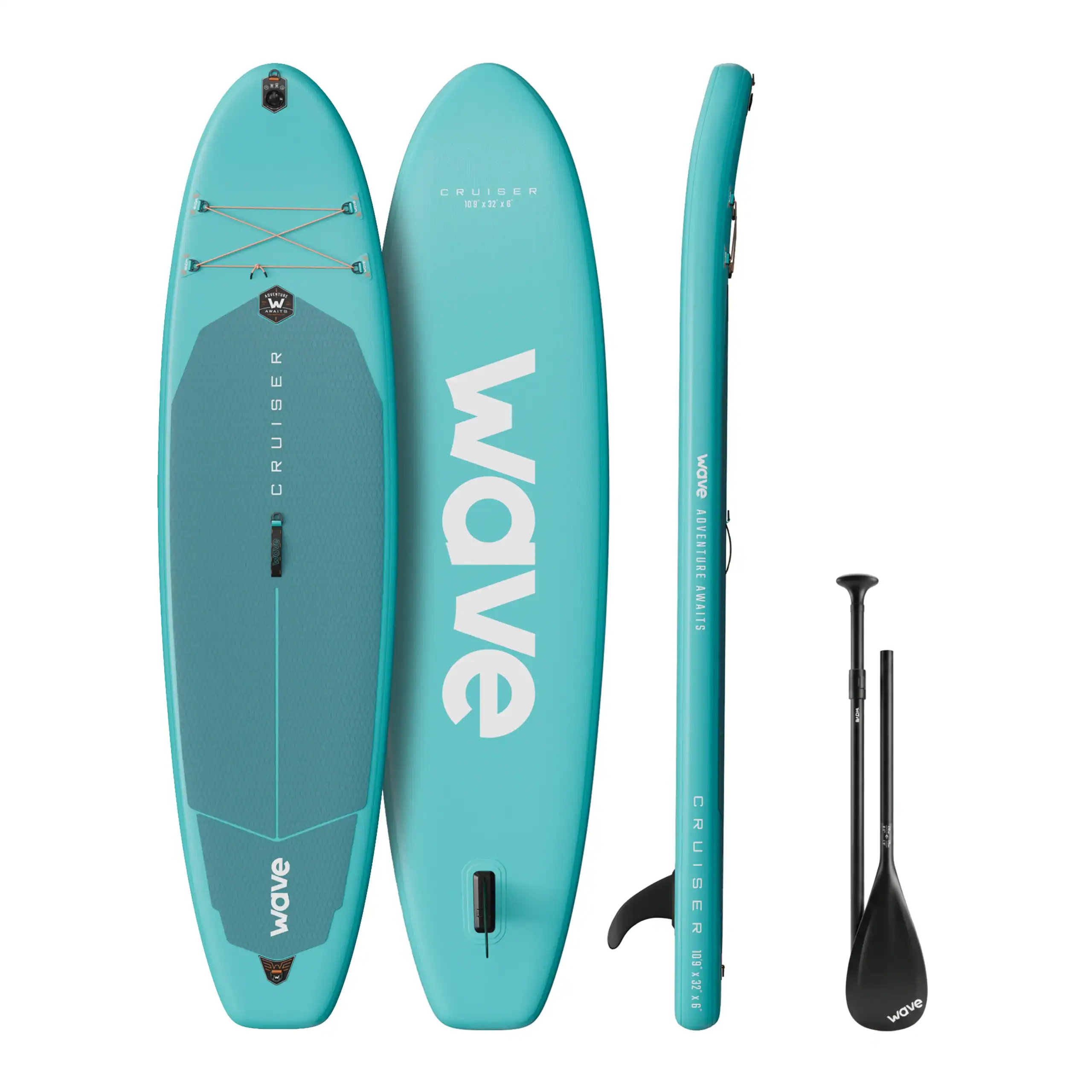
Best For: New paddlers and weekend warriors who want one board that does everything well.
Key Benefits:
- Proper stability: 32″ width gives you confidence from day one
- Lighter than ever: ~10% weight reduction over the 2.0 Built to last:
- WST welded construction handles bumps and scrapes
The Cruiser 3.0 is still Wave’s Swiss Army knife. Wide, stable, and forgiving enough that complete beginners get on it and immediately feel at ease — but capable enough to catch small waves or explore new spots once you’re comfortable.
The 32″ width gives you a solid platform for learning, while the 6″ thickness keeps you well clear of the water. What’s genuinely changed in the 3.0 is the overall rigidity at pressure. The WST construction means the board holds its shape better than the 2.0 did, which makes a noticeable difference when you’re trying to paddle in a straight line.
At around 7.9kg — roughly 10% lighter than the previous Cruiser 2.0 — it’s also easier to carry to the water without feeling like you’ve already done your workout.
The kit includes a paddle, pump, leash, fins, and a carry backpack. For the price, it’s a solid package.
What’s Changed from the 2.0:
- Quick-release fins (tool-free setup)
- WST welded seam construction (stronger, more rigid)
- ~10% lighter build
- WQR™ quick-release leash
Pros:
- Excellent entry point for beginners
- Noticeably lighter than the 2.0
- Better rigidity thanks to WST construction
- Great value full-kit package
- Versatile shape works in waves and flat water
- Quick setup and packdown
Cons:
- Only available in one length (10’9″)
- Paddle is aluminium rather than carbon — fine for beginners, but you’ll notice the difference eventually
- 140kg weight limit might be tight for larger paddlers with gear
Unlock 10% off automatically when you click through my links
Wave Tourer 3.0
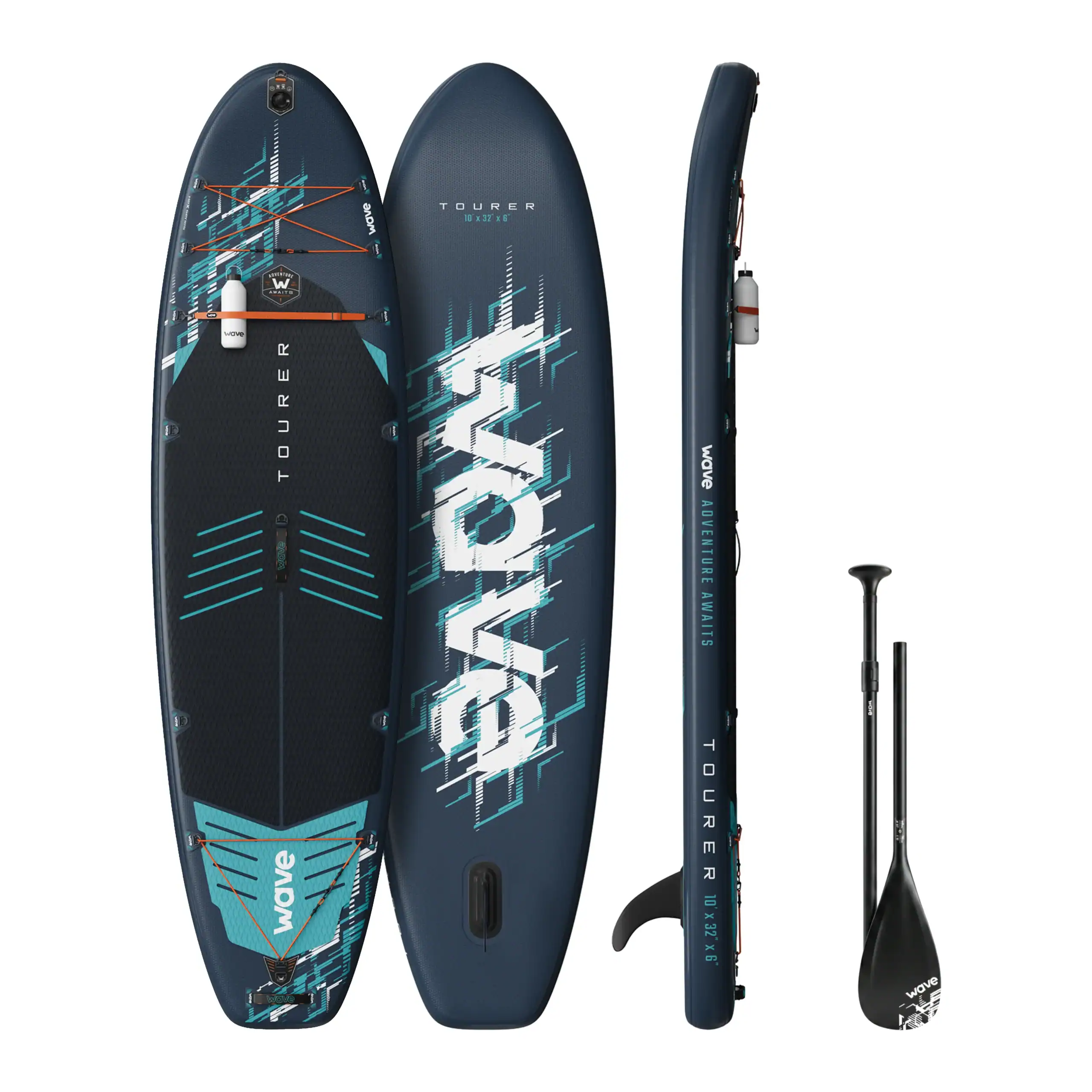
Best For: Paddlers who want a bit more range and glide, with stability for exploring.
Key Benefits:
- Two sizes: 10’3″ or 11’3″ depending on your goals
- Lighter construction than the 2.0
- Same 32″ stability width with added touring length
The Tourer 3.0 is arguably the smartest buy in the Wave range for most people. The extra length over the Cruiser gives you noticeably better tracking and glide — you put less effort in and go further with each stroke. That matters if you’re planning coastal paddles, river sessions, or just want to cover ground.
The two-size option is genuinely useful. The 10’3″ is more manoeuvrable and suits lighter paddlers or tighter waterways. The 11’3″ is the one to go for if you want the full touring benefit — it tracks better over distance and handles a bit of chop more confidently.
Construction is the same WST-based build as the rest of the 3.0 range. Weight has come down ~10% from the 2.0, which is welcome when you’re shifting it on and off the car roof.
If you’re not sure whether to get the Cruiser or the Tourer, get the Tourer. It’s only £20 more, and you’ll appreciate the extra length once you’ve got a session or two under your belt.

I’ve been using the Tourer 2.0 for a few years now, for everything from sunrise sessions to coastal tours, and the Tourer has become my go-to board whenever introducing friends who are learning how to paddleboard for the first time.
The Tourer is built for adventure!
What’s Changed from the 2.0:
- WST construction across both sizes
- ~10% lighter
- WQR™ leash system
- Quick-release fin system
- Price reduced on 10’3″ entry point
Pros:
- Two-size option suits different paddlers and use cases
- Better glide and tracking than an all-rounder
- Lighter 3.0 build
- 32″ width keeps it stable for beginners
Cons:
- Slightly less manoeuvrable than the Cruiser at 11’3″
- Included paddle is the same as the Cruiser — aluminium, not carbon
Want the full story? Check out my Wave Tourer review for more in-depth insights.
Unlock 10% off automatically when you click through my links
Wave Pro 3.0
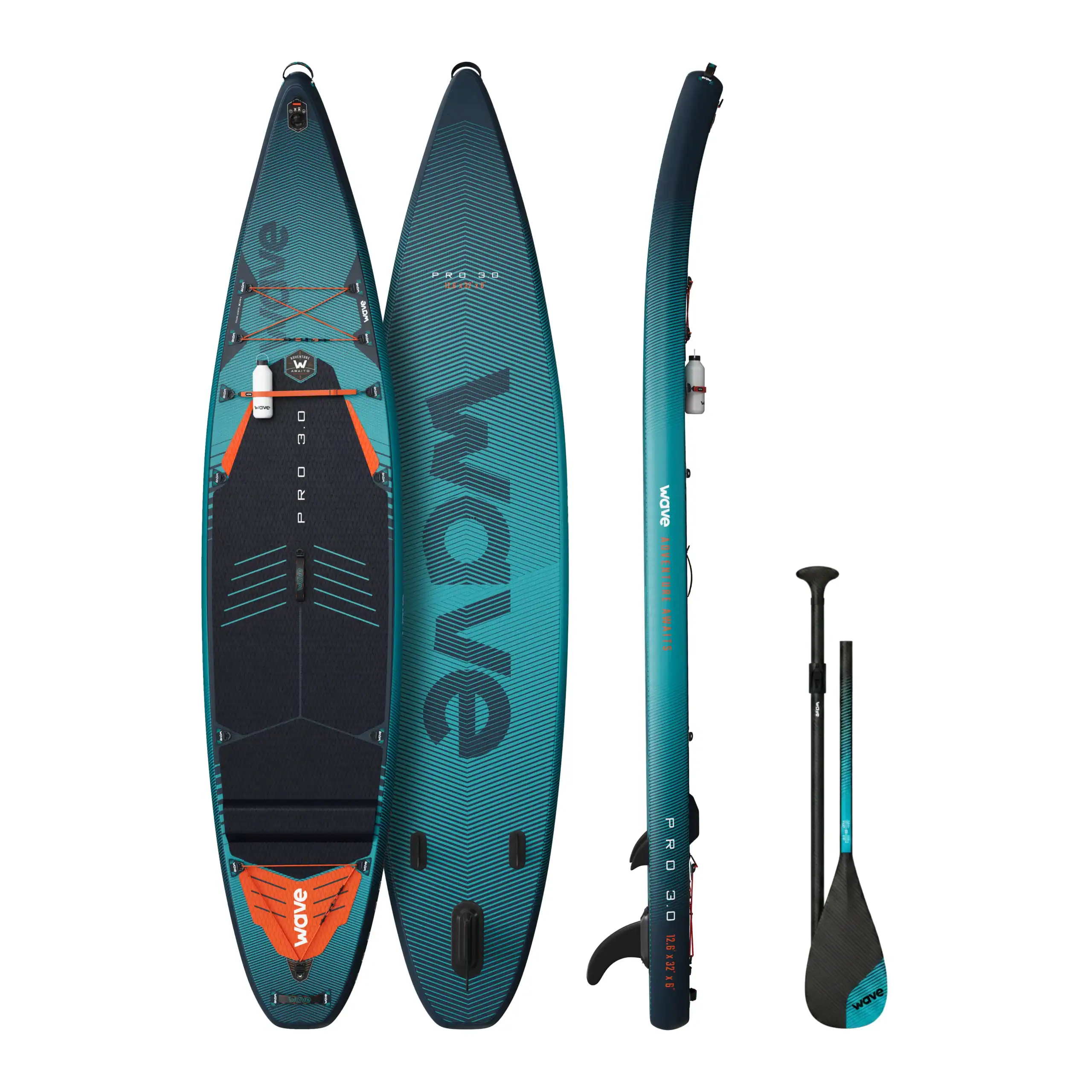
Best For: Paddlers who want touring performance and race-level tracking without a hardboard price tag.
Key Benefits:
- 12’6″ length: genuinely fast, with excellent tracking
- 32″ wide — significantly more accessible than the 30″ Pro 2.0
- Carbon-fibre paddle and wheeled case included
I’ve recently tested the Wave Pro 3.0 personally at Cuckmere Haven on the East Sussex coast, and it’s comfortably the most impressive board in the Wave range. I’ve written a full review if you want the deep-dive: Wave Pro 3.0 Review

The headline change from the Pro 2.0 is the width. The 2.0 was 30″ — narrow enough that it required some experience to feel comfortable. The 3.0 has gone to 32″, bringing it in line with the rest of the range and making it accessible to a much wider group of paddlers. You still get the speed and tracking of a 12’6″ board, but you’re not white-knuckling it from side to side while you find your balance.
The kit is the best in the range by a clear margin: a 3-piece carbon-fibre paddle, a triple-action pump, a wheeled carry case, a coiled leash, quick-release fins, and a repair kit. At £269.99 for the full package, it represents genuinely strong value against comparable touring boards from other brands.
The WST construction at 20 PSI gives it a rigidity that genuinely makes you question whether you need a hardboard. On calm water, the glide is exceptional. The quick-release fin system is a significant upgrade over what the 2.0 shipped with.
What’s Changed from the 2.0:
- Width increased from 30″ to 32″ — a significant accessibility improvement
- WST welded seam construction
- Triple-action pump (upgrade from single-action)
- Wheeled carry case (new)
- WQR™ leash system
- Quick-release tri-fin setup
Pros:
- Best-in-class speed and tracking at this price
- 32″ width makes it accessible to intermediates (big improvement over 2.0)
- Carbon paddle and wheeled case included
- Exceptional rigidity at 20 PSI via WST construction
- Strong value versus comparable touring boards
Cons:
- At 12’6″, it’s longer than average — needs a bit more space to manoeuvre
- The wheeled bag is slightly awkward on your back
- Not the right choice if you’re a complete beginner
Unlock 10% off automatically when you click through my links
Check out my full in-depth review of the Wave Pro 3.0 – New for 2026!
Wave Recon 3.0
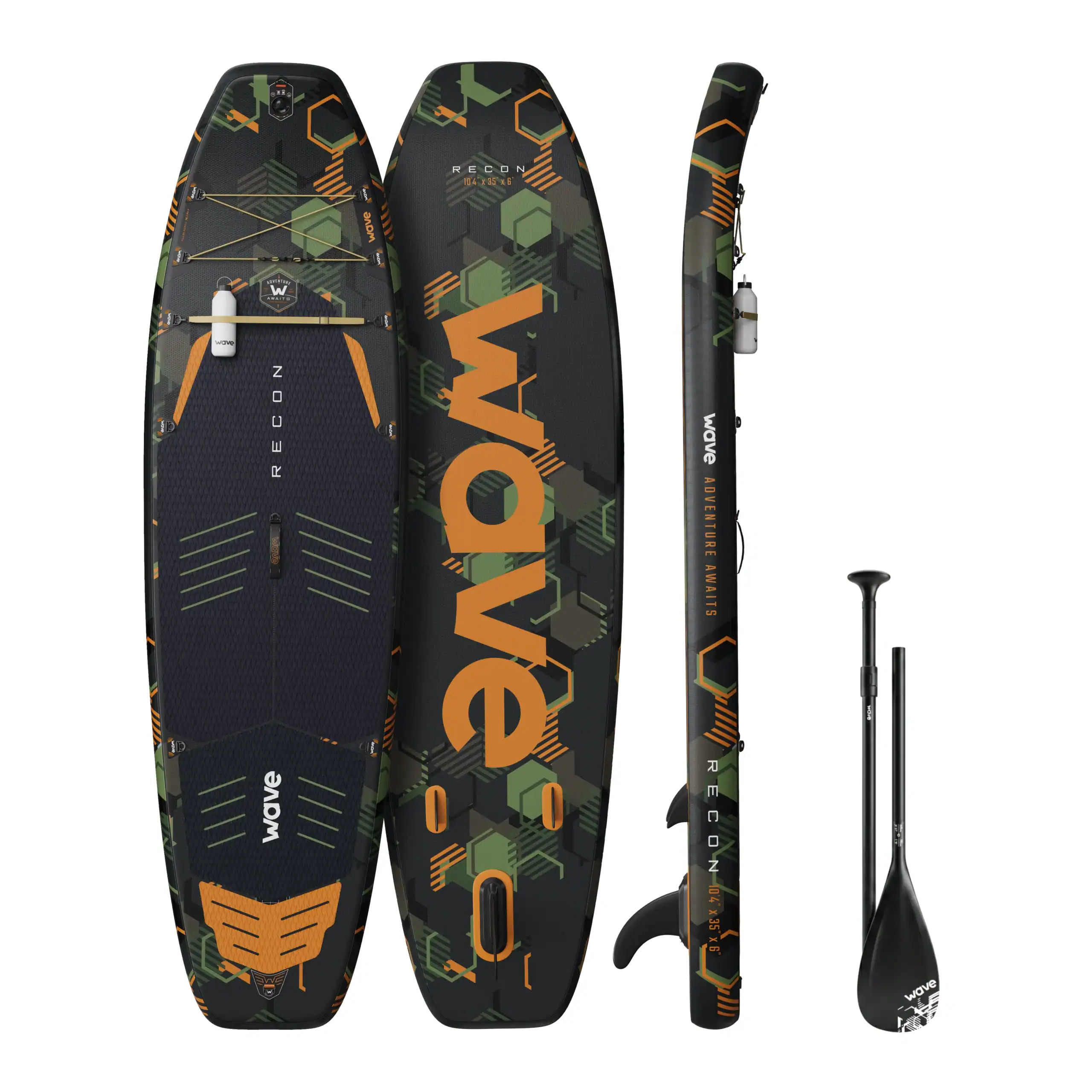
Best For: Anglers, adventurers, and anyone who wants a tank of a board.
Key Benefits:
- 33″ wide deck: the most stable Wave board by some margin
- Triple-layer military-grade PVC — this thing is built tough
- Quick-release triple-fin system for variable conditions
The Recon 3.0 is the outlier in the Wave range, and deliberately so. Where every other board in the lineup is 32″ wide, the Recon stretches out to 33″ — plus it’s built with triple-layer PVC rather than the standard double. It’s heavier as a result (around 8.5kg estimated), but the platform you get in return is rock-solid.
Designed with fishing in mind, the extra width means you can stand, turn, cast, and crouch without wobbling. The full-length diamond-grooved EVA deck pad gives grip from nose to tail, which matters when you’re shifting around on the board.
The triple-fin system is a nice touch for this use case — you can configure it for flatwater stability or more directional control in moving water or coastal conditions.
For the 3.0 update, Wave has applied the same WST welded construction and heat-fused seams that the rest of the range benefits from. At 20 PSI with that triple-layer build, the rigidity is genuinely impressive.
What’s Changed from the 2.0:
- WST welded seam technology applied to triple-layer PVC build
- Quick-release triple-fin system
- WQR™ leash
- Refined 2026 deck pad design
Pros:
- Widest, most stable board in the range
- Bulletproof triple-layer PVC construction
- Triple-fin system handles multiple conditions
- Great for fishing, photography, and loaded expeditions
Cons:
- Heavier than the rest of the range due to a triple-layer build
- Less suited to distance paddling — it’s built for stability, not speed
Unlock 10% off automatically when you click through my links
Wave Woody 3.0
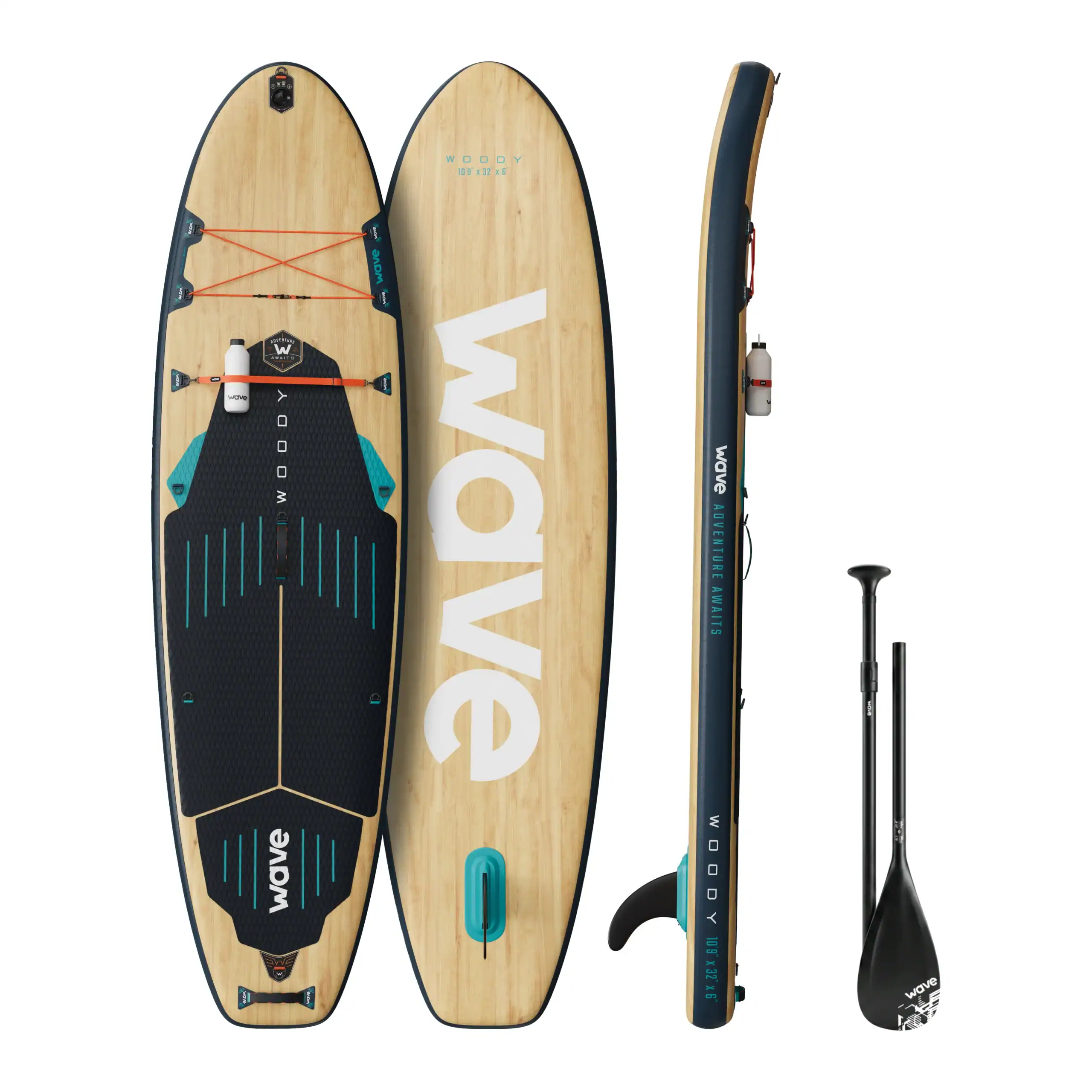
Best For: Paddlers who want a capable all-rounder that also turns heads on the water.
Key Benefits:
- Signature high-definition woodgrain finish — genuinely eye-catching
- 32″ width for stable, versatile use
- Military-grade PVC with WST construction
The Woody is an odd one to categorise, because it’s essentially the same shape and spec as the Cruiser but with a completely different aesthetic — and a slightly higher price tag. The woodgrain design is UV-stabilised material, not a printed decal, which means it won’t fade after a summer of use in the way some patterned boards tend to.
In terms of performance, it sits squarely in the all-round category. Same 10’9″ length, same 32″ width, same 6″ thickness as the Cruiser. The main reason to choose the Woody over the Cruiser is honestly the look — if aesthetics matter to you, this is the board to go for.
For 2026, the 3.0 update brings the WST construction, quick-release fins, and WQR™ leash system. Available in Navy and Aqua colourways, both with the woodgrain finish.
If you’re going to be photographing your paddling sessions or you simply want a board that gets a few comments at the water’s edge, the Woody earns its price premium over the Cruiser.
What’s Changed from the 2.0:
- WST welded seam construction
- WQR™ leash system
- Quick-release fins
- Two new colourways (Navy and Aqua) with an updated woodgrain finish
Pros:
- Distinctive design that holds up over time
- WST construction delivers better rigidity than 2.0
- 32″ width makes it stable and versatile
- Suits yoga, photography, and casual cruising
Cons:
- Spec-for-spec, very similar to the cheaper Cruiser
- Only one size and no colour options beyond the two new colourways
Unlock 10% off automatically when you click through my links
Wave Wildcat Kids (2-in-1 SUP/Kayak)

Best For: Kids and families who want versatility and a safe entry to paddleboarding.
Key Benefits:
- Kid-friendly 8’6″ size and 30″ width
- Convertible SUP/kayak functionality
- Safety-focused leash and paddle setup
The Wildcat Kids carries over into the 3.0 era as the go-to option for younger paddlers and family use. At 8’6″ with a 30″ wide deck, it’s a manageable size for children and lighter paddlers.
The convertible SUP/kayak feature — attaching a seat and using a split paddle — is genuinely useful for families where kids lose confidence mid-session and want to switch to seated paddling. It’s not a trick that works on most SUPs; the Wildcat is specifically designed around it.
At £219.99, it’s slightly pricier than you might expect for a kids’ board, but the dual functionality and complete package make it a decent value for family use.
Pros:
- Converts between SUP and kayak
- Stable and manageable size for children
- Complete package with age-appropriate paddle
Cons:
- Not the best choice for adults due to size limitations
- Slightly pricier than comparable kids’ boards
Unlock 10% off automatically when you click through my links
Wave Surf 3.0 — New for 2026
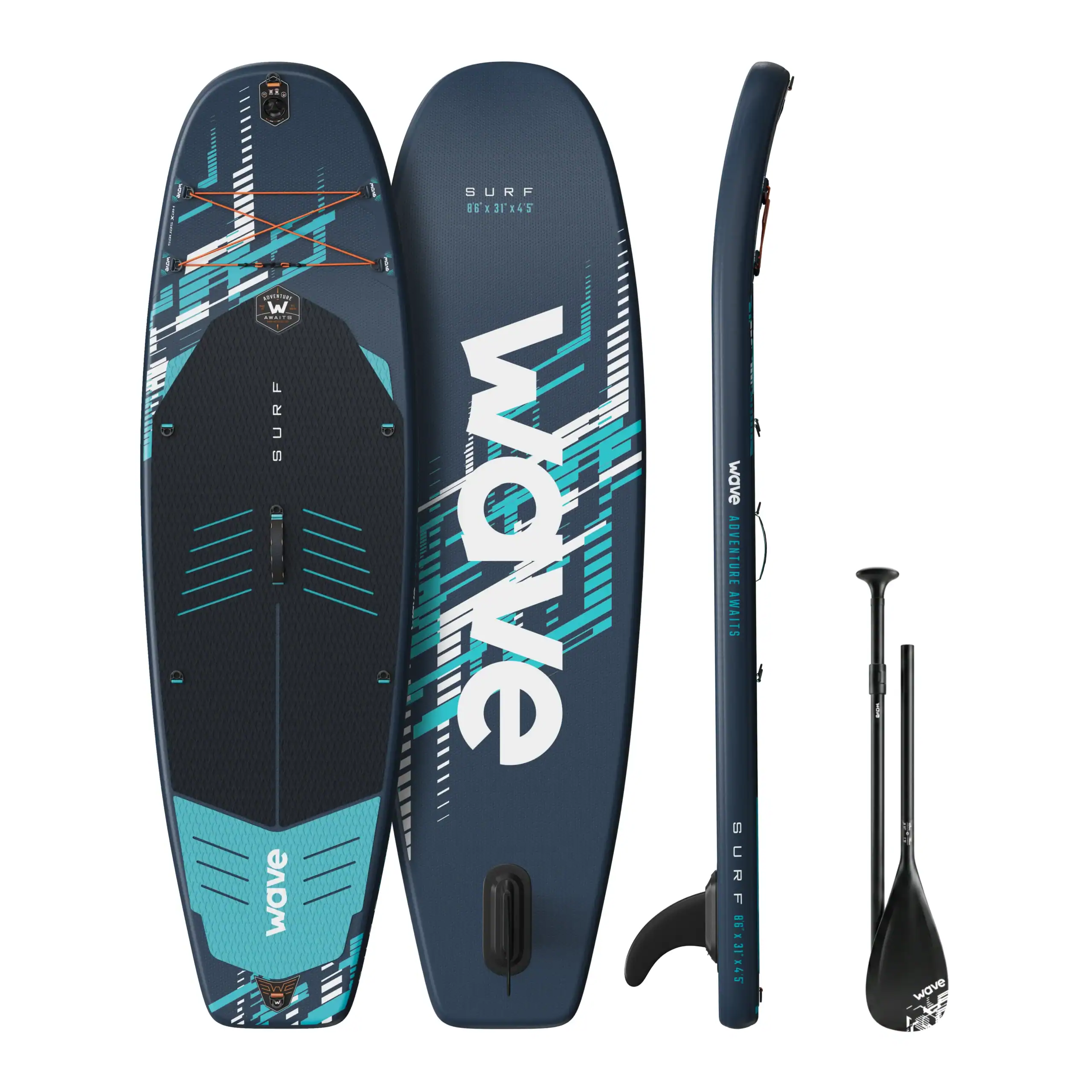
Best For: Anyone who wants to catch waves rather than just paddle on flat water.
Key Benefits:
- 8’6″ short board shape designed specifically for surfing
- 4″ thin profile with surf-style rocker — a genuinely different feel to the rest of the range
- 7kg — light enough to manoeuvre in the surf zone
This is the most significant new addition to the Wave range for 2026. The Surf 3.0 is not just a shorter version of an all-rounder — it’s a completely different board designed around surf performance. The 4″ thickness (compared to the standard 6″ across the rest of the range), combined with a surf rocker, creates a board that responds differently on a wave.
At 8’6″ and 29.5″ wide, it’s noticeably narrower and shorter than anything else in the Wave lineup. You won’t want to use this for long flatwater paddles — it’s not built for tracking, it’s built for turning. But if you’re heading to the coast specifically to catch waves, this is the board that makes sense.
The WST construction and 20 PSI capability mean it still inflates firm, which matters in surf conditions where a soft board is immediately punishing. At 7kg, it’s manageable to carry down to the beach and easy to duck-dive through whitewater.
I haven’t tested this one personally yet, but based on the spec and design, it fills a genuine gap in the Wave range that the old Wildcat (originally aimed at kids) couldn’t really cover for adult surfers.
What’s New:
- Entirely new model — no 2.0 predecessor in this exact spec
- Surf-specific rocker profile
- 4″ thickness (vs 6″ across the rest of the range)
- Narrower 29.5″ width for improved surf response
- WST construction, WQR™ leash
Pros:
- Surf-specific board — not just a short all-rounder
- Light at 7kg and easy to handle in the water
- WST construction holds up in surf conditions
- Competitive price at £179.99
Cons:
- Not suitable for flatwater touring or beginners
- 29.5″ width requires some balance and confidence
Unlock 10% off automatically when you click through my links
Wave Hopper 3.0 — New for 2026

Best For: Wave enthusiasts who want something portable and cheap to complement their SUP, or kids learning to bodyboard.
This one’s a bit different from everything else on this page — the Hopper 3.0 is not a paddleboard. It’s an inflatable bodyboard. But I’m including it because it’s new to the Wave range for 2026, and if you’re already a Wave fan, it’s worth knowing about.
At 3kg and £69.99, it’s light, packs down small, and uses a drop-stitch core that gives it more rigidity than a foam bodyboard at a fraction of the faff. If you’re heading to the coast with your paddleboard and want something the kids can use in the shore break, this fits neatly alongside your existing kit.
It’s not something you’d buy as a standalone purchase for serious bodyboarding. But as an add-on to a family beach kit, it’s a reasonable bit of kit at the price.
Unlock 10% off automatically when you click through my links
Choosing Your Wave Board
Still not sure which one’s for you? Here’s a quick steer:
Complete beginner, want to get on the water as simply as possible → Cruiser 3.0 Widest beginner-friendly board, best price in the range, everything you need included.
Want to go further and explore more → Tourer 3.0 Spend the extra £20 over the Cruiser. The longer length is worth it once you’ve got your balance sorted.
Going fishing or want maximum load-carrying stability → Recon 3.0 The only choice if you need a proper work platform on the water. The extra width and triple-layer PVC put it in a different league for stability.
Want something that looks the part and performs well → Woody 3.0 If aesthetics matter, the Woody earns its place. Same core spec as the Cruiser but with a finish that holds up over time.
Want the best board in the range → Pro 3.0 If you’re serious about paddling or want a board you’ll genuinely progress with, the Pro 3.0 is the one. The 32″ width on the 3.0 (vs 30″ on the 2.0) makes it far more accessible than its predecessor.
Heading to the coast to surf waves → Surf 3.0 New for 2026 and the only Wave board designed for wave riding. If flat water bores you, this is worth a look.
Buying for children → Wildcat Kids The convertible SUP/kayak functionality makes it the sensible choice for younger paddlers.
My Take on Wave SUPs
The 3.0 range is a meaningful step forward from the 2.0 series. The WST construction is the most tangible improvement — boards that hold pressure better, flex less, and feel more planted on the water. The lighter weights across the Cruiser and Tourer make a practical difference for anyone who’s lugged a board across a beach.
The big-picture move that stands out to me is the Pro 3.0 going to 32″ wide. The 30″ Pro 2.0 was technically impressive but limited to paddlers who already had decent balance. At 32″, the 3.0 is a board that genuinely suits paddlers from intermediate upward. That’s a smart call.
The Surf 3.0 fills the obvious gap in the range for coastal paddlers who actually want to ride waves rather than just paddle alongside them. I’m looking forward to getting one in the water later this season.
For the money, Wave boards remain one of the better-value options in the UK iSUP market.
The 10% discount through my links makes these boards even better value. Wave’s pricing is already competitive, and the discount puts them ahead of many alternatives.
Wave Paddle Boards FAQs
Related Guides & Reviews
The resources below cover the basics, common questions, and related kit to help you get more out of your time on the water.
- How To Paddle Board: Complete SUP Guide for Beginners
- Best Budget Paddle Boards in the UK
- Best Paddle Board Accessories
- Wave Pro 3.0 Paddleboard (SUP) Review
- Wave Tourer SUP Review
- Bluefin Cruise Paddle Board Review
Images courtesy of Wave.

About the Author
Steve Cleverdon is an outdoor adventure specialist with 15+ years of hiking, camping, and paddle boarding experience. He has conquered Europe’s toughest trails including the GR20 in Corsica, walked 3,000km solo across New Zealand, and worked professionally in the outdoors industry. Steve’s gear reviews and recommendations are based on real-world testing across four continents, from coastal waters to mountain peaks. Learn more about Steve or get in touch.


