For solo backpackers, the usual options are a bivvy bag — ultralight, but claustrophobic and exposed — or a conventional tent that adds unwanted weight and bulk. Neither feels like the right answer when you want to go light without feeling like you’re roughing it more than necessary.
Most shelters light enough to fit inside a small pack, either cut corners on weatherproofing, charge a premium you’d expect from a brand with decades behind them, or both.
The StealthTrail 1P is a Traverseon tent that is trying to change that. A double-walled, four-season tunnel tent weighing just 1.35 kg, it sits neatly between a bivvy and a full backpacking tent — ultralight and low-profile, but with enough structure to feel like a shelter rather than a last resort. At just over £100, it’s lighter than most tents at this price, and cheaper than most tents at this weight.
I took it out for an overnight camp in the East Sussex countryside to find out.
Thanks for your support – I may earn a small commission from affiliate links in this article Learn more
Traverseon kindly gifted the StealthTrail 1P for review. All opinions are my own.
At a Glance
- Build Quality
- Performance
- Accessories & Kit
- Value for Money
The Verdict
The Traverseon StealthTrail 1P is a surprisingly capable ultralight shelter for the money. It’s not a tent for those who want to sit up, spread out, or camp in comfort — it’s a go-light option for solo backpackers who want to cover miles and sleep dry without being weighed down. I’m yet to test it in rain before drawing any firm conclusions on the weatherproofing, but the weight, pack size, and price point make it a compelling buy for anyone stepping into ultralight wild camping without wanting to spend several hundred pounds doing it.
See the full ratings breakdown below, or jump straight to my personal testing experience.
Best For: Solo hikers and wild campers looking for an affordable, ultralight entry-level tent for wild camping.
Price: £105 direct from Traverseon
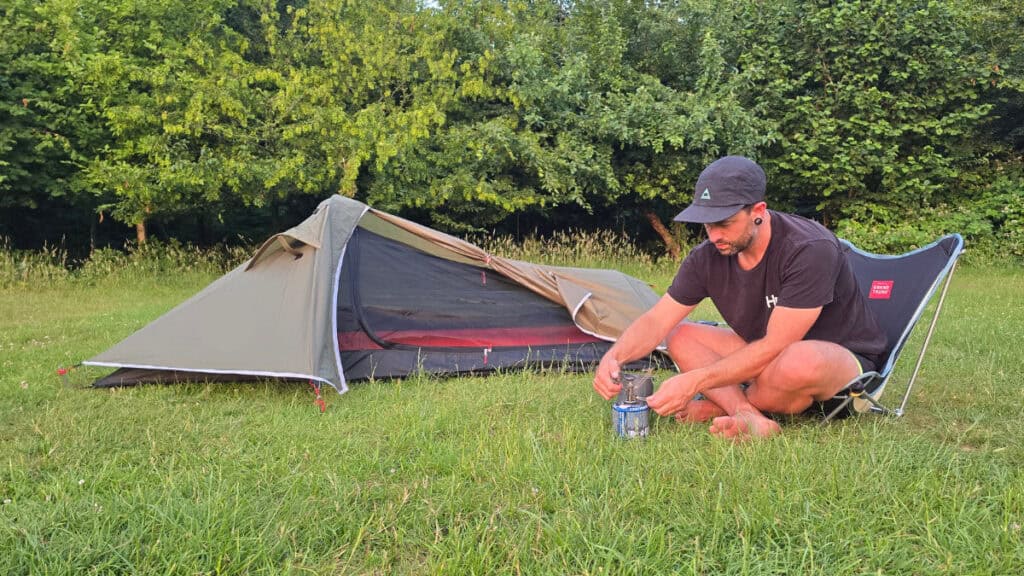
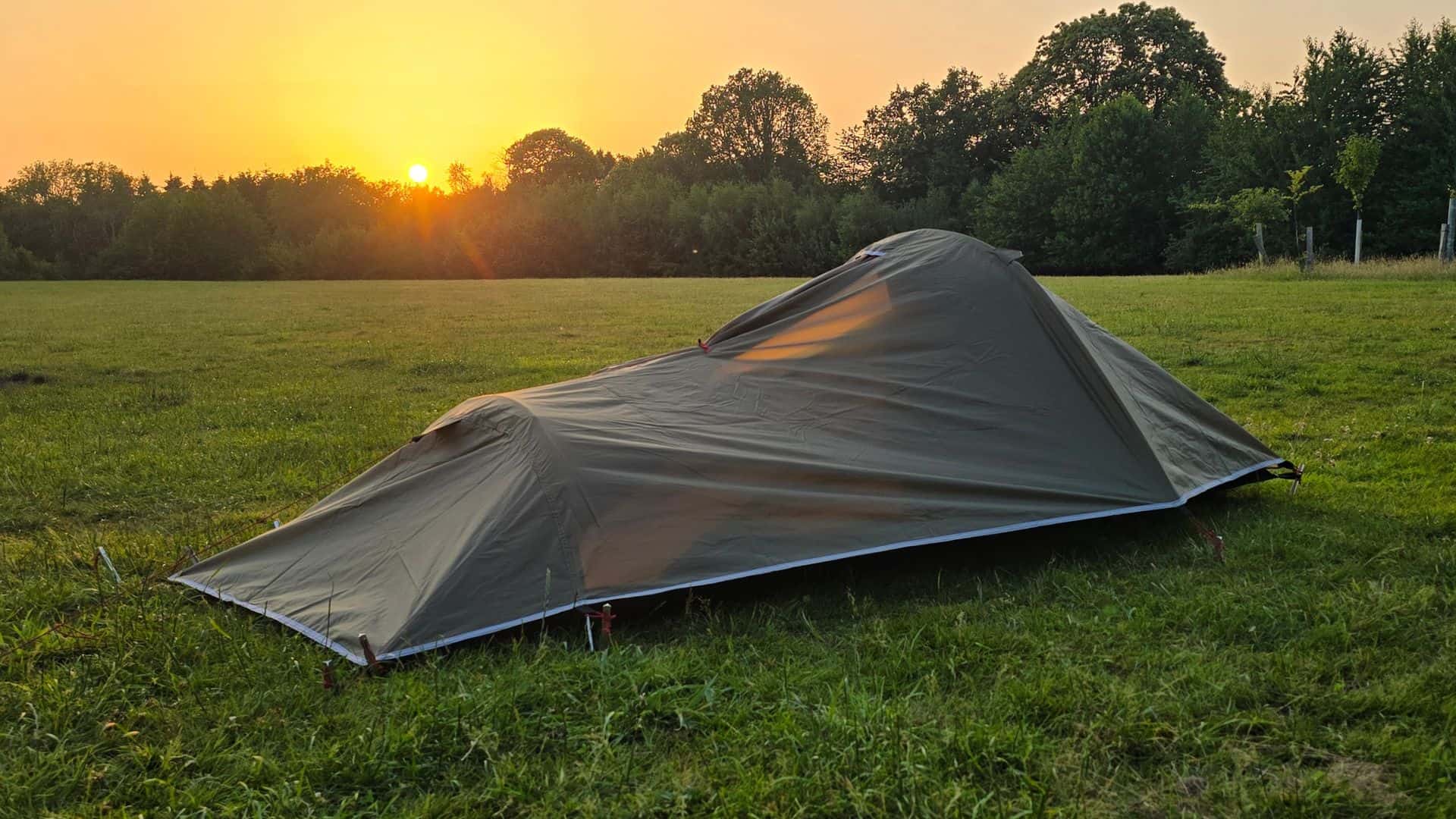
The Traverseon StealthTrail 1P Bivy Tunnel Tent is a one person backpacking tent built around a low-profile, matte-finish design that blends into woodland and grassland terrain. At 1.35 kg packed, it’s designed for backpackers who want a capable four-season shelter without a premium price tag. It comes with a PU3000 ripstop polyester fly, a PU4000 Oxford floor, and two aluminium poles.
Top Features of the Traverseon StealthTrail 1P
For a tent in this price bracket, this Traverseon tent packs in a solid range of features. The focus is very much on weight-saving and stealth — this isn’t a roomy base camp shelter, it’s a minimalist bivy tent for getting out and getting down for the night ideal for solo camping where every gram in your pack has to earn its place.
Bivy Tunnel Tent Design

The tent uses a two-pole tunnel structure that keeps a very low profile, making it a discreet bivy tent for solo camping. This makes it inherently stable in wind and naturally stealthy — hugging the ground rather than standing out against the skyline. It’s not a freestanding design, so you need to peg the base before the poles go in, but once it’s up, the structure is solid.
Ultralight Packed Weight
At 1.35 kg all in — tent, poles, pegs, guylines, and stuff sacks — the StealthTrail 1P sits comfortably in ultralight territory. For context, that’s lighter than many three-season tents from established UK brands, and comparable to much more expensive options on the market.
PU3000 Fly and PU4000 Floor
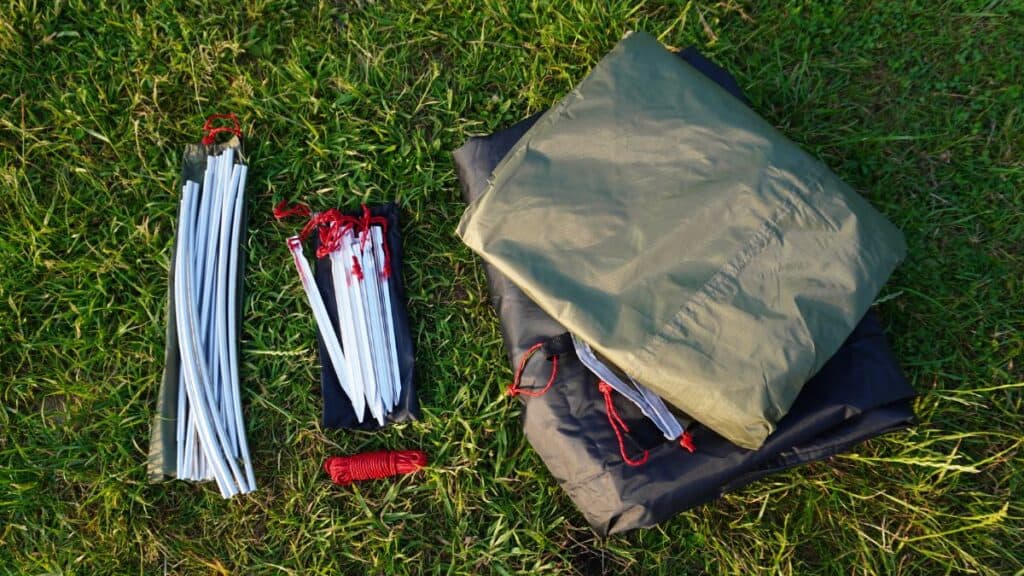
The outer fly uses a 210T ripstop polyester with a PU3000 mm waterproof rating, which should be more than adequate for typical UK rain. The floor steps it up to PU4000 mm on a 210D Oxford fabric — that’s a meaningful upgrade from the flysheet, keeping ground moisture out even on damp pitches.
Aerospace-Grade Aluminium Poles
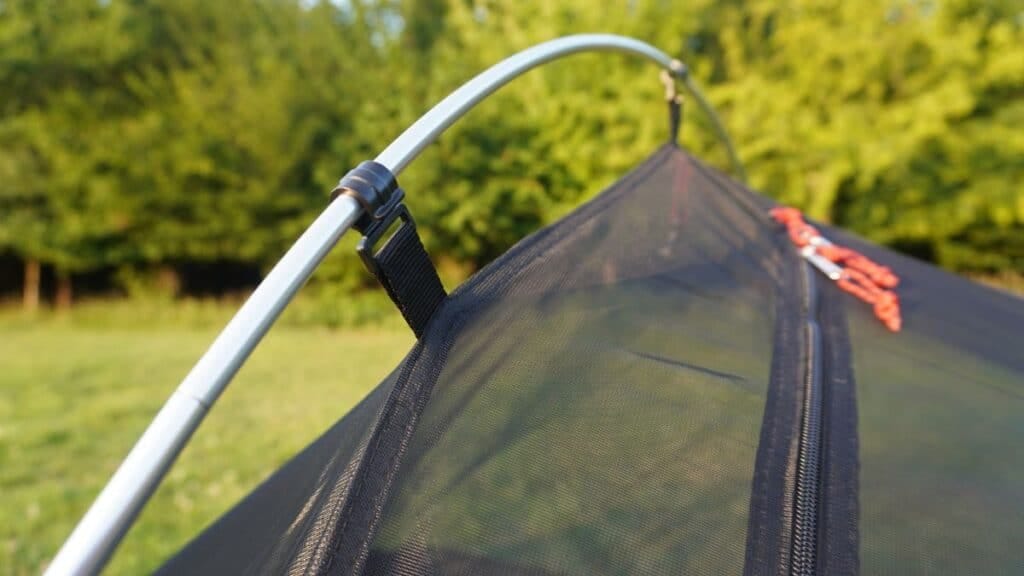
The two poles are made from 7001-T6 aluminium alloy. These are genuinely light and felt solid during setup — they attach to the inner fly via plastic clips rather than threading through pole sleeves, which makes assembly quick.
Front Vestibule
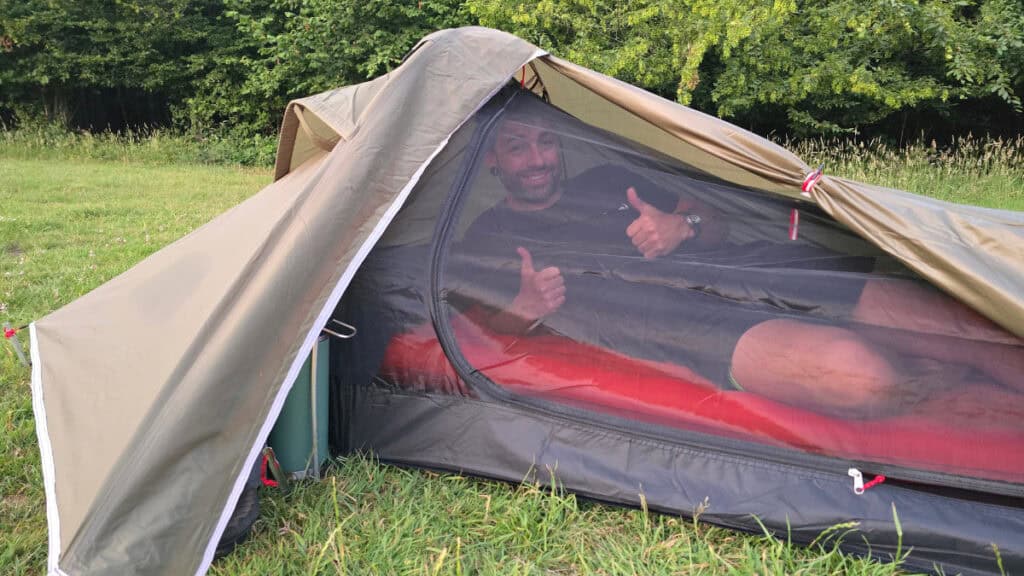
There’s a covered front vestibule which provides useful storage space for boots, a pack, or a small stove setup. It’s not huge, but it does the job of keeping your key bits of kit out of the elements.
Mesh Inner for Ventilation
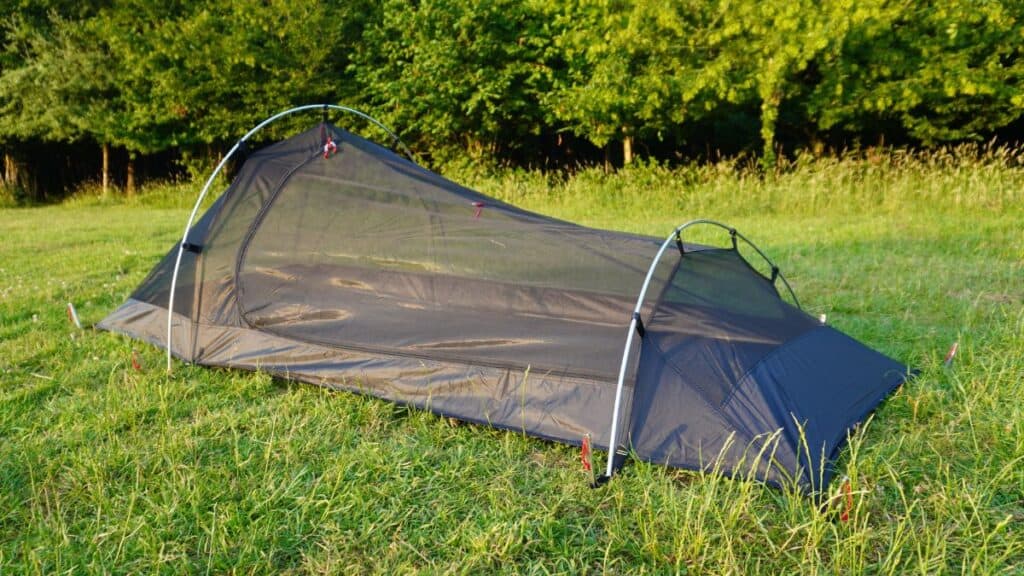
The inner tent uses a high-density mesh construction, which allows airflow through the night and keeps insects out. In warm conditions, it makes a noticeable difference to comfort.
Peak Hook for Lighting

Inside the inner fly, there’s a small hook at the peak — handy for hanging a head torch to light the interior, or, in my case, a useful place to hang my glasses overnight.
Traverseon StealthTrail 1P Specifications
| Spec | Detail |
|---|---|
| Weight | 1.35 kg (all inclusive) |
| Packed Size | 35 × 13 cm |
| Pitched Dimensions | 260 × 170 × 77 cm |
| Fly Material | 210T ripstop polyester, PU3000 mm |
| Floor Material | 210D Oxford fabric, PU4000 mm |
| Inner | Breathable mesh |
| Poles | 7001-T6 aerospace aluminium |
| Structure | Double-layer tunnel (non-freestanding) |
| Seasons | 4-season adaptable |
| Capacity | 1 person |
| Colour Options | Military Green / Earth Sand |
At 1.35 kg and packing down to just 35 × 13 cm, this sits well below the average weight for a four-season solo tent — most comparable shelters from established brands come in at 1.6–1.9 kg. The trade-off, as you’d expect, is interior space and headroom, with a peak height of 77 cm putting this firmly in the lie-flat-or-crouch category.
My Personal Experience with the Traverseon StealthTrail 1P
Finding the time to head out into the hills for a wild camp isn’t always easy, especially when you’ve got a busy family and work life pulling you in every direction. So, for this one, I had schedule it in. Book a date, stick to it, and make it happen.
When that date finally came around though, it turned out to be perfectly wedged between the two hottest days the south coast had ever recorded, right in the middle of the late June 2026 heat wave. I’ll be completely honest — the idea of hauling a loaded pack up into the hills in those temperatures held absolutely zero appeal.
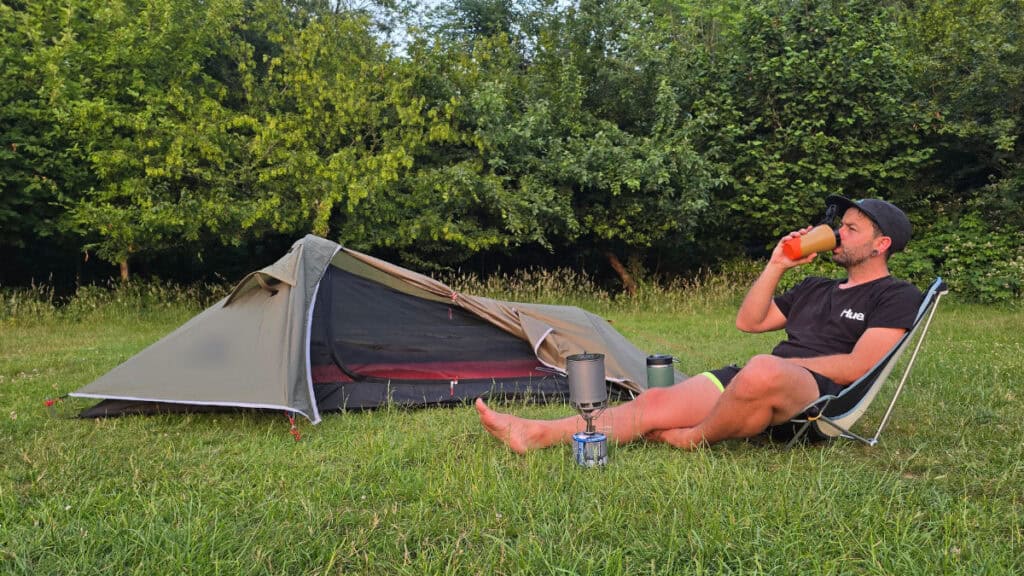
But dates don’t come easy, so rather than write it off entirely, I made a call to swap the hills for the next best thing: a wild camping-style campsite. And I’m glad I did. I ended up at a beautiful little spot called Kitt Campsite, just outside Haywards Heath — tucked on the edge of woodland, not far from Sheffield Park and the River Ouse. The kind of place that feels genuinely removed from everything, even if you’re not technically in the middle of nowhere.
I didn’t roll into camp until quite late in the day — again, a deliberate move to dodge the worst of the heat. I started pitching around half seven, eight o’clock in the evening, and even taking it slow and steady, I was a sweaty mess by the time I was done.
Looking at the tent itself, this is marketed as an ultralight backpacking shelter, and that’s obvious the moment you pick it up. The stuff sack is not much bigger than my Thermos insulated water bottle, and it weighs pretty much the same — 1.35 kg all in. I headed out with everything I needed for a solo camping trip packed into a 30-litre rucksack: roll mat, sleeping bag, pot and stove, snacks, breakfast for the morning — and the StealthTrail sat in there comfortably with room to spare.
Inside the stuff sack you get two fly sheets — a base and an outer — a peg bag with pegs and some guylines, plus a pole bag containing two sets of poles.
Now, this is a tunnel-style tent, which means it’s not freestanding. That’s worth being clear about when you’re planning a pitch. With the heat wave having baked the ground solid for days, getting the pegs in was a bit of a battle. That said, they’re a triangular cross-section design, which I actually liked — they felt solid and resisted bending even when I was forcing them into hard ground.
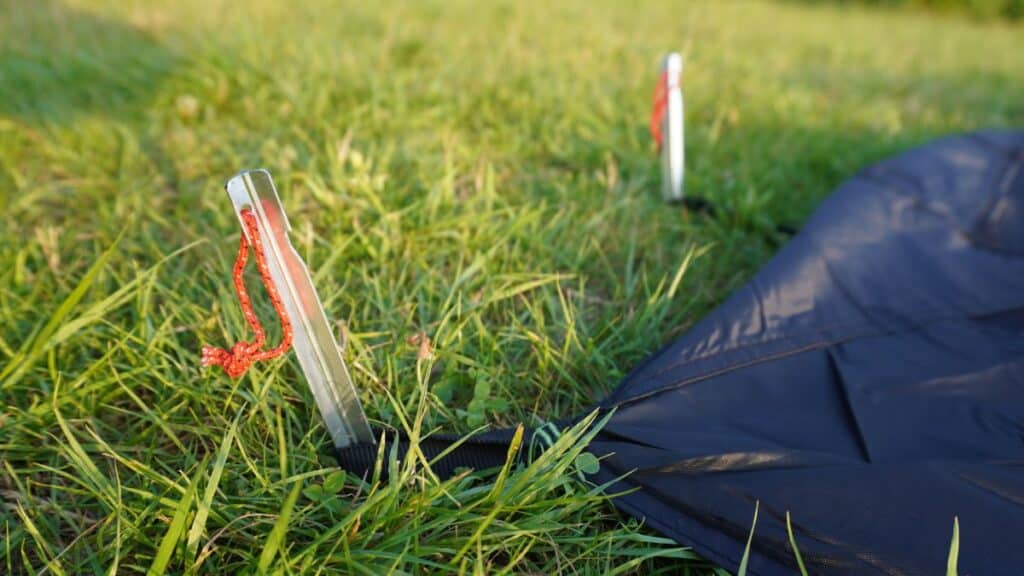
The base sheet takes four pegs, one at each corner, plus another four around the base where the poles attach to the inner fly — eight pegs in total for the initial setup. The poles themselves are straightforward: a smaller one at the foot end, a larger one to create the peak. Both clip onto the inner fly via plastic clips along the length of the pole, and once they’re in place you’ve got your basic structure.
I’ll be honest, getting the outer fly on was more fiddly than I expected. Normally with a tent like this, I’d use the same pegs to anchor both the inner and outer fly — but I couldn’t get any real tautness on the outer shell doing it that way. I had to improvise a bit: looping some of the outer fly’s attachments around pegs I’d already placed, then using the remaining pegs sparingly to get a tight, taut shell.
Now, this was my first time pitching it, and a lot of that was just the learning curve. Now I know the quirks of how it goes up, I don’t anticipate it being an issue again.
Once up, it’s worth setting your expectations about interior space. This is a one person tent — think large, elongated bivy rather than a conventional solo shelter. The peak height of 77 cm means sitting up isn’t really an option. Storage space is limited too. I was able to slide my 30-litre pack down to the foot end comfortably, with boots and my stove tucked into the vestibule — but if you’re travelling with a larger pack, it’s going to feel a bit tighter on sleeping space.
There’s a single entrance with a zipped mesh door, with the outer fly over the top of that. Given the heat, I actually slept with the outer fly rolled up and held back with a toggle to let more air through — though there is also a small flap on the fly that Velcros open to allow some airflow when the tent is fully closed.
One negative on the interior is the lack of any pockets — nowhere to stash a phone or the bits and pieces you want within arm’s reach. There is, however, a small hook at the peak of the inner fly, which I ended up using to hang my glasses on. Its more obvious use would be clipping a head torch up to light the interior.
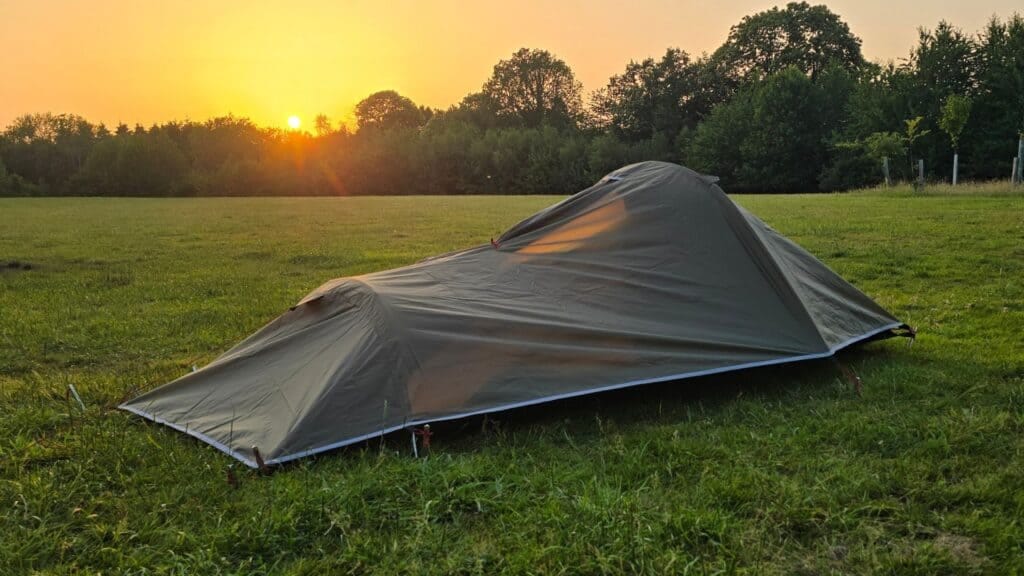
Despite the heat of the day, I slept really comfortably. The mesh inner did its job, and with the outer fly pegged back, there was enough airflow to keep things bearable through the night.
One thing I can’t fully report on from this outing is waterproofing — it stayed dry throughout, so I didn’t get the chance to put the fly to the test in any real rain. The tent carries a PU3000 mm hydrostatic head rating on the fly and PU4000 mm on the floor, which on paper should make it more than capable of handling typical UK conditions. That’s something I’m looking forward to testing on a future trip.
Come morning, there was the usual condensation on the inside of the outer fly — nothing unexpected given the warm, humid night. I laid both sheets out on the ground in the early sun for a few minutes before packing down, and they dried off quickly. Pack-up itself was as straightforward as setup — everything went back into the stuff sack just as neatly as it came out.
Overall, a really positive first outing. Setup was a little fiddlier than I’d anticipated, particularly getting the outer fly taut, but that’s largely a first-time thing. Now I know how it goes together, I’d expect it to be quick and painless. I’m looking forward to taking the StealthTrail out in tougher conditions — wind, rain, proper autumn nights in the hills — to see how it holds up. But on the strength of this trip, it’s made a very good first impression.
Traverseon StealthTrail 1P Rating Breakdown
Build Quality — 4/5
For the price, the materials feel solid. The ripstop polyester fly and Oxford floor both have a reassuring weight to them, and the aluminium poles are noticeably stiffer than the fibreglass poles you’d find in budget alternatives at this price point. The triangular pegs were a highlight — they held firm even in baked-hard ground without bending. The overall finish lacks the polish of a more established brands, but nothing raised any serious durability concerns.
Performance — 4/5
In the conditions I tested it — a warm, still summer night — it performed well. The mesh inner kept airflow moving and insects out, and I woke up comfortable. The outer fly’s ventilation flap is a smart touch. What I can’t yet speak to is performance in rain or sustained wind, and for a tent marketed as four-season, that’s the part that matters most. The tunnel design is inherently stable, and the low profile should handle wind well — but I’ll reserve full judgement until I’ve tested it in harsher conditions.
Features & Usability — 3.5/5
The packed size and weight are the standout selling points — extremely compact for a double-walled shelter with poles and pegs included. The vestibule is functional and the peak hook is a small but useful detail. The lack of internal pockets is a miss, and the outer fly setup requires a bit of trial and error on first pitch.
Value for Money — 4/5
At around £100, the StealthTrail 1P is hard to argue with. You’re getting a double-walled, four-season-rated, sub-1.4 kg tunnel tent with aluminium poles for a price that undercuts most comparable UK options by a significant margin. It won’t replace a Terra Nova or a Hilleberg, and you do need to accept some compromise on refinement. But as an entry point into ultralight wild camping — or a lightweight second tent for those times you need to go really light — the value proposition is strong.
Traverseon StealthTrail 1P Pros and Cons
Pros
- Ultralight at 1.35 kg — competitive with tents costing two to three times the price
- Packs incredibly small — just 35 × 13 cm — easily inside a 30-litre pack alongside full overnight kit
- Solid aluminium poles — noticeably stiffer than fibreglass alternatives at this price
- Strong triangular pegs — performed well in very hard, dry ground
- Ventilation flap on the fly — a useful feature for warmer nights when you don’t want to unpeg the whole fly
Cons
- No internal pockets — nowhere to keep a head torch, phone, or glasses within easy reach
- Non-freestanding design — requires pegging out the base before poles go in; ground conditions matter
- Outer fly setup requires practice — getting a taut shell takes some trial and error on first pitch
- Very low headroom (77 cm) — no sitting up; more bivy-style than traditional tent
Top Alternatives to the Traverseon StealthTrail 1P
If you’re weighing up the StealthTrail 1P against other options available in the UK, here are three alternatives worth considering across different budgets.
Vango Soul 100
The Soul 100 is one of the most recognisable entry-level solo tents on the UK market, and it’s easy to see why — it’s widely available, straightforward to pitch, and comes with internal pockets and lantern hanging points the StealthTrail lacks. But it weighs 1.82 kg against the StealthTrail’s 1.35 kg, and uses fibreglass poles rather than aluminium. If you’re not prioritising pack weight, the Soul 100 is a decent shout. If weight matters though, the StealthTrail wins by a clear margin.
Naturehike Cloud Up 1
The Cloud Up 1 is the StealthTrail’s closest direct rival — a popular ultralight option that turns up constantly in this price bracket. It’s freestanding, which makes pitching more forgiving on awkward ground, and the slightly roomier interior gives it an edge on comfort. At around 1.5 kg packed, it’s marginally heavier than the StealthTrail, and you lose the low-profile stealth design that makes the Traverseon well suited to wild camping specifically. For general backpacking use, it’s a strong alternative. For wild camping where discretion matters, the StealthTrail’s ground-hugging tunnel shape has the advantage.
OEX Phoxx I Ultralight
The Phoxx I UL is the lightest of the three at around 860 g packed – available at Go Outdoors, Blacks, or Millets. The catch is the fly’s hydrostatic head rating — at 1,500 mm, it’s significantly lower than the StealthTrail’s PU3000 mm, which matters in a UK downpour. It’s also priced at £174, putting it well above the StealthTrail in cost despite the lower waterproofing spec. If shaving every possible gram is the priority, the Phoxx I UL is worth considering — but for the balance of weight, weatherproofing, and price, the StealthTrail makes a stronger overall case.
| Feature | Traverseon StealthTrail 1P | Vango Soul 100 | Naturehike Cloud Up 1 | OEX Phoxx I UL |
|---|---|---|---|---|
| Weight | 1.35 kg | 1.82 kg | 1.5 kg | 0.86 kg |
| Fly HH | PU3000 mm | 3,000 mm | PU4000 mm | 1,500 mm |
| Floor HH | PU4000 mm | 10,000 mm | PU4000 mm | N/A |
| Poles | Aluminium | Fibreglass | Aluminium | Aluminium |
| Freestanding | No | No | Yes | No |
| Internal Pockets | No | Yes | No | No |
| Price | £105 | £70 | £140 | £174 |
Final Thoughts
The Traverseon StealthTrail 1P is a solid entry-level ultralight wild camping tent that punches above its price point on weight and pack size.
If you’ve been considering a bivvy bag for the weight savings but want just a bit more structure and weather protection around you, this is a logical step up — without the jump in weight or cost you’d normally expect.
It won’t suit everyone — if you need to sit up inside your tent, cook under a spacious porch, or want something that pitches in seconds, look elsewhere. But if you’re stepping into ultralight backpacking and want a 1 person backpacking tent that won’t weigh you down while still getting a capable, low-profile shelter with decent weatherproofing credentials, this is worth serious consideration.
Traverseon Tent – StealthTrail 1P FAQs
Is the Traverseon StealthTrail 1P suitable for UK weather?
The fly is rated to PU3000 mm and the floor to PU4000 mm, which should handle standard UK rain without issue. The tunnel design also handles wind well due to its low profile.
Is the StealthTrail 1P freestanding?
No. It’s a tunnel-style tent, meaning you need to peg the base out first before inserting the poles. This makes it slightly more dependent on ground conditions than a freestanding design. On hard or rocky ground, pitching can take more time and patience.
How does the StealthTrail 1P compare to more established UK brands?
It’s lighter than most comparably priced tents from brands like Vango and OEX, and undercuts the weight of many mid-range UK options significantly. The trade-off is on interior space, refinement, and brand track record — it’s a newer brand without the long-term reputation of names like Vango or Terra Nova. For the price point, though, it’s difficult to find another double-walled tent this light.
Can I use the StealthTrail 1P for four-season camping?
Traverseon markets it as four-season adaptable. The tunnel design and low profile do handle wind effectively, and the waterproof ratings are solid. That said, I’d recommend treating this as a three-season tent until you’ve tested it in colder, wetter conditions. It’s not in the same league as a dedicated winter mountaineering shelter.
Does the StealthTrail 1P come with pegs and guylines?
Yes — the tent comes with a full set of pegs (triangular cross-section aluminium), guylines, and all required poles. Everything is included in the stuff sack, and it all packs back down neatly.
Related Guides & Reviews
The resources below cover the basics, common questions, and related kit to help you get more out of your time in the hills.
- UK Camping Guide: Wild Camping, Gear & Safety Tips
- Best Tents For Wild Camping
- Sierra Designs Meteor 3000 Review
- OLPRO Blakedown Breeze 4P Inflatable Tent Review
- Best Places for Wild Camping Wales, Scotland and The Lake District

Steve Cleverdon
Adventure-driven outdoor gear reviewer and paddleboarder, Steve has spent 20 years exploring rivers, coastlines, and trails across Britain and abroad, sharing what he’s learned along the way. Learn more about Steve or get in touch.